


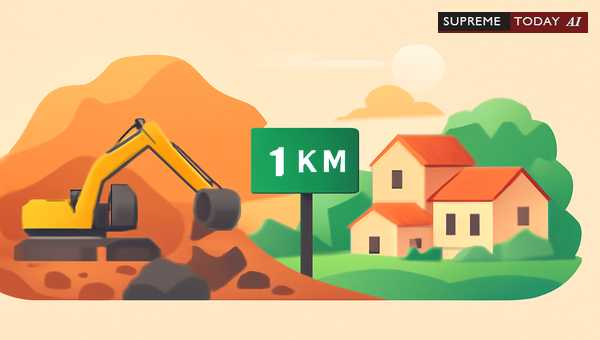
Is There a 1 km No-Habitation Rule for Mining Sites in India?
In the mining industry, one common concern revolves around proximity to residential areas. A frequent question arises: No human habitations within 1 kilometer of mining—is this an absolute requirement under Indian law? Many operators, locals, and regulators grapple with this, fearing violations could lead to or legal battles. While no nationwide blanket ban exists, specific guidelines and judicial precedents, particularly in states like Andhra Pradesh, emphasize a 1 km safe distance to mitigate pollution, noise, and vibrations. This post breaks down the legal landscape, drawing from affirmations and pollution control norms. 2003 8 Supreme 685
Main Legal Finding
There is no absolute national prohibition under Indian law, such as the , mandating zero human habitations within 1 km of all mining operations. However, in contexts like stone quarrying and crushing—especially in Andhra Pradesh—courts and pollution boards have upheld a 1 km safe distance as sufficient to shield residential areas from adverse effects. The has affirmed this based on expert studies showing negligible impacts beyond this range. 2003 8 Supreme 685
This distinction is crucial: rules emerge from environmental safeguards rather than a uniform federal mandate.
Key Points on the 1 km Safe Distance
- Guidelines: Effective from , these mandate a 1 km separation between crushers/quarries and human habitations. The upheld this as protective, modifying a order from 2 km to 1 km in a Kokapet village case. 2003 8 Supreme 685
- Expert Validation: Studies by the , , Dhanbad, confirmed no blast vibrations, good air quality (SPM, RPM, NOx, SO2, Pb below limits), and no impacts at 2 km—thus endorsing 1 km as safe. 2003 8 Supreme 685
- No General National Rule: Neither the MMDR Act nor central policies impose a universal 1 km habitation restriction. Requirements stem from site-specific under the , state guidelines, or court orders. 2003 8 Supreme 685 2015 7 Supreme 257
Detailed Analysis: Origins of the 1 km Norm
Pollution Control Guidelines and Siting Criteria
The APPCB's 1997 guidelines explicitly state a 1 km safe distance between crusher and human habitation. Pre-1997, shorter distances applied (e.g., 500 meters from national highways), but courts standardized 1 km post-expert reports. An interim order once barred operations within 500 meters of habitations, but the final ruling settled on 1 km, noting no vibrations, air pollution, or runoff beyond it. 2003 8 Supreme 685
In stone crushing cases, similar scrutiny applies. For instance, a appeal on a stone crusher unit addressed claims of habitations within 500 meters or 1 km. A joint inspection revealed no authorised habitation over the stated lands, upholding and setting aside revocation. This reinforces that verified distances and compliance trump presumptions. 2011 0 Supreme(Ori) 170
Judicial Affirmation in Key Cases
The , in the Kokapet quarries matter (sites 2 km from village), relied on the report: The village being at a distance of about 2 km would not receive the blast vibrations... The ambient air quality at the village was good... concentrations of the SPM, RPM, Nox, So2 and Pb... well below the permissible limits. It rejected extending the buffer to 2 km, deeming 1 km adequate. 2003 8 Supreme 685
Elsewhere, have classified mining projects by proximity: one located at least 1.0 KM away from human habitation and another located within a distance of 1.0 KM from human habitation. Courts struck down ad-hoc guidelines exceeding powers, stressing adherence to central norms over arbitrary classifications. 2014 0 Supreme(Mad) 2291
Distinction from Protected Areas
The 1 km rule for habitations differs from ecological zones. Orders prohibit mining within 1 km of national parks, sanctuaries (e.g., Goa, ), or , but these protect biodiversity, not residents. No law equates habitations to these, and site-specific assessments govern residential proximity. 2015 7 Supreme 257 2022 5 Supreme 477 2013 0 Supreme(SC) 552
Exceptions and State Variations
While AP sets a strong precedent, flexibility exists:
- Pre-1997 Leases: Operations as close as 500 meters were allowed for leases before , with interim relief. 2003 8 Supreme 685
- Expert Studies Override: Mining may proceed closer if air quality, vibration, or noise studies confirm no impact, per Pollution Control Board (PCB) nods. 2003 8 Supreme 685
- State-Specific Rules: Goa and Odisha emphasize parks/ESZs over habitations. In Jharkhand, mining lease terminations for environmental issues require hearings, not automatic bans. 2015 7 Supreme 257 2017 6 Supreme 104 2020 0 Supreme(Jhk) 903
- Enforcement: allows lease cancellation for violations, but only post-hearing. 2003 8 Supreme 685
Other contexts, like teacher engagements, define habitations as 1 km apart with 300+ population, but these are unrelated to mining. 2013 0 Supreme(J&K) 8 2013 0 Supreme(J&K) 13
Practical Recommendations for Compliance
To navigate this:
- Secure site-specific environmental clearance and PCB NOC, backed by studies (e.g., ISM-style reports) proving negligible <1 km impacts.
- For new sites, target ≥1 km from habitations per local guidelines; renewals may need distance verification.
- Conduct joint surveys for accurate mapping; challenge revocations via appeals citing precedents. 2003 8 Supreme 685
Always consult experts, as conditions vary.
Key Takeaways and Conclusion
The notion of no human habitations within 1 kilometer of mining is not an absolute national rule but a practical safeguard rooted in AP guidelines and wisdom. It balances industry needs with public health, hinging on science over rigidity. Operators should prioritize empirical data and clearances to avoid pitfalls. 2003 8 Supreme 685
This overview provides general insights based on precedents—not specific legal advice. For tailored guidance, engage a mining law specialist. Stay compliant, and mining can coexist safely with communities.
References:- 2003 8 Supreme 685: SC ruling, APPCB guidelines, expert studies on 1 km safe distance.- 2015 7 Supreme 257: 1 km for parks/sanctuaries, no uniform habitation ban.- 2014 0 Supreme(Mad) 2291: SEIAA classification by 1 km habitation distance.- 2011 0 Supreme(Ori) 170: Stone crusher sitting criteria validation.
#MiningLaw #EnvClearance #IndiaLegal












