


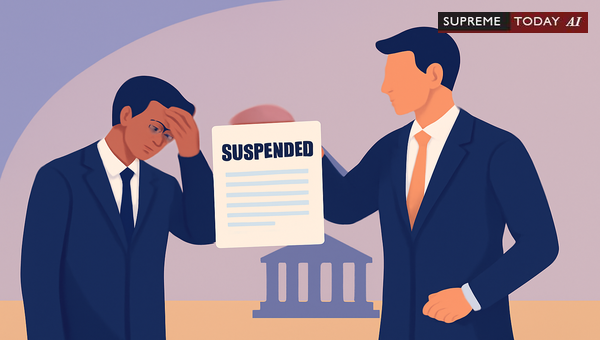
Yogendra Jauhari vs : Limits on Suspending Lawyers
In the complex world of legal practice regulation, one pivotal judgment stands out: Yogendra Prakash Jauhari v. (2012) 11 SCC 615. This case addresses critical legal issues in Yogendra Prakash Jauhari v 2012 11 SCC 615, particularly whether the (BCI) can suspend or debar a lawyer's license after enrollment. For lawyers, bar councils, and those navigating disciplinary matters, understanding this ruling is essential. This post breaks down the decision, its implications, and related precedents—note: this is general information, not specific legal advice. Consult a qualified lawyer for your situation.
Main Legal Finding: Exclusive
The held that the cannot pass any order suspending a lawyer's license or in exercise of its disciplinary powers under the , once the advocate's name is enrolled on the roll. Such actions can only be imposed by the statutory disciplinary authorities—namely, the or the BCI—following due process under the Act2019 0 Supreme(SC) 345 1978 0 Supreme(SC) 300.
Key points from the judgment include:- The power to suspend or debar is exclusively vested in the statutory disciplinary bodies, i.e., and BCI 2019 0 Supreme(SC) 345 1978 0 Supreme(SC) 300.- BCI cannot exercise general to suspend; it can only review or modify orders from or act in under 2019 0 Supreme(SC) 345 1978 0 Supreme(SC) 300.- BCI's rule-making powers under do not cover pre-enrolment training or post-enrollment practice conditions 1999 2 Supreme 460.- Courts' jurisdiction under is limited to , not direct suspension 2019 0 Supreme(SC) 345 1978 0 Supreme(SC) 300.
This ruling reinforces the statutory framework, ensuring procedural fairness in disciplinary actions.
Powers of the and
Under the , disciplinary powers are clearly delineated. The Act vests suspension or authority solely in these statutory bodies after proper procedure2019 0 Supreme(SC) 345. The Court referenced Bar Council of Maharashtra v. M.V. Dabholkar (1975), observing that disciplinary powers, including suspension and removal, are exclusively within the jurisdiction of the statutory bodies, and the Court's role is limited to reviewing or exercising under 2019 0 Supreme(SC) 345. BCI cannot usurp ' powers or issue original suspension orders.
Appeals flow through Section 37 (BCI hears State Bar Council orders) and Section 38 ( appeals), but these do not permit bypassing due process 1978 0 Supreme(SC) 300.
Related precedents echo this exclusivity. For instance, in cases involving lawyer like strikes, courts emphasize that discipline follows statutory channels. It is settled law that it is as well as unbecoming for a lawyer who has accepted a brief to refuse to attend Court even in pursuance of a call for strike or boycott by the or the Bar Council2023 0 Supreme(All) 1672. Where suspended under , advocates are debarred from practice, but only via proper proceedings 2023 0 Supreme(All) 1672.
Limitations on the Court's Powers Under
The Constitution empowers courts under to punish contempt and ensure justice, but not to directly suspend or debar advocates. The Court overruled aspects of Vinay Chandra Mishra, clarifying that suspension or of advocates is a statutory power that cannot be exercised by the Court in exercise of its constitutional jurisdiction2019 0 Supreme(SC) 345.
Exceptions exist for , but not as a substitute for statutory discipline 2019 0 Supreme(SC) 345 1978 0 Supreme(SC) 300. This aligns with broader jurisprudence: cannot adjudicate disciplinary complaint merits, leaving that to Bar Councils. by the High Court does not extend to adjudicating the merits of disciplinary complaints against lawyers, which must be handled by the Bar Council2024 0 Supreme(Mad) 1794.
Scope of BCI's Rule-Making Powers
BCI's authority under is limited to post-enrollment regulation, like practice conditions during suspension, not pre-enrollment training. Rules like the Training Rules, , were declared for exceeding this scope 1999 2 Supreme 460.
Supporting cases highlight rule limits. The has not granted their approval for the impugned action taken by the State Council for collection of special fee and additional fee for resumption application over and above resumption fee prescribed in the Rules... any action taken by the State Bar Council so as to stipulate any fee styled either as resumption fee or as special fee in addition to the resumption fees prescribed by the would fall foul of the restrictions and limitations imposed in the Advocates Act2017 0 Supreme(Ker) 1521. requires notifying the State Bar Council with the enrollment certificate, per 2017 0 Supreme(Ker) 946 2017 0 Supreme(Ker) 945.
Lawyer Strikes and Professional
Strikes often trigger disciplinary scrutiny, tying back to statutory powers. Courts have ruled State Bar Council strike calls illegal and unconstitutional. The State Bar Council's call for strike was illegal, unconstitutional, and against statutory provisions, as well as contrary to the judgments of the . Lawyers have no right to go on strike or give a call for boycott2023 0 Supreme(MP) 807. Such actions may lead to contempt proceedings, but discipline remains with Bar Councils 2023 0 Supreme(All) 1672.
The 's stand against striking lawyers underscores expeditious trials under and , directing action for 2023 0 Supreme(All) 1672. Similarly, The call of the Bar Council to Advocates of the State to abstain from work, does not fall within the four corners of the Act2023 Supreme(Online)(MP) 27297.
and Resumption
rules are strict: Advocates must inform the State Bar Council by registered post with their certificate. Resuming requires application and fees per BCI Rules 2022 0 Supreme(Ker) 214 2017 0 Supreme(Ker) 945. Conflicts arise, as in welfare fund cases where rules contradicting statutes were set aside for equity 2017 0 Supreme(Ker) 945.
Recommendations and Key Takeaways
- Bar Councils should initiate discipline only via statutory procedures; avoid general jurisdiction suspensions.
- Courts limit Articles 129/142 to contempt, deferring to Bar Councils.
- Lawyers facing complaints defend before Bar Councils; is narrow 2024 0 Supreme(Mad) 1794.
- Strikes constitute , potentially leading to suspension via due process 2023 0 Supreme(All) 1672 2023 0 Supreme(MP) 807.
In conclusion, Yogendra Prakash Jauhari v. safeguards procedural integrity in lawyer discipline under the Advocates Act. Statutory bodies hold exclusive powers, promoting fairness. Statutory bodies must act objectively, as seen in critiques of lax discipline 2013 0 Supreme(Pat) 812. For practitioners, this underscores adherence to rules and channels for resolution.
Key Takeaway: Post-enrollment, only or BCI via due process can suspend/debar—courts and BCI's general powers cannot substitute. Stay informed, practice ethically.
#LawyerDiscipline, #AdvocatesAct, #BCIPowers












