


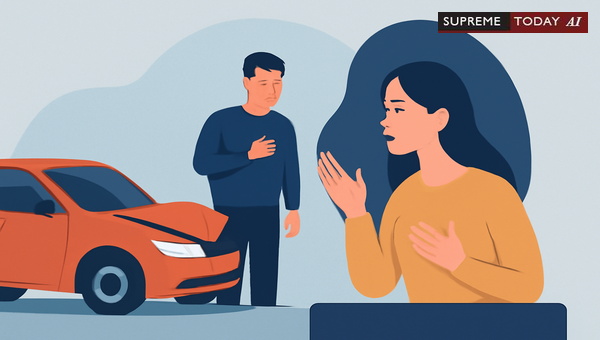
Is Enough to Prove Accused Drove Vehicle?
In high-stakes criminal cases involving vehicle accidents, proving who was behind the wheel at the time of the incident is crucial. Questions like Is Sufficient to Establish that at the Time of Incident the Accused was Driving the Vehicle often arise. , a court-ordered of seized property like vehicles, is frequently invoked. But does it conclusively pin the accused as the driver? This post dives into the legal nuances, drawing from key judgments and evidence standards to provide clarity.
Typically, prosecutions under (causing death by negligence) or () hinge on establishing the accused's control of the vehicle. While offers procedural insights, it's rarely standalone proof. Let's break it down.
Understanding in Criminal Cases
refers to the provisional release of seized items, such as vehicles involved in accidents, to their registered owner or another party. This prevents deterioration during prolonged trials. Courts grant it under conditions like a and restrictions on vehicle use. 2022 0 Supreme(MP) 778 2024 0 Supreme(MP) 5
The process implies the applicant's connection to the vehicle—often as owner or possessor—but does not automatically confirm they were driving at the incident time. For instance, courts emphasize releasing vehicles from police custody to avoid decay, provided no competing claims exist. 2023 0 Supreme(MP) 8 2024 0 Supreme(MP) 5
Key conditions include:- Financial guarantee (surety).- Assurance against further misuse.- No risk to investigation integrity.
However, handing over the vehicle on merely establishes possession or ownership links, not direct driving evidence during the accident.
Legal Burden: Proving the Accused Was Driving
The prosecution must prove :1. The accused was driving the vehicle at the accident time.2. The accident resulted from rash/negligent acts.3. Death/injuries directly stemmed from those acts. 2022 0 Supreme(AP) 1216
can suffice, including:- Vehicle possession.- Accused's admissions.- Eyewitness accounts. 2022 0 Supreme(AP) 1216
In one case, unchallenged eyewitness testimony sealed the deal: The testimony of PWs.1 to 3 regarding the identity of the accused is not seen challenged at all. There is not even a suggestion seen put to PWs.2 and 3 that it was not the accused who was driving the vehicle at the relevant time. 2024 0 Supreme(Ker) 1124
Courts uphold convictions where such corroboration exists, even without direct confession.
When Supports—but Doesn't Prove—Driving
can bolster circumstantial chains. If the accused applies for release as the registered owner and admits familiarity, it hints at involvement. Combined with other proofs, it strengthens the case. 2022 0 Supreme(AP) 1216
For example:- Eyewitnesses identifying the driver.- Vehicle inspection reports ruling out mechanical faults. 2024 0 Supreme(AP) 265- Admissions like: Therefore, it is established, as admitted, that at the time of the incident, the accused was driving the offending vehicle. 2023 0 Supreme(Del) 56
Yet, courts clarify 's limits. In scenarios where witnesses falter, it fails: Hence, the prosecution has failed to establish the first essential ingredient that accused was driving the offending vehicle on the date of incident. 2023 0 Supreme(Del) 53
Limitations: Why Alone Falls Short
Multiple judgments underscore that does not conclusively establish the driver. Possession post-seizure differs from control at the incident.
Separate from Driver Identity: Merely obtaining a vehicle on supurdgi () and identifying the driver at the time (e.g., Vibhishan or others) is generally not sufficient to conclusively establish that the accused was driving the vehicle during the incident. (References: 2025 Supreme(Online)(MP) 4618 2023 Supreme(Online)(MP) 22626)
Need Eyewitness Corroboration: Witnesses must detail . One source notes: The witness further stated that the original applicant/accused was not driving the vehicle properly and the original applicant/accused was driving the vehicle in the state of intoxication. But without rashness specifics, it weakens. 2024 0 Supreme(MP) 643
Acquittals for Insufficient Proof: The prosecution has miserably failed to lead evidence to prove the charge levelled against the accused and due to non-availability of sufficient evidence, the accused was acquitte.... 2023 0 Supreme(Guj) 365
Owner vs. Driver Distinction: Owners may not know the exact driver: He categorically confirms that he is not aware about the driver of the vehicle at the time of incident or that appellant was driving the vehicle at the time of incident. 2017 0 Supreme(Guj) 1813
Proving rash/negligent driving requires more: It is necessary to bear in mind that the prosecution must produce evidence to establish rash or negligent driving of the motor vehicle by the accused. 2015 0 Supreme(Ker) 1596
In contraband cases, direct statements like At the time of incident, the petitioner was driving the vehicle aid, but accident contexts demand scene-specific links. 2024 Supreme(Online)(Mp) 34711 2024 Supreme(Online)(MP) 53577
Integrating Evidence for Strong Cases
Successful prosecutions blend with:1. Unchallenged Witness IDs: As in cases where no cross-examination disputes the driver's identity. 2024 0 Supreme(Ker) 11242. Physical/Forensic Proof: No mechanical defects, linking vehicle to scene. 2024 0 Supreme(AP) 2653. Descriptions: High speed, intoxication, or negligence. 2022 0 Supreme(J&K) 235
In the instant case, it has been established by the prosecution that the petitioner/accused was driving the vehicle at the relevant time. 2022 0 Supreme(J&K) 235
Practical Recommendations
- For Prosecution: Collect eyewitness statements early, challenge defenses on identity.
- For Accused/Defense: Highlight 's procedural nature; demand direct proof.
- Vehicle Release: Comply with court conditions to avoid trial hurdles. 2023 0 Supreme(MP) 8
Always consult a lawyer for case-specific advice.
Key Takeaways
- aids but is insufficient alone to prove the accused drove at the incident time.
- Eyewitness testimony, admissions, and proofs are essential.
- Courts prioritize beyond-reasonable-doubt standards, acquitting on weak links.
This analysis draws from precedents like 2022 0 Supreme(AP) 1216 2022 0 Supreme(MP) 778 2024 0 Supreme(Ker) 1124 2023 0 Supreme(Guj) 365, emphasizing holistic evidence.
Disclaimer: This is general information, not legal advice. Laws vary; seek professional counsel.
#Supurdginama, #DrivingLiability, #CriminalEvidence


















