Searching Case Laws & Precedent on Legal Query.....!
Analysing the retrieved Case Laws
Scanned Judgements…!



Searching Case Laws & Precedent on Legal Query.....!
Analysing the retrieved Case Laws
Scanned Judgements…!
PARAMANATHAN et al. v. SARAVANAMUTTU
"], ["PEDRIS et al. v. FERNANDO et al.
"], ["RABOT et al v. NEINA MARIKAR et al.
"]).The joint estate at the time of the first death is administered according to the joint will, and the survivor cannot revoke or alter the disposition regarding the joint property thereafter ([" PARAMANATHAN et al. v. SARAVANAMUTTU RABOT et al v. NEINA MARIKAR et al.
Insights:
RABOT et al v. NEINA MARIKAR et al.
"]).PARAMANATHAN et al. v. SARAVANAMUTTU
"], ["PEDRIS et al. v. FERNANDO et al.
"], ["PEDRIS v. FERNANDO
"]).Mutual wills are considered as two distinct wills, each applicable to the individual’s share of the estate, unless explicitly massed into a joint estate ([" DE SILVA v. DE ALWIS PEDRIS et al. v. FERNANDO et al.
Insights:
PEDRIS v. FERNANDO
"]).| Aspect | Joint Will | Mutual Will ||---------|--------------|--------------|| Nature | Single document, typically massed estate, irrevocable after first death | Separate wills, often revocable until first death, but may be irrevocable if massed and benefits accepted || Revocation | Generally irrevocable post first death if property is massed | Revocable until first death unless massed into joint estate with irrevocable terms || Disposition | Disposes of joint or consolidated estate | Disposes of individual shares, often reflecting a common intent || Operation | Operates as a single act, binding after first death | Operates as two separate wills, binding if benefits are accepted |
References:- ["
PARAMANATHAN et al. v. SARAVANAMUTTU
"], ["PEDRIS et al. v. FERNANDO et al.
"], ["RABOT et al v. NEINA MARIKAR et al.
"], ["PEDRIS v. FERNANDO
"], ["DE SILVA v. DE ALWIS
"]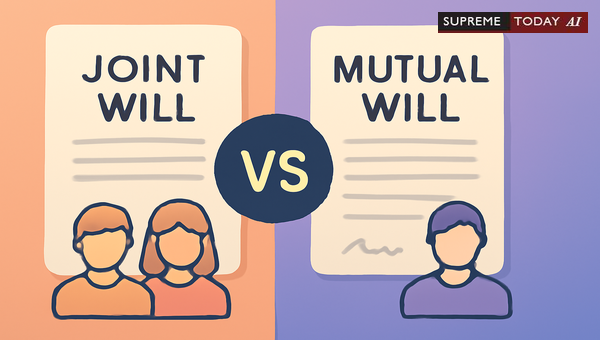
When planning your estate, choosing the right type of will is crucial. Many people confuse joint wills and mutual wills, but understanding their differences can prevent family disputes and ensure your assets are distributed as intended. This guide breaks down the Joint Will vs Mutual Will debate, drawing from legal definitions and key Indian court judgments to help you make informed decisions.
Whether you're a couple looking to align your or seeking flexibility in estate planning, grasping these concepts is essential. We'll explore definitions, key differences, legal implications, and practical recommendations—always remembering this is general information, not specific legal advice. Consult a qualified attorney for your situation.
A joint will is a single legal document executed by two or more individuals, typically spouses, that outlines their shared wishes for asset distribution after death. It functions as one binding all parties. 1996 0 Supreme(SC) 2106
As noted in judicial interpretations, a joint will is a single instrument by which two persons give effect to their . 1999 0 Supreme(Bom) 262 This unified document treats the estates as interconnected, often making it harder to alter post-execution.
Key characteristics include:- Single document: Signed by all parties together.- Binding nature: Generally without mutual consent. 1986 0 Supreme(Raj) 40- : Upon one party's death, the survivor may hold the property in trust for the intended beneficiaries. 2017 3 Supreme 35
For instance, courts have held that in a joint will, the survivor can revoke the Will and execute a new Will, but only under specific conditions, emphasizing its joint character. 2017 3 Supreme 35
In contrast, a mutual will consists of separate wills created by two or more individuals with . Each will is independent but reflects a mutual agreement on asset distribution. 1996 0 Supreme(SC) 2106
A Will is mutual when two testators confer upon each other reciprocal benefits, as by either of them constituting the other his . 2021 0 Supreme(Ker) 514 This setup allows each party to act as both and beneficiary for the other.
Typical features:- Separate documents: Each person has their own will.- Reciprocal terms: Mirror provisions, but independently unless contractually bound.- Agreement element: Often stems from an understanding not to revoke after one death, .
Courts distinguish it clearly: Unless it is clear that a mutual will is a joint will, it must be read as two wills, spouse dealing with his or her share of the property.
The distinctions boil down to structure, revocability, and legal effects. Here's a breakdown:
| Aspect | Joint Will | Mutual Will ||---------------------|-------------------------------------------------|--------------------------------------------------|| Nature | Single document signed by all. 1988 0 Supreme(SC) 158 | Separate documents with reciprocal terms. 1937 0 Supreme(Mad) 103 || Binding Effect | without all parties' consent; survivor often holds in trust. 2008 5 Supreme 76 | Independently unless agreement prohibits. 1974 0 Supreme(SC) 307 || Legal Implications | Treated as one act; first death may lock terms for survivor. 2006 7 Supreme 153 | Each remains valid post-death of one party. 2003 6 Supreme 662 || Flexibility | Low—changes require consensus. | Higher—individual alterations possible. 2003 0 Supreme(Kar) 931 |
These differences are pivotal. For example, the basic difference between a joint will and a joint & mutual will hinges on and irrevocability post-death if benefits are accepted. 2019 0 Supreme(All) 517
Indian courts, particularly the , have clarified these concepts through landmark cases. In one ruling, the court emphasized: For a joint mutual Will to be it is necessary that under the Will the surviving must have received benefits from the deceased under the mutual Will and the mutual Will should have been executed pursuant to an agreement that the shall not revoke the mutual Will. 1999 0 Supreme(Bom) 262
Two conditions must align:1. Survivor receives benefits.2. Agreement against revocation exists, provable from the will or externally. 2017 3 Supreme 35
In Palaniappa Chettiar's case, the analyzed a will where spouses intended properties for charities post-survivorship. It ruled it a joint and mutual will, granting the survivor absolute rights but binding remaining properties to the trust. Alienations by the survivor were valid if not undermining the trust. 2019 0 Supreme(All) 517
Another case underscored: The Will is not a mutual Will but only a joint Will. The Will clearly states that survivor can revoke the Will. This highlights intent's role in classification. 2017 3 Supreme 35
cases reinforce: Mutual wills are ordinarily divisible into two wills by which each spouse disposes of his or her half. 2004 0 Supreme(Mad) 861 Proof of execution under , and , remains critical. 2021 0 Supreme(Ker) 514
These precedents show courts construe wills based on language and intent: A Will should be construed in accordance with intention of the testators which can be inferred from the language of the Will itself. 2017 3 Supreme 35
Choosing between a joint or mutual will depends on your goals:- Opt for joint will if you want unbreakable unity and shared control.- Choose mutual wills for reciprocity with retained flexibility.
However, complexities arise:- Revocation risks: Joint wills bind survivors equitably if benefits are taken. 1999 0 Supreme(Bom) 262- Proof burdens: by two witnesses is mandatory; invalidate. 2005 0 Supreme(Mad) 606- Family dynamics: Joint ownership disputes may require to maintain . 2023 0 Supreme(P&H) 587
Always document agreements clearly to avoid litigation. Sources like Rajasthan and Karnataka judgments affirm tailored drafting's importance. 1986 0 Supreme(Raj) 40 2003 0 Supreme(Kar) 931
In summary, a joint will is a unified, often rigid document, while a mutual will offers separate yet mirrored flexibility. Primary distinctions lie in structure (one vs. separate), binding effects, and post-death enforceability. Court rulings stress intent, reciprocity, and benefits received as determinants. 1996 0 Supreme(SC) 2106 1988 0 Supreme(SC) 158
Key Takeaways:- Evaluate flexibility needs before deciding.- Seek legal counsel to comply with laws like the .- Use precise language to reflect intentions.
Estate planning safeguards legacies—start informed. This overview draws from established precedents but is for educational purposes. Laws vary by jurisdiction; professional advice is recommended.
*Sources: cases [
#JointWill, #MutualWill, #EstatePlanning


This matter of difference should have been then decided and administration of the estate directed accordingly. ... ] is that a mutual will which disposes of the joint property of the survivor, the property being consolidated into one mass for the purpose of a joint disposition of it, becomes irrevocable by the survivor if he has accepted some benefit under it. ... When these two conditions are not present the #HL_ST....
It will make no difference, (i.) that some of the dispositions of the first-dying take effect upon his or her death, or (ii.) that the whole joint estate is not disposed of provided only that there is a joint disposition of some of the joint estate on or after the survivor's death?. ... -"That joint or mutual wills, notwithstanding their form are to be read as separate wills, the dis....

is joint participation in the management and control of the enterprise or a right of mutual control. ... Stated another way, the basic difference between a joint venture and a joint enterprise is that a business relationship is needed for a joint venture but not for a joint enterprise; that is, there is no business motive underlying the parties' efforts in a j....
" (3) That either of the spouses is at liberty to revoke his or her part of the will after the death of the co-testator, subject, however, to the following: -That the surviving spouse has no right or power to revoke a mutual will if (a) the mutual will disposes of the joint property on ... A mutual will may be drawn in such terms-and often is that it operates as the separate will of each of the spouses, but only of ....
A surviving spouse has no right to revoke a mutual will (a) if the mutual will disposed of the joint property on the death of the survivor, that is to say, where the property is consolidated into one mass for the purpose of a joint disposition of it; and (b) if the survivor has accepted ... that a surviving spouse has no right to revoke a mutual will (a) if the mutual will disposed....

Parties undertake that they shall duly file a joint petition of divorce by mutual consent and shall also appear before the concerned Court for recording of their respective statements for dissolving the marriage by mutual consent. 5. ... It is agreed between the parties that they shall dissolve their marriage by mutual consent. 2. ... Parties shall appear before the Family Court for filing the joint amend....
Unless it is clear that a mutual will is a joint will, it must be read as two wills, spouse dealing with his or her share of the property (Juta Leading II., 107-115). H. V. Perera, in reply. ... A mutual will, even where there has been a massing of property for the purpose of a joint disposition after the death of the survivor, is ordinarily divisible into two wills by which each spouse disposes of his or her half in....

It is not in dispute between the parties that the suit land between them is joint, they are co-sharers though have their separate respective possession as per mutual arrangement,and the land has not been partitioned by metes and bounds. ... But by way of mutual adjustment, the parties and other co-sharers were cultivating separate killa numbers for the last several years as per their shares. ... It was admitted that by virtue of m....
] it was laid down that such mutual wills are to be read as separate wills, the dispositions of each spouse being treated as applicable to his or her share of the joint property. ... She afterwards herself died without having made any testamentary disposition other than the joint will. ... By their joint will two spouses, the father and mother of the daughters who are the parties in this appeal, af....

This is because the plaintiff and the defendant both contributed equally to the acquisition and financing of the properties, which were financed through their companies or joint accounts. ... In this regard, I agree with the plaintiff that the parties are bound by the terms of the Deed of Mutual Understanding which both the parties herein have entered into, so this Court is entitled to give effect to the clear and plain meaning of the said Deed of #HL_STAR....

But where the legatees are distinct from the testators, there can be no question of a mutual will.” Thayankoot Thekkot Lakshmi Amma and Others, AIR 1959 SC 71, the distinction between a mutual Will and a joint Will is pointed out as follows:- “A Will is mutual when two testators confer upon each other reciprocal benefits, as by either of them constituting the other his legatee; that is to say, when the executants fill the roles of both testator and legatee towards each other.

High Court after referring to the large number of cases has come to the conclusion that it is a Joint and Mutual Will, since both the testator and testatrix agreed to devote their properties for carrying out charities, the High Court concluded that intention of both testator and testatrix to give property to charities is manifest from the reading of the Will in its entirety. The High Court in the impugned judgment has elaborately considered whether a Will is a Joint Will or Joint and....

The Will is not a mutual Will but only a joint Will. The Will clearly states that survivor can revoke the Will and execute a new Will. The bone of contention between the parties is, as to whether, the Will is a joint Will or a joint and mutual Will. We thus, first proceed to examine the nature and characteristics of joint will and joint & mutual Will. Though, the laws relating to joint & mutual Wills originated in Roman Dutch Law, which by ....

He also submitted that the leave obtained under section 92 C.P.C. during the pendency of the suit would not cure the defect in instituting the suit. Learned senior counsel submitted that to regard a Will as a joint and mutual Will, the survivor should have received benefit under the Will and there should be an agreement not to revoke the Will. He also submitted that the Will in question is a joint Will and not a joint and mutual Will. He submitted that both the conditions to ....

A will is mutual when two testators confer upon each other reciprocal benefits as by either of them constituting the other his legatee, that is to say, when the executants fill the role of both the testator and legatee towards each other. 6.The distinction between Joint Will and mutual reciprocal will had been a matter of judicial consideration before various courts. The mutual reciprocal will is the will by two or more persons which are reciprocal in their prospects and exec....


An indispensable Tool for Legal Professionals, Endorsed by Various High Court and Judicial Officers
Please visit our Training & Support
Center or Contact Us for assistance

Scan Me!
India’s Legal research and Law Firm App, Download now!


For Daily Legal Updates, Join us on :



 Back to top


