


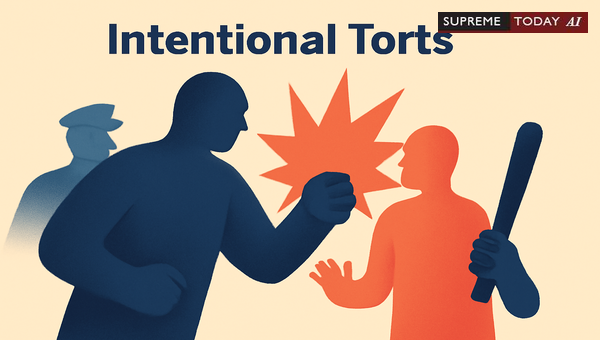
What Is ? Essential Legal Guide
In the realm of civil law, individuals and businesses often encounter situations where one party's actions cause harm to another without any contractual relationship. A common question arises: What is ? This concept lies at the heart of tort law, focusing on wrongful acts designed or resulting in harm. Whether through direct intent or , understanding can help victims seek justice and remedies like damages.
This guide breaks down the definition, key elements, types, and real-world applications, drawing from legal principles and case insights. Note that this is general information and not specific legal advice—consult a qualified attorney for your situation.
Defining Tort Law Basics
A tort is fundamentally a civil wrong that causes harm or loss to another individual, leading to legal liability. Unlike breaches of contract, torts do not require a pre-existing agreement between parties. Tort law aims to provide remedies for harm caused by others' wrongful acts, whether intentional or negligent. The duty in torts is typically imposed by law and owed to persons generally, allowing claims for to compensate the injured party 2004 0 Supreme(All) 2105.
Tortious duties differ from contractual ones as they arise by operation of law, enabling liability in diverse scenarios where one party's actions infringe on another's rights 2023 0 Supreme(All) 537.
What Constitutes ?
specifically refers to actions intended—or in some cases, negligently leading—to harm another party. It encompasses:- : Deliberate acts like , , or aimed at causing harm.- : Failure to exercise reasonable care, resulting in unintentional injury to others.
The term often highlights scenarios with a clear intent to injure, distinguishing it from mere accidents. For instance, dictionaries define injure consistently as to do harm to; to hurt; damage; impair, underscoring harm as the core element 2025 Supreme(US)(scotus) 2567.
Key Elements of
To establish a claim, plaintiffs typically must prove:1. Intent: A clear intention to cause harm to the plaintiff. This is pivotal for intentional variants.2. : Where multiple parties conspire, the predominant purpose must be to injure the plaintiff, even via lawful means 1984 0 Supreme(MP) 226.3. Damage: Actual harm or loss suffered by the plaintiff due to the act.
These elements ensure claims are not frivolous, requiring evidence of breach of a legally imposed duty.
Conspiracy to Injure: A Prominent Form
A key subset is the , recognized in two main types:- : Agreement plus overt acts using illegal methods causing damage.- : Agreement with the predominant purpose to injure, even if means are legal.
As noted, the gist of the tort of conspiracy is not the conspiration agreement to injure alone, but the agreement plus the over acts causing damage
. Courts emphasize that plaintiffs bear the burden to prove the agreement, intent to injure, and resulting damage
.
Case Examples Illustrating Conspiracy Claims
Real cases highlight application:- In one appeal, claims for by unlawful means survived , as they involved new fraud allegations not barred by . was limited, not covering false evidence creation
.- Conversely, a suit alleging extortion and conspiracy failed due to insufficient particulars; general claims lacked evidence of agreement or damage, deemed an abuse of process
.- Another court dismissed conspiracy claims for failing to prove unlawful means or financial loss causation, stressing plaintiffs must show incapability alone did not cause harm
.
These rulings underscore the need for precise pleadings: mere allegations insufficient without facts establishing elements.
Distinctions from Related Concepts
differs from:- Contract Breaches: No prior agreement needed; duties are statutory or common law-based.- Criminal Acts: While overlapping (e.g., extortion as criminal under ), tort seeks civil remedies
.- or : These may involve injury to goodwill or statutory duties but require specific proofs like distinctiveness or care breaches 2020 0 Supreme(Del) 554 2016 0 Supreme(Mad) 3695.
In constitutional contexts, breaches of fundamental rights by state actors (e.g., unlawful detention) may yield public law compensation as a tort remedy, distinct from private disputes 2002 0 Supreme(AP) 1202. Blacklisting without notice has been deemed a tortious conspiracy-like act, violating 2019 0 Supreme(All) 2183.
Legal Framework and Remedies
Liability stems from breaching duties fixed by law, leading to damages for harm. Courts assess intent via statutory construction; if a duty implies taking care not to injure, it's akin to 2016 0 Supreme(Mad) 3695.
Remedies include , sometimes . However, claims must disclose a reasonable , or risk .
Practical Recommendations
If facing potential :- Gather Evidence: Document intent, acts, and damages thoroughly.- Assess Viability: Check for conspiracy elements if multiple parties involved.- Seek Professional Help: A lawyer can evaluate claims, especially distinguishing civil from criminal paths.
Always act promptly, as limitations periods apply.
Conclusion and Key Takeaways
encapsulates wrongful acts—from solo intentional harms to conspiratorial schemes—aimed at causing damage. Core to success: proving intent (or ), combination where applicable, and actual loss. Cases like those on remind us that while powerful, these claims demand robust evidence
.
Key Takeaways:- Torts compensate civil wrongs without contracts.- Conspiracy requires agreement + damaging acts.- Intent and damage are essential; vague claims fail.- Consult experts for tailored advice.
Understanding these principles empowers better navigation of legal disputes. For jurisdiction-specific guidance, reach out to a legal professional.
#TortLaw, #ConspiracyToInjure, #LegalGuide















