


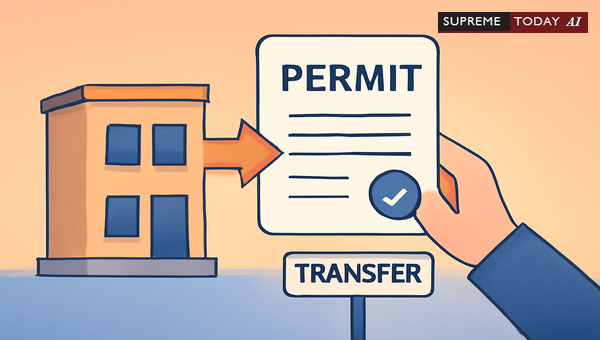
Can Part of a Building Permit Be Transferred in India?
In the bustling real estate market of India, property owners and developers often face complex questions about . One common query arises when dealing with partial property sales or subdivisions: Whether Part of Building Permit can be Transferred. Imagine you've secured a building permit for a large plot, but now need to sell off a portion—does the permit follow seamlessly, or does it risk invalidation? This blog post dives deep into the legal framework, drawing from key judicial insights and regulations to provide clarity.
While are essential for construction, their transferability—especially for parts—is not straightforward. We'll examine core principles, relevant case laws, and practical recommendations. Note: This is general information based on available legal documents and not specific legal advice. Consult a qualified attorney for your situation.
Understanding in India
are mandatory approvals for erecting, adding to, or altering buildings. As per legal documents, are required for the erection, addition, or alteration of buildings. 2022 0 Supreme(SC) 1290
The term building broadly includes any construction or part of a construction intended for specific purposes. 2019 0 Supreme(SC) 888 2020 1 Supreme 336
These permits are tied to the property and project specifics, governed by local building rules, panchayat regulations, and acts like the . They ensure compliance with zoning, safety, and revenue norms.
Key Legal Principles on Transferability
The provided legal documents do not directly address transferring portions of . However, they offer valuable insights into property transfers and permit conditions.
Property Transfers and Rules
Transfer of Property: Governed by specific provisions, including registration and communication to authorities. The transfer of property, including buildings, is subject to specific legal provisions and regulations. 2023 0 Supreme(SC) 340 2019 0 Supreme(SC) 888
Prohibition: Sites cannot generally be fragmented, except for amalgamations of commercial or industrial plots. This implies restrictions on splitting permits tied to the site. 2019 0 Supreme(SC) 888
Permit Validity Upon Transfer
Transferring property impacts permit status:
Part of Plot Transfer: Under , a permit becomes invalid if part of the plot included in the approved plan is transferred or sold to another person. However, transferring the entire property does not automatically invalidate it, provided proper notification. 2023 0 Supreme(Ker) 993
Notification Obligation: Permit holders must inform the Secretary of any transfer of the whole or part before commencing or continuing work (unless construction is complete with ). Failure may affect validity. 2023 0 Supreme(Ker) 993 2024 0 Supreme(All) 1706
In one case, permission was deemed non-transferable: the 1st respondent- has no jurisdiction to incorporate a condition as the one in Ext.P-2 that permission granted to the 1st petitioner is not transferable. 2017 0 Supreme(Ker) 60
Analysis: Can Part of a Building Permit Be Transferred?
Based on the documents, a building permit is integral to the project and site. prohibitions suggest transferring a portion is restricted, but not impossible with compliance.
Scenarios from Case Law
Invalidation Risks: Permits obtained via can be canceled. Even then, petitioners obtained the said building permit order dated by way of / . 2025 0 Supreme(Telangana) 600
Development Permits Linked: On the issuance of a building permit, it shall be deemed that is also granted. No separate permit needed if no land development. 2021 0 Supreme(Ker) 588
Construction Status Matters: Permits have validity periods; delays require renewal. Transfers mid-construction demand authority approval. 2025 0 Supreme(Ker) 2876
Transferee Rights: Under the Industrial Area Development Act, a transferee is defined as a person to whom land or building is transferred. Proper registration is key. 2024 0 Supreme(All) 1706
In summary, part of a building permit can be transferred-related obligations exist, but only with proper notification and compliance. Transferring part of the property triggers mandatory reporting; non-compliance risks revocation. Entire property transfers are safer if documented. Authorities can revoke for violations after due process. 2025 0 Supreme(Telangana) 413 2024 Supreme(Online)(TEL) 22880
Practical Recommendations
To navigate transfers safely:
Review Local Regulations: Check jurisdiction-specific building rules (e.g., panchayat, municipality, ).
Notify Authorities Promptly: Inform the Secretary before any transfer. 2023 0 Supreme(Ker) 993
Seek Revalidation: If construction incomplete, apply for permit extension or transfer endorsement.
Consult Professionals: Engage real estate lawyers. Cases show parallel remedies (e.g., writs alongside civil suits) may be allowed but complicate matters. 2015 0 Supreme(Ker) 183 2015 0 Supreme(Ker) 210
Avoid : Full disclosure prevents cancellation. 2025 0 Supreme(Telangana) 600
Exemptions exist for special cases like road widening. 2025 0 Supreme(Ker) 2868
Common Pitfalls and Revocation Powers
: Leads to cancellation post-hearing.
Pending Litigation: Authorities may halt new permits. Whether the 1st respondent-Secretary of the Grama Panchayat is not allowed to consider petitioner’s Ext.P8 application for building permit in view of the pending civil proceedings? 2015 0 Supreme(Ker) 183
Occupancy Certificates: Issued post-completion; transfers afterward are smoother. 2016 0 Supreme(Ker) 844
Revocation rests with higher bodies like Commissioners.
Conclusion and Key Takeaways
Transferring part of a building permit in India is feasible but fraught with conditions. Permits are site-specific, and partial transfers demand notification to maintain validity. Adhere to rules, disclose fully, and notify promptly to avoid invalidation or revocation.
Key Takeaways:- Entire property transfers: Generally valid with notice. 2023 0 Supreme(Ker) 993- Partial transfers: Risk invalidation; inform authorities. 2024 0 Supreme(All) 1706- Always consult local regs and lawyers.- Permits aren't freely transferable without compliance.
For property dealings, prioritize . Stay informed on evolving rules to protect investments.
Word count: 1028. Sources cited are from judicial documents for reference only.
#BuildingPermitTransfer, #RealEstateLawIndia, #PropertyTransfer















