


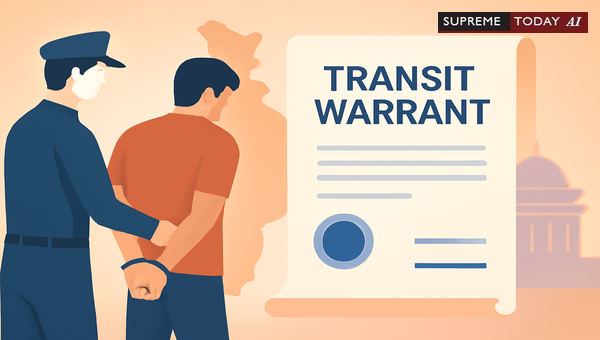
Requirements: Is It Mandatory?
In the complex landscape of Indian criminal law, ensuring procedural compliance during arrests is crucial, especially when an accused is apprehended outside the issuing court's jurisdiction. One key question often arises: What are the requirements for a ? Particularly, is it mandatory if the accused is arrested in another state? This blog post delves into the legal provisions, judicial interpretations, and practical considerations to provide clarity on this vital topic.
Note: This article offers general information based on legal provisions and case law. It is not a substitute for professional legal advice. Consult a qualified lawyer for specific cases.
Understanding Transit Warrants
A (also known as a warrant) is a judicial order that authorizes the lawful transfer of an accused person from one jurisdiction to another, typically across state lines, for production before the court where the case is pending. It acts as a to prevent and uphold the accused's rights under and the .
The primary concern is legality: Can police from one state arrest someone in another without proper authorization? The answer hinges on strict adherence to statutory procedures. As per legal findings, a is generally considered mandatory when an accused is arrested outside the jurisdiction of the court intending to produce them before it 2021 0 Supreme(SC) 334.
Key Legal Provisions: Section 105 of CrPC
outlines detailed procedures for the execution of warrants outside the issuing court's jurisdiction. It mandates that warrants be sent to the presiding officer of the court within whose jurisdiction the execution is to occur 2021 0 Supreme(Bom) 1088.
Key requirements include:- Warrants must be in writing, signed, and bear the court's seal2021 0 Supreme(SC) 334.- Proper transmission through court channels ensures validity; otherwise, the arrest may be deemed illegal 2021 0 Supreme(SC) 334.- The section emphasizes handling documents and things found during search or seizure, so far as possible, highlighting procedural rigor 2021 0 Supreme(Bom) 1088.
Failure to follow these steps can violate the accused's rights, rendering detention unlawful. For instance, when police seek to transport an accused, they often produce them before a for a warrant, as time constraints may prevent immediate production before the 2024 0 Supreme(AP) 570.
Judicial Interpretations and Case Law
Courts have consistently reinforced the necessity of transit warrants. In , it was held that warrants issued outside the jurisdiction are not automatically valid unless transmitted through proper channels 2021 0 Supreme(SC) 334. Executing a warrant without this can lead to illegal arrest claims.
Judicial views emphasize:- Procedural necessity to prevent rights violations during inter-state arrests 2021 0 Supreme(SC) 334.- Magistrates must satisfy themselves with sufficient grounds, supported by case diary entries, before granting —a judicial decision based on evidence Mr. KVR Vidyasagar vs The State Of - , 2024 Supreme(Online)(Bom) 8082.
Other precedents illustrate practical application:- In a case involving at Ahmedabad, a Prisoner was obtained for custody, underscoring standard practice 2025 Supreme(Online)(KER) 12827.- Courts have directed release on or remand when proper procedures are followed, as in a Maharashtra execution scenario
.
The and stress constitutional safeguards under , requiring the accused be informed of arrest grounds and allowed to consult a lawyer before transit 2025 Supreme(Online)(Del) 2427.
When is a Mandatory?
Yes, generally mandatory for arrests in another state or jurisdiction. Here's why:- Ensures lawful transfer and production before the jurisdictional magistrate Mr. KVR Vidyasagar vs The State Of - , 2024 Supreme(Online)(Bom) 8082.- Protects against arbitrary detention; without it, arrests can be challenged 2021 0 Supreme(SC) 334.- Common in scenarios across states, where applicants fear transit arrest
.
For example, when an accused anticipates arrest in transit, may be sought, defined as temporary release for those expecting arrest while moving between places
.
Exceptions and Practical Considerations
While transit warrants are the norm, courts recognize limited exceptions:- Urgency or risk of escape: Judicial discretion may allow alternatives like if safeguards are met Mr. KVR Vidyasagar vs The State Of - , 2024 Supreme(Online)(Bom) 8082.- Existing custody: If the accused is already detained, transfer might proceed with other mechanisms, but justification is required 2024 Supreme(Online)(GUJ) 13276.- Extraordinary circumstances: Rare cases where compliance is impossible, but courts demand compelling reasons2021 0 Supreme(SC) 334.
In practice:- Police produce the accused locally for if direct production is delayed 2024 0 Supreme(AP) 570.- applications arise when fearing arrest en route
.
However, lapses often lead to release directives or bail, as seen in inter-state custody disputes 2025 Supreme(Online)(KER) 12827.
Recommendations for Compliance
To avoid challenges:- Authorities: Always secure a via proper channels before inter-jurisdictional arrests 2021 0 Supreme(Bom) 1088.- Courts: Enforce transmission procedures strictly 2021 0 Supreme(SC) 334.- Legal Practitioners: Verify warrant validity, including duplicates and seals, and advise on if needed
.- Accused persons should demand production before a magistrate and legal consultation 2025 Supreme(Online)(Del) 2427.
Conclusion and Key Takeaways
In summary, a is generally mandatory under CrPC Section 105 when arresting and transporting an accused across jurisdictions, ensuring procedural fairness and legality 2021 0 Supreme(Bom) 1088, 2021 0 Supreme(SC) 334. While exceptions exist, they require judicial justification to uphold rights.
Key Takeaways:- Follow transmission protocols to validate arrests.- Leverage or bail for safeguards.- Prioritize constitutional protections in inter-state cases.
Stay informed on evolving case law, such as recent High Court rulings on transit procedures 2024 0 Supreme(AP) 570. For personalized guidance, reach out to a criminal law expert.
References
- 2021 0 Supreme(SC) 334: Emphasizes prescribed issuance and transmission of warrants.
- 2021 0 Supreme(Bom) 1088: Details Section 105 CrPC procedures.
- 2024 0 Supreme(AP) 570, 2024 Supreme(Online)(Bom) 8082, and others as cited.












