




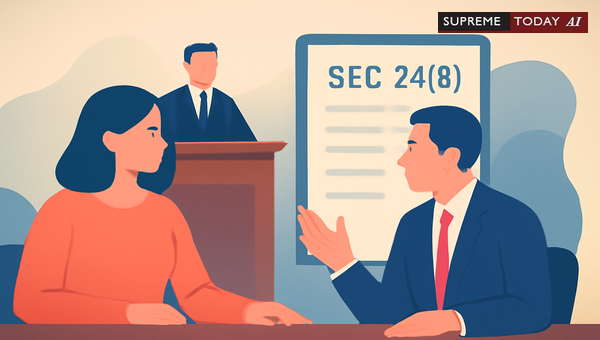
: Decoding Victim's Role in Criminal
In the realm of criminal justice, the balance between state-led and victim involvement is crucial for ensuring . The landmark case of addresses a pivotal question: What is the extent of a victim's or private individual's participation in the process under the ? This ruling from the clarifies the boundaries, emphasizing that while victims have a voice, it remains subordinate to the 's authority.
This blog post delves into the nuances of the judgment, drawing from court documents and related . Whether you're a legal professional, victim advocate, or someone navigating a criminal case, understanding these limits can guide expectations in court proceedings. Note: This is general information based on judicial interpretations and not specific legal advice—consult a qualified lawyer for your situation.
The Core Issue: Victim Participation Under
The proviso to Section 24(8) CrPC allows victims to engage counsel to assist the . However, in Uma Saha v. State of Tripura, courts have interpreted this narrowly. The victim's or private counsel's role is limited to assisting, such as suggesting questions or raising objections, but does not extend to independently conducting , examining witnesses, or making . 2024 Supreme(Online)(DEL) 12306
The explicitly stated: the victim's counsel has a limited right of assisting the , which may extend to suggesting questions to the court or the , but not putting them by himself. 2024 Supreme(Online)(DEL) 12306 This ensures the , as an officer of the court and minister of justice, retains control to uphold trial fairness. 2021 1 Supreme 758
Key Judicial Findings and Limitations
Conducted Solely by
The mandate is clear: must be led by the . Victims cannot dilute this role. Any overreach by private counsel could hamper fairness and compromise impartiality. 2021 1 Supreme 758
In related observations, courts have reinforced that the proviso to Section 24(8) permits victims to furnish post- evidence, but not oral advocacy or witness handling without oversight. 2021 1 Supreme 758
Assisting Role: Suggestions and Objections Only
Victims may:- Suggest questions for witnesses.- Raise objections to irrelevant queries.
However, these must be channeled through the court. The judge decides merit, potentially invoking (additional evidence) or (court's power to question). 2024 Supreme(Online)(DEL) 12306
This aligns with broader . For instance, in a supporting reference: If the Judge finds merit in them, he may take action accordingly by invoking his powers under Section 311 of the Cr.P.C. or . 2022 0 Supreme(Mad) 520 The in Uma Saha is directly cited here, affirming the assisting-only stance. 2022 0 Supreme(Mad) 520
Detailed Court Analysis from Uma Saha
Subordinate Participation and Court Discretion
The High Court in Uma Saha underscored that victim involvement is subordinate to the control and conduct of the . Private counsel lacks unbridled authority. 2021 1 Supreme 758 2024 Supreme(Online)(DEL) 12306
If the falters—e.g., neglects proper examination—the court intervenes, not the victim's counsel. This prevents bias and ensures justice. 2024 Supreme(Online)(DEL) 12306
Interpretation of Proviso to Section 24(8)
Introduced for victim empowerment, the proviso does not grant independent prosecutorial rights. Its language limits roles to assistance, preserving the state's primary duty. Courts have rejected expansive readings that could undermine Public Prosecutors. 2021 1 Supreme 758
A parallel case on appointments under Section 24(8) highlights caution: Appointing counsel who previously represented complainants creates bias risks and is invalid without public interest justification. This echoes Uma Saha's fairness concerns. 2021 0 Supreme(Kar) 952
Broader and Related Rulings
Echoing Uma Saha, other decisions affirm limited victim roles. In one analysis: we agree with the observations made by the in Smt. Uma Saha vs. State of Tripura... that the victim's counsel has a limited right of assisting the . 2021 0 Supreme(Kar) 952
On further investigations post-trial commencement, courts prioritize truth-seeking without victim-led overreach, allowing appeals but not independent conduct. This complements Uma Saha by stressing judicial control. 2022 0 Supreme(Mad) 520
While some sources reference unrelated matters (e.g., employment disputes citing Uma Devi cases), the criminal law thread consistently prioritizes structured participation.
Exceptions: When Courts Step In
- Neglect: Suggest questions; court poses if merited. 2024 Supreme(Online)(DEL) 12306
- Fairness Safeguards: Invoke Sections 311 CrPC or 165 Evidence Act. 2022 0 Supreme(Mad) 520
- No Independent : Strictly prohibited. 2021 1 Supreme 758
These mechanisms protect victims without granting prosecutorial powers.
Practical Recommendations for Stakeholders
- For Victims/Private Counsel: Stick to suggestions and objections via court approval to avoid procedural rebukes.
- For Courts: Vigilantly control proceedings to maintain impartiality.
- For Legislators: Consider clarifying victim rights to reduce ambiguity.
In practice, overstepping can lead to objections or quashing, as seen in Special PP challenges. 2021 0 Supreme(Kar) 952
Conclusion: Balancing Rights and Fairness
The ruling solidifies that victims play a vital supportive role in , not a leading one. By confining participation under to assistance, courts safeguard trial integrity while acknowledging victim interests. Key takeaway: Channel input through the or judge for effectiveness.
This promotes real justice—preventing wrongful prosecutions and ensuring culprits face accountability—without compromising neutrality. Stay informed on evolving interpretations, as criminal procedure adapts to societal needs.
References:1. 2021 1 Supreme 758: Sessions Judge order and High Court affirmation on limited victim roles.2. 2024 Supreme(Online)(DEL) 12306: details on assisting rights and court powers.3. 2022 0 Supreme(Mad) 520: Reinforces Uma Saha on suggestion limits and judicial intervention.4. 2021 0 Supreme(Kar) 952: Agrees with Uma Saha on victim counsel's restricted scope.
#UmaSahaCase, #CrPC248, #VictimRightsIndia












