


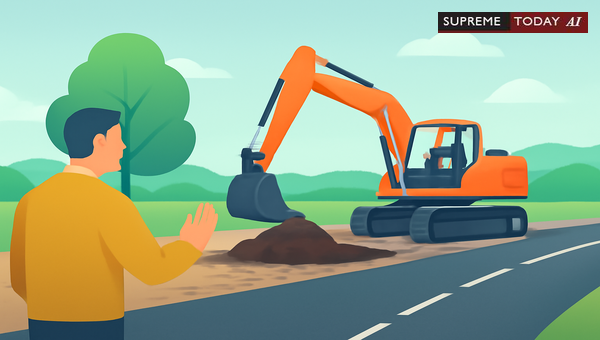
Can You Remove Soil for Roads Without Neighbor Consent?
In the world of property development and infrastructure projects, disputes over land use are common. Imagine a scenario where soil from land adjacent to yours is eyed for road construction. Can a person remove soil reserved for forming a road without the consent of the adjacent landowner? This question strikes at the heart of property rights, , and legal boundaries under Indian law.
As landowners or developers, understanding these rules is crucial to avoid costly litigation. This post breaks down the legal principles, key cases, and practical steps, drawing from established precedents. Note: This is general information, not specific legal advice. Consult a qualified lawyer for your situation.
Understanding the Core Legal Issue
Road construction often requires land acquisition, but what happens when soil from private or adjacent land is targeted? Indian courts have consistently ruled that land cannot be utilized for road construction without the consent of the landowner or proper acquisition proceedings. Courts emphasize that projects must follow , ensuring compensation or consent 2023 0 Supreme(Pat) 506 2020 0 Supreme(UK) 78.
Without this, actions like soil removal can lead to , damages, or even criminal charges for or .
Key Legal Principles Governing Soil Removal
Here are the foundational rules:
- Consent and Acquisition Requirement:
No land can be taken for public use without lawful acquisition. The , mandates and compensation. Under the , no owner can be deprived of their land without and compensation 2020 0 Supreme(UK) 78.
:
Adjacent landowners are protected from excavations that undermine their property. An owner cannot remove soil from their land if it impairs the of adjacent land. This principle protects adjacent landowners from damage caused by excavation or soil removal 1982 0 Supreme(Ker) 167. Removing soil risks , cracks, or collapses on neighboring land.
Public Property vs. Private Use:
Roads are public assets, but private interference without authorization is prohibited. Public property, including roads and pathways, cannot be used for private purposes without proper authorization. The state has the right to acquire land for public use, but this must be done lawfully 2002 0 Supreme(Del) 1783
.
Environmental and Special Land Restrictions:
- For forest or protected land, removal is even stricter. It is not justifiable to remove forest soil seemingly to a place without proper monitoring and environmental benefits. Till date, the petitioner has not applied to the for permission to remove the soil from the assigned forest land 2023 0 Supreme(Ker) 290. Soil leveling for construction may be allowed, but outright removal typically requires nod, which is rarely granted.
Landmark Cases and Court Rulings
Judicial precedents reinforce these principles:
In a pivotal case, the court dismissed a petition to remove a road section without adjacent landowner consent, stating land utilization demands proper acquisition 2023 0 Supreme(Pat) 506.
Municipal authorities were barred from demolishing private properties for road widening sans lawful process: The court reiterated that municipal authorities cannot demolish private properties for road widening without lawful acquisition and consent 2022 0 Supreme(AP) 1005.
was upheld in excavation disputes: Soil removal affecting neighbors is impermissible 1982 0 Supreme(Ker) 167.
Additional insights from related rulings:
Co-Owner Restrictions: A co-owner cannot convey title or rights over joint property, like reserved lanes, without all co-owners' consent. Whether a co-owner of a joint property can convey valid title in specific parcel of land forming part of joint property without partition between the co-owners and without consent of all the co-owners? 2011 0 Supreme(MP) 845. This applies to shared road reserves
.
Highway Access Rights: Adjacent owners have private access rights to roads. The owner of a property adjacent to a highway or a public street has got a that the owner of the property adjacent to a public street has obstructed by any one of the owner of the land highway
. Obstructing or altering soil undermines these 2021 0 Supreme(Mad) 678.
Sub-Soil Extraction: Even on one's land, sub-soil sand removal needs landowner consent and environmental clearance. The settlee may remove sub soil sand from after taking consent and adequately compensating the land owner 2020 0 Supreme(Pat) 630.
These cases illustrate that courts prioritize landowner protection, often issuing stays against unauthorized actions.
Additional Considerations from Broader Sources
Beyond roads, related laws add layers:
Forest Soil Protections: Unauthorized removal from forest land is unjustifiable without monitoring or permission. Government retains rights over adjacent roads and quarries 2023 0 Supreme(Ker) 290.
and : Shared pathways can't be sold or altered unilaterally. Servitude-Co-owners-Partition of land by deed-Lone reserved for common use-Sale of lot by one co-owner-No title to right of way
.
Encroachment and Planning: Plans can't be canceled or encroachments removed without , even for roads 2014 0 Supreme(Kar) 597.
Family Property Access: Courts recognize implied in family disputes, preventing sales that block access 2012 0 Supreme(Mad) 342 2012 0 Supreme(Mad) 338.
Developers must secure environmental clearances () and mine plans for any extraction 2020 0 Supreme(Pat) 630.
Practical Steps and Recommendations
If you're facing soil removal threats:
Verify Ownership and Reserves: Check deeds for road reservations or .
Demand Documentation: Insist on acquisition notices or consent proofs.
Seek : File for urgent stays if is at risk 1982 0 Supreme(Ker) 167.
Engage Authorities: Report to municipal or forest departments for forest-adjacent land 2023 0 Supreme(Ker) 290.
Negotiate Compensation: Use the Act for fair deals 2020 0 Supreme(UK) 78.
Professionals should draft mine plans and obtain clearances early.
Conclusion: Protect Your Rights Proactively
In summary, a person generally cannot remove soil reserved for road construction without the adjacent landowner's consent or legal acquisition processes. This is backed by principles of , fair compensation, and public-private boundaries, as seen in cases like 2023 0 Supreme(Pat) 506 2022 0 Supreme(AP) 1005 1982 0 Supreme(Ker) 167 2020 0 Supreme(UK) 78. Unauthorized actions invite legal backlash, from to compensation claims.
Landowners: Stay vigilant. Developers: Prioritize compliance. For tailored advice, consult a land law expert. By respecting these rules, we balance infrastructure growth with property sanctity.
Word count: 1028. Sources integrated for comprehensive analysis.
#LandLawIndia, #PropertyRights, #RoadConstructionLaw












