


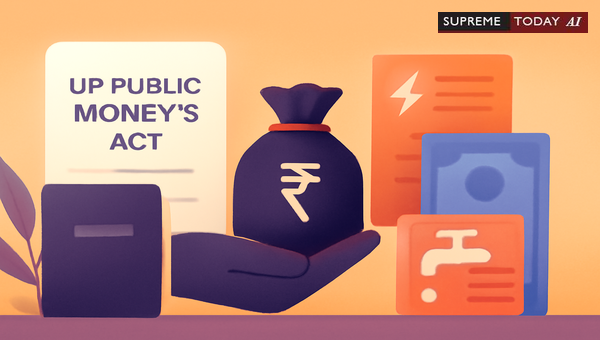
Does UP Public Moneys Act Cover Supply Agreements?
In the realm of in Uttar Pradesh, businesses and consumers often face questions about recovering dues from supply agreements. Whether it's electricity bills, water charges, or other goods and services, one pressing issue arises: whether an agreement for supply comes under the purview of the ? This Act allows recovery of certain as , a powerful mechanism for enforcement. However, its application isn't automatic. This post breaks down the legal landscape, drawing from court precedents and regulations to guide you.
The Core Legal Question
At its heart, the query revolves around supply contracts—think agreements for electricity, water, or similar utilities. Do dues from these fall under the , enabling recovery as land revenue arrears? The answer hinges on specific wording in the agreement and governing statutes. Generally, no—unless explicitly stated otherwise. This position is reinforced across multiple judicial decisions. 2007 7 Supreme 206 2005 0 Supreme(Ker) 457
Main Legal Finding
An agreement for supply of goods or services generally does not fall within the scope of the Act unless it explicitly provides that the dues are recoverable as . Recovery typically follows the contract terms or relevant service regulations, not the Act by default. Courts emphasize that invoking land revenue recovery requires clear contractual or statutory backing. 1967 0 Supreme(All) 123 2007 7 Supreme 206
For instance, the has clarified: recovery of dues for electricity or water supply is governed by regulations and agreements, applicable under the Act only if explicitly stated as recoverable as land revenue. 2007 7 Supreme 206
Key Points from Court Rulings
- Explicit Provision Required: The Act applies only where the agreement states dues are recoverable as . 1967 0 Supreme(All) 123
- Contractual Governance: Dues from electricity or water supplies are handled via agreement terms and service rules, not automatically as land revenue. 2007 7 Supreme 206 2005 0 Supreme(Ker) 457
- Judicial Consistency: Courts limit land revenue recovery to cases with explicit provisions, rejecting automatic application to contracts like or service charges. 2007 7 Supreme 206 1954 0 Supreme(SC) 51 2022 0 Supreme(All) 1960
Detailed Analysis: Legal Principles
Principles from Key Documents
Core to this is that service supply recovery follows specific statutes and contract clauses. For electricity, Regulations relating to Conditions of Supply of Electrical Energy (e.g., and 15(e)) deem dues as only if the agreement so provides. 2005 0 Supreme(Ker) 457
The in underscored: terms of the agreement and statutes dictate recovery modes—land revenue or otherwise. 2007 7 Supreme 206 Similarly, in Isha Marbles, it was held that electricity/water dues recovery aligns with regulations, invoking only on explicit agreement terms. 2023 0 Supreme(Gau) 1017
Contractual Dues vs. Land Revenue
Contractual amounts, absent explicit clauses, don't qualify. Cases like Ram Bilas Tibriwal, Mohd. Umar affirm: no automatic coverage under the Act without clear provisions. 2022 0 Supreme(All) 1960 2007 7 Supreme 206 1954 0 Supreme(SC) 51
Insights from Related Cases and Sources
Related jurisprudence reinforces this nuance. In electricity supply contexts, duties on supply are tied to specific levies, not broadly under land revenue unless specified: The levy as land cess can be used by operation of read with and the definition of the word 'land'. 1997 Supreme(Online)(SC) 77
Power supply agreements, like one for a hatchery unit, highlight regulatory tariffs under bodies like the , where categories (e.g., poultry farming) determine applicability, not blanket land revenue recovery. 2012 0 Supreme(Ori) 350
Broader commercial transactions, such as construction contracts involving water supply and infrastructure, fall under definitions but underscore that disputes aren't excluded from specific recovery Acts without fitting criteria. 2021 0 Supreme(AP) 1044
In land-related matters, like proceedings, courts scrutinize succession or transfers strictly, dismissing misuse for non-qualifying claims. 2014 0 Supreme(All) 2874 This mirrors the precision needed for public moneys recovery.
Even in adoption or tenancy contexts, agreements are invalidated only if hitting specific prohibitions, not broadly. 2003 6 Supreme 1011 2002 0 Supreme(Bom) 8 These illustrate courts' reluctance to expand statutes beyond explicit scopes.
Exceptions and Limitations
While the general rule holds, exceptions exist:
- Explicit Clauses: If the agreement states dues as , the Act applies fully. 1967 0 Supreme(All) 123
- Statutory Variations: Service-specific regulations may enable it; courts check language closely. 2007 7 Supreme 206
- Dues Classification: Taxes/fees differ from contracts; governs. 2005 0 Supreme(Ker) 457
Limitations include judicial oversight: recovery without basis is impermissible, protecting against overreach.
Practical Recommendations
To navigate this:
- Draft Clearly: Include clauses specifying land revenue recovery in supply agreements if desired.
- Verify Regulations: For electricity/water, align with board regulations like those under Regulation 15.
- Litigation Prep: Courts examine contracts/statutes; gather evidence of explicit provisions.
- Alternative Recovery: Use civil suits or service-specific mechanisms if Act inapplicable.
Always consult a legal professional for case-specific advice, as outcomes depend on facts.
Conclusion and Key Takeaways
In conclusion, supply agreements (electricity, water, etc.) do not automatically fall under the . Recovery as land revenue requires explicit contractual stipulation. This protects parties from unintended harsh measures while enabling enforcement where intended.
Key Takeaways:- No automatic application—explicit wording is key. 1967 0 Supreme(All) 123- Rely on contract terms and sector regulations first.- Courts prioritize statutory/contractual precision.
This post provides general insights based on precedents and is not legal advice. Laws evolve; seek expert counsel for your situation.
References:1. on electricity/water recovery. 2007 7 Supreme 2062. Electricity Supply Regulations. 2005 0 Supreme(Ker) 4573. Explicit agreement requirement. 1967 0 Supreme(All) 123
#UPLaw, #LandRevenueAct, #SupplyContracts















