Searching Case Laws & Precedent on Legal Query.....!
Analysing the retrieved Case Laws
Scanned Judgements…!



Searching Case Laws & Precedent on Legal Query.....!
Analysing the retrieved Case Laws
Scanned Judgements…!
Withdrawal of Suit - Generally, once a plaintiff files an application for withdrawal under Order 23 of the CPC, the suit is deemed withdrawn, and the withdrawal is effective without necessarily requiring a court order. The court's permission is only needed if the plaintiff seeks to institute a new suit on the same cause of action. [2023 Supreme(Online)(MP) 27240, 2023 Supreme(Online)(MP) 27245, 2023 0 Supreme(All) 1760]
Sign of Party - Filing a withdrawal application without the party’s signature or proper authorization raises questions about the validity of the withdrawal. In some cases, suits filed by an incompetent person or through a GPA holder without following proper procedures are not maintainable. The signature and consent of the party are crucial, and unauthorized withdrawal can be challenged as illegal or without jurisdiction. [2025 0 Supreme(Telangana) 508, 2025 0 Supreme(HP) 65]
Procedure and Legal Principles - The law emphasizes strict adherence to procedural rules under Order 23 CPC. An unconditional withdrawal leads to automatic dismissal of the suit, and the court generally cannot permit partial withdrawal with liberty to file a fresh suit unless explicitly allowed. The court can restrict defendants’ rights if withdrawal affects their interests. [2023 0 Supreme(All) 1760, 2023 0 Supreme(Ker) 505, 2022 0 Supreme(MP) 364]
Collusive and Vague Withdrawals - Withdrawals based on vague or technical defects, especially without the consent of all parties, can be challenged as collusive or invalid. Courts scrutinize whether the withdrawal was made with genuine consent and proper grounds. [2025 0 Supreme(Kar) 248, 2022 0 Supreme(Guj) 1593]
Implications of Withdrawal Without Party Signatures - Filing withdrawal applications without the signatures or consent of the party, or by a person not authorized, can render the withdrawal invalid and subject to legal challenge. Proper authorization and adherence to procedural rules are essential for the withdrawal to be valid. [2025 0 Supreme(Telangana) 508, 2025 0 Supreme(HP) 65]
Analysis and Conclusion:The provided sources collectively establish that a withdrawal application filed by counsel without the signature or approval of the party is generally not sustainable. Proper legal procedures, including obtaining the party’s consent and following the prescribed rules under Order 23 CPC, are mandatory. Unauthorized or unsigned withdrawal applications can be challenged as illegal, and courts may refuse to recognize such withdrawals, emphasizing the importance of compliance with procedural norms to ensure the withdrawal's validity in civil suits.
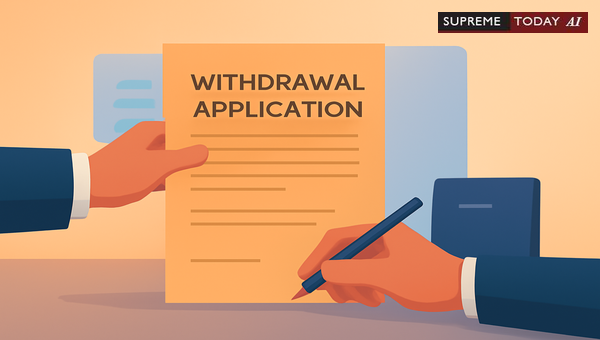
In the realm of Indian , plaintiffs often seek to withdraw suits or petitions for various strategic reasons—settlements, new evidence, or tactical shifts. But when can a court allow withdrawal of a suit or petition? This question is central to , which governs such requests. However, complications arise when withdrawal applications are filed by counsel without the party's signature, raising issues of authority and validity.
This blog post delves into the general principles, judicial precedents, exceptions, and practical recommendations. While this provides general insights based on established case law, it is not legal advice. Consult a qualified lawyer for your specific situation.
allows a plaintiff to withdraw a suit or part thereof with the court's permission. Key aspects include:
Courts emphasize procedural compliance to prevent abuse. Withdrawal becomes final once ordered, often without notice to defendants if unconditional 2009 0 Supreme(Del) 1222.
A core issue is whether an application signed only by counsel, sans the party's signature, is maintainable. Generally, no—it must be signed by the party or an authorized representative.
In practice, unsigned applications risk dismissal or challenge, as the petition is not a party and the application must be filed by the party or with proper authority 1996 0 Supreme(Mad) 1006. Similarly, prayers for withdrawal and liberty to refile are inseparable, and unsigned filings are not maintainable 2005 0 Supreme(Mad) 1848.
Indian courts have clarified these rules through precedents:
In a notable instance 2009 0 Supreme(Del) 1222, withdrawal was permitted despite the defendant's claim of no personal signature. The court reasoned it was unconditional, filed in counsel's presence, with no objections, and no notice required. The order stood final.
Contrastingly, a civil revision petition (C.R.P.) withdrawal by counsel without petitioner's signature was deemed unjustifiable 1996 0 Supreme(Mad) 1006. Another ruling stressed that applications without signatures or authority fail tests 2005 0 Supreme(Mad) 1848.
These cases highlight courts' scrutiny: proper authority is paramount.
While strict, exceptions exist:
Limitations include:
One source notes: Counsel for the plaintiff has filed C.M. Application for withdrawal of suit 2008 0 Supreme(P&H) 1375, but success hinges on backing documentation.
To navigate withdrawal:
Delays, like those attributed to COVID-19, may excuse non-disclosure but not procedural flaws 2021 0 Supreme(P&H) 919. Substitution issues post-withdrawal applications further complicate matters 2019 0 Supreme(Cal) 92.
Implications of non-compliance: Unauthorized withdrawals can be set aside, , or challenged as illegal or without jurisdiction 2025 0 Supreme(Telangana) 508, 2025 0 Supreme(HP) 65. Courts prioritize strict adherence to procedural rules under Order 23 CPC 2023 0 Supreme(All) 1760, 2023 0 Supreme(Ker) 505, 2022 0 Supreme(MP) 364].
Courts allow suit or petition withdrawal under Order 23 CPC when procedurally sound, but applications by counsel without party signatures are typically invalid unless authority is established. Prudence dictates securing signatures, PoAs, or consents to avoid challenges.
Key Takeaways:- Always obtain party signatures or explicit counsel authority.- Multi-plaintiff suits demand unanimous consent 2023 0 Supreme(All) 2323.- Unconditional withdrawals are straightforward; conditional ones need court nod.- Reference precedents like 2009 0 Supreme(Del) 1222 for exceptions, but err on compliance.
For litigants, this underscores procedural diligence. Stay informed, but seek professional legal counsel for tailored advice. This analysis draws from judicial insights to empower better decision-making in civil proceedings.
#SuitWithdrawal, #Order23CPC, #IndianLaw


CPC as not maintainable as it was filed by incompetent person without valid GPA and without following the procedure laid down under Rules - 32 and 33 of Civil Rules of Practice on the following grounds: i) The suit was filed by plaintiff No.1 through GPA holder ... without following the procedure. ... In case of a party executing a General Power of Attorney in favour of another person, ....

the suit without any justification therefor. ... As soon as an application is filed under this sub-rule, the withdrawal of the suit is complete and such withdrawal is not dependent on the court's order. The court's permission is only required in case the plaintiff desires to institute a fresh suit for the same cause of action. ... Bai had obtained their signatures #HL_S....

the suit without any justification therefor. ... As soon as an application is filed under this sub-rule, the withdrawal of the suit is complete and such withdrawal is not dependent on the court's order. The court's permission is only required in case the plaintiff desires to institute a fresh suit for the same cause of action. ... Bai had obtained their signatures #HL_S....

The High Court was of the view that once the application for withdrawal of the suit is filed the suit stands dismissed as withdrawn even without any order on the withdrawal application. Hence, the second application was not maintainable. , (2018) 9 SCC 691 on the issue if the mere lodging of an application to unconditionally withdraw ....

There is no rule of law that a party to the suit cannot withdraw his consent once he had agreed on certain terms for settlement of suit. ... without any reason. ... withdrawal of the application would not amount to res judicata. ... The respondents herein have filed Civil Suit No. 14 of 2015 on the files of learned Civil Judge (Senior....

It is submitted that after withdrawal of the said suit, respondent No.1, filed O.S.No.125/2020 without making the petitioner as a party and without seeking the relief sought in the earlier suit. It is submitted that the attempt of respondent No.1 is to get a collusive decree against the petitioner. ... Later, respondent No.1 filed an application seeking withdr....

to Regular Civil Suit Nos.72 and 73 of 1998, if required, the learned Civil Court is at liberty to restrict Party-in-person to a particular time limit for making his submissions. ... Special Civil Application No. 22285 of 2022 and Special Civil Application No.21956 of 2022 are disposed of with the following directions : (i) The request to transfer the ....

The trial court did not grant liberty to file a fresh suit, though withdrawal was granted overlooking the fact that the application is a conditional one seeking permission to file a fresh one and to allow withdrawal of the pending suit. ... Necessarily, unless it was consented to by the plaintiff, no such order in part can be granted while allowing withdrawal of suit #H....
Civil Misc. Delay Condonation Application No.14 of 2022 Civil Misc. ... under sub rule (3) any suit or part of a claim without the consent of the other plaintiffs" meaning thereby the deponent who is a petitioner no-2 will have no right to get the petition dismissed as withdrawn, without having obtained the due consent of the other petitioners hence the Order in question ... there is no....

This Revision under section 115 of the Code of Civil Procedure has been preferred by the applicant/plaintiff against the order dated 23.1.2022 passed in Civil Suit No.88-A/2015 by the VIth Civil Judge, Class-I, District Dewas whereby his application under Order 23 Rule 1 and 3 of the CPC for withdrawal ... The application has been rejected by the trial Court by observing that the grounds....

It is also admitted by the counsel that it was subsequently that the application for withdrawal of the said civil suit was moved, which has been accepted and the civil suit stands withdrawn. He asserts that the petitioner had not intentionally withheld the said information from the Court and therefore, the writ petition may not be dismissed on that score alone. He further states that the withdrawal of the civil suit was delayed because of COVID-19 pandemic. 3. Learned counsel....

Although Suvendro was sought to be substituted as one of the sons of Purnendro, a plaintiff in the suit, in the first composite application for substitution and withdrawal of suit, upon the trial court granting leave to file separate applications for substitution and withdrawal of suit, only an application for withdrawal was filed, but no further substitution. Learned counsel for the petitioner further argues that the second application for withdrawal of the suit, under Section 151 o....

Pursuant to the said oral agreement the plaintiffs and the proforma defendants executed and registered a Deed of Conveyance transferring their 1/3rd share in Plot No. 1946 and in terms of the said oral agreement. Since the defendants failed to amicably partitioned the property comprised in Plot Nos. 1941, 1942 and 1947, the present suit is filed for partition of the aforesaid plots. An application for withdrawal of the suit was filed.

"Counsel for the plaintiff has filed C.M. Application for withdrawal of suit.

Copies of application dated 22-6-2006 are collectively filed herewith as Annexure-P/4. It is further submitted that the Presiding Officer put the matter for 22-7-2006, and on 22-7-2006 as well as on 24-8-2006 the Presiding Officer was on inspection and ultimately on 12-9-2006 the suit was dismissed for want of prosecution. In pursuance of the direction given by the petitioner the counsel appearing before the Civil Court on 22-6-2006 filed an application to withdraw the suit along wit....


An indispensable Tool for Legal Professionals, Endorsed by Various High Court and Judicial Officers
Please visit our Training & Support
Center or Contact Us for assistance

Scan Me!
India’s Legal research and Law Firm App, Download now!


For Daily Legal Updates, Join us on :



 Back to top


