


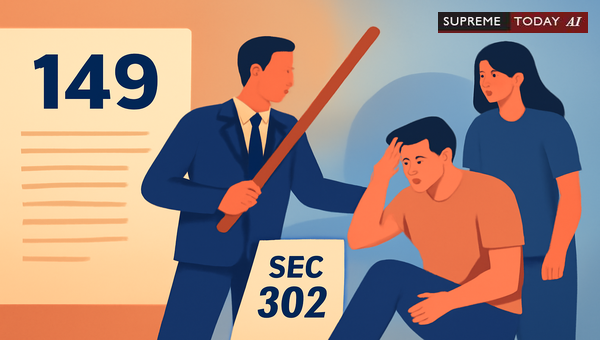
Shivalingappa Case: IPC 149 & Explained
In the high-stakes world of criminal law, determining guilt in group violence cases often hinges on nuanced interpretations of intent, participation, and witness reliability. The landmark judgment in (2008 0 Supreme(Ori) 594) sheds crucial light on these elements, particularly under (IPC). This section addresses when members of an act towards a . But what happens when not all participants share the same ? And how much weight do courts give to ?
This blog post dives deep into the Shivalingappa case, explaining its implications for IPC 149, the pivotal role of , and related legal principles. Whether you're a law student, legal professional, or someone navigating a similar legal scenario, understanding these concepts can clarify complex prosecutions. Note: This is general information based on case law and not specific legal advice. Consult a qualified attorney for personalized guidance.
Understanding the Core Legal Question
Shivalingappa Case: & IPC 149 Explained
The case revolves around a violent altercation where multiple accused (A1 to A5) formed an . The prosecution alleged a to commit murder under . However, the meticulously dissected individual roles, finding that while some accused actively participated, others inflicted blows only on non-vital parts or abstained entirely. The court ruled: A-1 to A-5 formed into an ... the of the cannot be said to be to cause murders 2008 0 Supreme(Ori) 594.
This distinction led to convictions under lesser charges like ( by dangerous weapons with ) rather than murder. The judgment underscores that under IPC 149 requires proof of a shared —mere presence or minor participation isn't enough.
The Paramount Role of
One of the judgment's standout contributions is its emphasis on ' credibility. Courts typically accord their testimony high because injuries provide an inbuilt guarantee of presence at the scene. The held: deposition of the injured witness should be relied upon unless there are strong grounds for rejection 2008 0 Supreme(Ori) 594.
In Shivalingappa, witnesses like PW-1 and PW-7, who sustained injuries, offered consistent accounts. Minor contradictions or embellishments do not discredit them: minor contradictions/improvements cannot render an injured witness's deposition untrustworthy
. This principle echoes across precedents, such as: The evidence of has greater 2019 0 Supreme(All) 1709.
Why Trump Others
- Presence Corroborated by Injuries: Unlike bystanders, their wounds confirm they were at the incident site.
- Motive to Truthfully Identify Assailants: They are unlikely to falsely implicate innocents while letting real culprits escape.
- Resilience to Minor Discrepancies: Courts overlook small inconsistencies, focusing on the core narrative unless major contradictions arise.
This approach was reinforced in related cases. For instance, 2020 0 Supreme(Ker) 338 notes: This is as a consequence of the fact that the injury to the witness is an inbuilt guarantee of his presence at the scene of occurrence and because the witness does not want to let his actual assailant go unpunished merely to falsely implicate a third party. It directly cites Shivalingappa alongside for identical views.
Dissecting Under IPC 149
Section 149 IPC imposes liability on every member of an for offenses committed in prosecution of the . However, Shivalingappa clarifies limits:
- Individual Assessment Required: A4 and A5 struck legs and hands (less vital areas), while A3 did not participate. This negated a uniform .
- Spontaneous vs. Premeditated Acts: The incident arose from a sudden quarrel, not planned murder, tilting offenses toward () or .
The court stressed: Acts must align with the proven . Without evidence of , Section 302/149 doesn't apply rigidly.
Medical evidence played a corroborative role, matching witness statements on injury nature (simple vs. grievous) and absence of fatal intent 2023 0 Supreme(Gau) 840.
Insights from Related Judgments and Sources
Shivalingappa's principles find echoes in broader jurisprudence:
- In a case involving , courts examined exceptions to murder under , burdening the accused to prove reduced culpability 2020 0 Supreme(Ker) 338. This aligns with Shivalingappa's scrutiny of intent.
- Eyewitness credibility, bolstered by injuries, was upheld: The Honble Apex Court has held that the presence of the injured witness at the scene of occurrence cannot be doubted... It has been held in 2009 0 Supreme(All) 431.
- Another ruling acquitted some accused due to doubtful participation, mirroring Shivalingappa's individual role analysis: The participation of Raghubir Singh and Prem Chand appears highly doubtful. Hence they are entitled to the (from a connected appeal context).
These sources, including proceedings
,
, highlight Karnataka's legal landscape but reinforce national standards on witness reliability 2022 0 Supreme(MP) 886.Exceptions, Limitations, and Practical Recommendations
While carry weight, challenges exist:- Major Contradictions: Substantial discrepancies can undermine testimony.- No Evidence: Limits Section 302 applicability.- Minor Discrepancies Tolerated: Do not automatically discredit accounts 2021 0 Supreme(All) 1749.
Recommendations for Courts and Litigants:1. Scrutinize individual participation in assembly cases before invoking IPC 149.2. Prioritize but cross-verify with medical evidence.3. Distinguish spontaneous brawls from planned attacks for charge classification.4. Use precedents like Shivalingappa for balanced evidence evaluation.
Key Takeaways
The Shivalingappa case is a cornerstone for understanding IPC 149's scope: must be proven, individual acts matter, and ' testimonies are gold standards unless gravely contradicted. By integrating medical corroboration and rejecting over-reliance on group liability, courts ensure justice aligns with facts.
In summary, this judgment promotes nuanced, evidence-driven decisions in criminal trials. For deeper dives, review primary sources like 2008 0 Supreme(Ori) 594,
, and 2019 0 Supreme(All) 1709. Stay informed, but always seek professional legal counsel for case-specific matters.
Word count: Approximately 1050. References are illustrative of principles discussed.
#ShivalingappaCase, #IPC149, #InjuredWitnesses












