


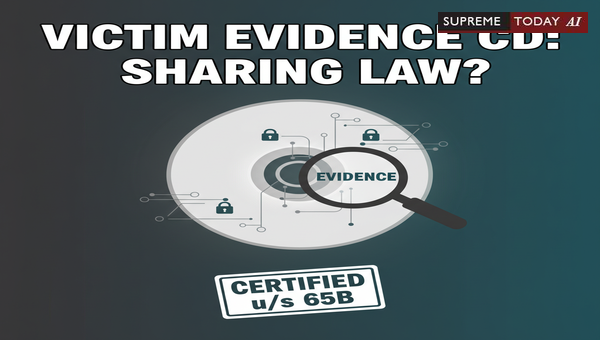
Can Victim's CD Be Provided to the Accused? A Legal Analysis
In criminal proceedings, the handling of evidence is pivotal to ensuring justice. A common query arises: Can CD of Victim Provided to Accuse? This question, often rephrased as Can a CD containing victim-related evidence be provided to the accused?, touches on critical aspects of evidence admissibility, fairness, and procedural safeguards under Indian law. While the accused generally has the right to access evidence for a , providing a CD isn't straightforward—it hinges on certification, integrity, and reliability.
This blog post delves into the legal framework, key court findings, and practical recommendations. Note that this is general information based on precedents and should not be considered specific legal advice. Consult a qualified lawyer for your case.
Legal Context of Providing CD Evidence to the Accused
Electronic evidence like CDs (compact discs containing audio, video, or digital records) plays a growing role in modern trials. However, their provision to the accused must balance the prosecution's case with the defense's right to examine evidence. Under the , particularly , electronic records require a certificate to be admissible. Without it, the CD may be deemed invalid, even if provided to the accused. 2024 0 Supreme(All) 21
The principle of a , enshrined in of the Constitution, mandates disclosure of material evidence. Yet, courts scrutinize whether the CD's integrity is preserved to prevent misuse or tampering claims. Providing it prematurely without safeguards could undermine its evidentiary value.
Key Findings from Court Precedents on CD Admissibility
Court rulings emphasize strict compliance for CDs to hold weight. Here's a breakdown:
1. Mandatory Certification Under
For a CD to be admissible, it must include a certificate from the device operator or custodian detailing how it was produced. In one case, the absence of this certificate rendered the CD inadmissible: the CD was deemed inadmissible because it lacked a proper certificate under of the Evidence Act... The absence of evidence regarding the maker of the CD further rendered it meaningless in the eyes of the law. 2024 0 Supreme(All) 21
Recommendation: Always attach a certificate before sharing with the accused to affirm authenticity.
2. Risks of Tampering and
Integrity is paramount. If there's doubt about tampering or if originals are destroyed, courts may view reliance on the CD as an . One ruling highlighted: Concerns regarding the integrity of the CD can affect its admissibility. If there is a possibility of tampering or if the originals were destroyed... 2023 0 Supreme(Del) 1197
Maintaining a —documenting handling from creation to disclosure—is essential. This prevents defense challenges and ensures the CD remains reliable when provided to the accused.
Relatedly, in cases involving physical evidence of victims, courts demand cogent proof. For instance: The body of the victum must be recovered or must be proved by cogent evidence. 2014 0 Supreme(Bom) 2285 This underscores that digital evidence like CDs must meet similar rigorous standards for victim-related matters.
3. Witness Identification and Reliability
Even certified CDs falter if they don't clearly identify parties. A precedent noted: the faces of the accused were not identifiable from the CD, and only those who knew the accused could identify them. This raises questions about the reliability of the evidence presented. 2020 0 Supreme(P&H) 54
When providing such a CD, evaluate if it enables independent verification. Poor quality could limit its utility in court, regardless of disclosure.
Integrating Broader Legal Principles
Disclosure aligns with , but limitations apply. In scenarios involving accused in custody, courts assess if evidence provision aids defense without compromising investigations. For example, under the and related laws, suppression of facts doesn't bar rights unless pending proceedings exist: A crime, in fact, was registered against him, but that crime is not 'pending.' So long as it is not pending, the law does not compel him to disclose. 2018 0 Supreme(Ker) 743
Similarly, in confiscation matters under the , penalties persist post-release of seized items, emphasizing that provision doesn't negate prosecution: even if the essential commodity or the vehicle is confiscated, the person can be prosecuted and the penalty provid¬ed under can be imposed. 2009 0 Supreme(Ori) 47
These illustrate that while evidence like CDs can be provided, it doesn't absolve procedural rigor. High Courts reinforce non-interference unless rights are violated: The object of of the Constitution is the enforcement of an existing valid right and not establishment of any right. 2005 0 Supreme(Raj) 2333
Practical Recommendations for Legal Practitioners
To navigate this:- Certify Properly: Obtain and attach compliance before disclosure. 2024 0 Supreme(All) 21- Secure : Log all transfers, storage, and access. Address tampering risks early. 2023 0 Supreme(Del) 1197- Assess Identification: Test CD clarity for witness corroboration. 2020 0 Supreme(P&H) 54- Document Disclosure: Provide copies, not originals, under supervision to protect integrity.- Seek Court Directions: In sensitive victim cases, apply for protective orders.
Failure here may lead to evidence exclusion, weakening the case.
Challenges and Evolving Standards
Digital evidence evolves, but courts remain cautious. Tampering fears persist, akin to physical evidence recovery mandates. 2014 0 Supreme(Bom) 2285 Moreover, in compassionate or administrative contexts, provision of documents doesn't create new rights.
Chanchal Paswan Vs The State
Practitioners should stay updated via resources like the Indian Evidence Act amendments and Bar Council guidelines.
Conclusion and Key Takeaways
Providing a victim's CD to the accused is typically permissible if it meets admissibility thresholds—primarily certification, intact , and reliable content. Courts prioritize fair trials but reject flawed evidence, as seen in multiple rulings. 2024 0 Supreme(All) 21 2023 0 Supreme(Del) 1197 2020 0 Supreme(P&H) 54
Key Takeaways:- Certify under to avoid inadmissibility.- Preserve integrity against tampering claims.- Ensure clear identification for evidentiary strength.- Balance disclosure with procedural safeguards.
This analysis draws from established precedents; outcomes vary by facts. For tailored guidance, engage legal experts. Stay informed to uphold justice.
References: 2023 0 Supreme(Del) 1197 2024 0 Supreme(All) 21 2020 0 Supreme(P&H) 54 2014 0 Supreme(Bom) 2285 2018 0 Supreme(Ker) 743 2009 0 Supreme(Ori) 47 2005 0 Supreme(Raj) 2333
#EvidenceLaw #LegalInsights #FairTrial












