
 Back
Back





IN THE HIGH COURT OF JUDICATURE AT MADRAS
P.T. ASHA, J.
T.Mallika - Appellant
Versus
K.Mathivanam - Respondent
A.S.No.259 of 2007 & Cross Objection No.1 of 2011
Decided on : 01-07-2024
JUDGMENT :
Prayer in A.S.No.259 of 2007: First Appeal is filed under Section 96 of C.P.C to set aside the Judgement and Decree made in O.S.No.56 of 2004 on the file of the Additional District Judge (Fast Track Court No.1) at Salem dated 28.04.2006 whereby granting preliminary decree declaring 1/5th share to the plaintiff, defendants 1, 3, 4 and 5 each.
Prayer in Cross Objection No.1 of 2011: Cross Objection is filed Under Order 41 Rule 22 of CPC to set aside the Judgement and Decree made in O.S.No.56 of 2004 on the file of the Additional District Judge (Fast Track Court No.1) at Salem dated 28.04.2006.
The defendants 1, 3 to 5 in a suit for partition are the appellants before this Court. They seek to challenge the judgement and decree of the Additional District Judge (Fast Track Court No.1) at Salem in O.S.No.56 of 2004. The facts which have culminated in the filing of the above First Appeal are herein below set out and the parties are being referred to in the same ranking as before the Trial Court. 2. The plaintiff has filed the above suit seeking a partition of his 6/10th share in the suit schedule properties. The A schedule consists of 30 items of property and the B schedule consists of 9 items of property.
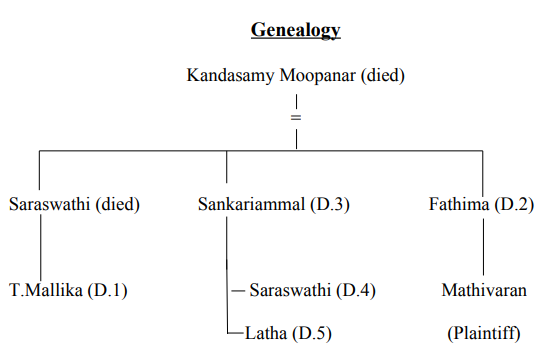
The genealogy given below will demonstrate the relationship:-
Plaintiff's Case:-
3. It is the case of the plaintiff that the suit properties were the ancestral properties of his father Kandasamy Moopanar. The said Kandasamy Moopanar had married one, Saraswathi through whom the 1st defendant was born. Thereafter, Saraswathi had passed away and the said Kandasamy Moopanar had married the plaintiff’s mother, Fathimabibi in the year 1965 and the plaintiff was born to them in the year 1966.
4. It is the case of the plaintiff that while his marriage with Fathimabibi was subsisting, the said Kandasamy Moopanar had developed an illicit relationship with one Sankariammal through whom defendants 4 and 5 were born. The plaintiff would submit that the properties are all ancestral properties in which the plaintiff and Kandasamy Moopanar had a half share each.
5. The said Kandasamy Moopanar died on 05.06.1988 living behind him surviving the plaintiff and the defendants 1 to 5. The 3rd defendant who is not a legally wedded wife is not entitled to any share in the suit properties. Therefore, on the death of the said Kandasamy Moopanar, his half share devolved equally on the plaintiff, defendants 1, 2, 4 and 5 each being entitled to a 1/10th share in the suit schedule properties and the plaintiff is entitled to a 6/10th share.
6. The plaintiff would submit that since he is a police constable he is constantly away from the suit property and taking advantage of his absence from the property, the defendants 1, 3 to 5 have alienated portions of the property to defendants 6, 10, one Manickam and Kodappan under sale deeds dated 22.11.1990, 23.08.1993, 29.01.1992 and 17.08.1994. The said Manickam had died leaving behind him surviving defendants 7 to 10 and Kodappan and Anarkali had together sold portions of the suit property to the 11th defendant. Therefore, the plaintiff has impleaded the purchasers and the legal heirs of the purchasers. The plaintiff would submit that the sale deeds are not binding on his share in the suit schedule properties. Further, defendants 12 to 14 are tenants under the plaintiff.
7. He would submit that on 05.05.1999, he had first made a demand to the defendants to partition the suit schedule properties. However, there was no response. The plaintiff had sent several reminders asking the defendants to partition the suit properties and had also attempted to convene a Panchayat on 04.11.2001. However, the defendants refused to cooperate in the same. Therefore, the plaintiff has been constrained to file the above suit.
Written statement of the 1st defendant:-
8. The 1st defendant had filed a written statement inter alia denying the fact that the plaintiff was born to Kandasamy Moopanar through the 2nd defendant. The 1st defendant had

AI
Children born from void marriages are deemed legitimate under Section 16 of the Hindu Marriage Act, allowing them to inherit from their parents' property, including ancestral property.

(1) A child born from a voidable marriage which has been annulled, such a child will have rights to or in property of parents and not in property of any other person.(2) When a Hindu dies after the c....

Children from void marriages cannot inherit ancestral property; their rights are confined to their parent's property, consistent with Hindu Succession Act amendments.

The court affirmed that ancestral property remains so despite partition, and daughters are entitled to equal shares under the Hindu Succession Act, 1956, as amended.


Daughters born before 1956 are entitled to coparcenary rights under the amended Hindu Succession Act, 2005, irrespective of their marital status.


Daughters are equal co-parceners with sons by birth, and the right is conferred by birth and not by inheritance, as per the Hindu Succession Amendment Act, 39 of 2005.



An indispensable Tool for Legal Professionals, Endorsed by Various High Court and Judicial Officers
Please visit our Training & Support
Center or Contact Us for assistance

Scan Me!
India’s Legal research and Law Firm App, Download now!


For Daily Legal Updates, Join us on :



 Back to top


