


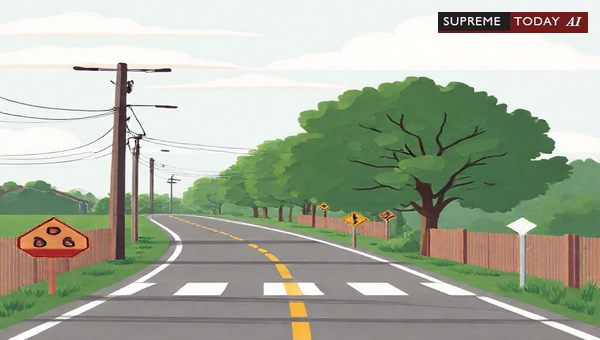
Who Can Sue Over an Encroachment on a Public Road and How Actually Works
Encroachments on public roads are among the most common property disputes reaching Indian civil courts. A shopkeeper finds his access blocked by a neighbour's gate, residents discover a compound wall eating into a pathway, or a structure appears on a street that the whole neighbourhood has used for decades. A question that frequently arises is whether the plaintiff alone has the right to file a suit with respect to the encroachment on the road, or whether others affected by the obstruction can also approach the court. The short answer, supported by consistent judicial authority, is that the right to sue is not confined to a single plaintiff.
The Core Principle: The Belongs to Everyone
The over a public highway is a right vesting in the public at large, not in any one individual. In 1964 0 Supreme(SC) 317, the court affirmed that the public may use the entire width of the highway, and that a municipality cannot put up structures on the public pathway which are not necessary for its maintenance or user as a pathway. Because the right of passage is a collective one, any person who is a member of the public — and whose use of the road is obstructed — generally has the standing () to seek removal of the encroachment.
This principle was reinforced in 2023 0 Supreme(Mad) 1146, where the court held that a public highway is dedicated not to a limited section of the public but for all subjects, that is to say, the public at large. Obstruction of such a highway constitutes a , and the affected individual can maintain a suit notwithstanding that others suffer the same inconvenience.
Declaration Without Proof of Special Damages
A critical objection often raised against private suits over public roads is the requirement of — proof that the plaintiff suffered harm peculiar to himself. The in , as cited in 2025 0 Supreme(Mad) 4045, settled that a suit for a mere over a public thoroughfare lies even without proof of special damages. Their Lordships held that a suit for a declaration would certainly lie for asserting an individual right to use the public road. This reasoning applies squarely to encroachment cases: a citizen whose access is obstructed may sue for a and a for removal of the obstruction.
That said, exceptions exist. Where the obstruction is minor and does not substantially affect the , courts have generally required proof of peculiar to the plaintiff before granting relief for obstruction of a public highway 1956 0 Supreme(AP) 14.
The Distinct Private Right of the
Apart from the , an enjoys a separate, to the highway from his land. In 2021 0 Supreme(Mad) 678, the court explained that an owner of land adjoining a highway is entitled to access to such highway at any point at which his land actually touches it — unless a strip of land belonging to another, not subject to the , intervenes. Interference with this is an independently actionable wrong, and the may recover damages where an unreasonable use of the highway has rendered access to his premises unnecessarily inconvenient.
This distinction matters in practice. Courts have repeatedly held that owners of houses or premises abutting a roadway can enforce their right of access if obstruction is caused 2020 0 Supreme(Mad) 14. Similarly, where a plaintiff's personal access to her property through a disputed roadway was established through long, open, and continuous use, the court upheld her under 2025 0 Supreme(Kar) 1975 and 2024 0 Supreme(Kar) 254.
Section 91 Suits and Collective Rights
Where the obstruction affects a section of the public rather than identifiable individuals, becomes relevant. This provision permits suits by two or more persons, with the Advocate-General's consent, for declarations and injunctions in cases of . In a Chennai dispute over a gated wall abutting Nathan Street 2021 0 Supreme(Mad) 2855, the court refused to reject the plaint at the threshold, holding that where both public and private rights of residents and neighbours would be infringed, the matter required a full trial rather than summary dismissal.
The same case law confirms that individuals can protect personal access rights even where the obstructed land is a public road. In one appeal concerning a 20-feet cross road vital for the plaintiff's access, the court held that personal rights to access can be enforced against public property encroachments, affirming the plaintiff's right to unhindered access while declining a mandatory demolition order unsupported by evidence 2025 0 Supreme(Kar) 850.
The Municipal Authority's Statutory Duty
Encroachments on municipal streets trigger parallel statutory remedies. In 1985 0 Supreme(SC) 226, the held there is no fundamental right to squat on or construct structures on pavements or public roads, and that the Corporation is obliged to remove obstructions from public streets. Where a road is maintained by a municipal body — as with roads recognised by BBMP for katha, plan sanction, and taxation — the corporation may be directed to keep the passage free of encroachments and enter it in its property register 2023 0 Supreme(Kar) 210. Courts have also directed municipalities to act on removal orders passed by their own engineering officials rather than allowing private compound walls and gates to remain on public passages.
An important limitation arises here: a private individual must demonstrate a right of his own. In one appeal, a plaintiff who sought to declare an exclusive right over a pathway failed because he did not implead another co-sharer with rights over the property 2026 Supreme(Online)(Mad) 107574. Conversely, in a pathway-suit under an approved layout, the appeal was dismissed because the appellant had no right over the road area and thus lacked 2011 0 Supreme(Mad) 3598. The lesson is that standing depends on a demonstrable public or private right affected by the encroachment — not merely an interest in the outcome.
Practical Steps for Someone Facing a Road Encroachment
- Identify the nature of the right affected: public passage, private access of an , or an acquired by long user.
- Approach the municipality or highways authority first where the street vests in a statutory body; the authority is typically under a duty to remove encroachments 1985 0 Supreme(SC) 226 and 2023 0 Supreme(Kar) 210.
- File a civil suit for declaration and where the authority fails to act or where a is directly infringed.
- Gather evidence of user: witness testimony, old plans, prior decrees, and municipal records have proved decisive in establishing both the existence of the road and the plaintiff's rights 2025 0 Supreme(Kar) 850 and 2024 0 Supreme(Kar) 254.
Key Takeaways
The plaintiff alone does not hold the right to file a suit over encroachment on a public road. Any member of the public whose passage is obstructed, any whose private access is interfered with, and in appropriate cases two or more persons acting under Section 91 CPC may all maintain such suits. A over a public thoroughfare generally lies without proof of special damages, though peculiar damage strengthens claims for obstruction that does not substantially block passage. Since outcomes turn on the specific facts — the nature of the right, the extent of obstruction, and the vesting of the road — anyone facing such a dispute should seek advice from a qualified advocate about their particular circumstances.
#Encroachment #RightOfWay #PublicRoad #LocusStandi #PropertyLaw









