SupremeToday Landscape Ad
AI Thinking

AI Thinking...

Searching Case Laws & Precedent on Legal Query.....!

Scanned Judgements…!

Checking relevance for RUGBER KAUR AJAIB SINGH vs HO SHEE FUN & ANOR...

RUGBER KAUR AJAIB SINGH vs HO SHEE FUN & ANOR - 2011 MarsdenLR 2831 : The court held that when assessing witness credibility, particularly where a witness lacks knowledge of the subject matter or where testimony is not substantiated by credible documentation, the court must critically assess the testimony against corroborative evidence. In this case, the High Court reduced future earnings claims due to the lack of credible supporting documentation and questionable witness reliability, indicating that a witness''''s lack of knowledge or inability to substantiate claims undermines their credibility. The court emphasized that courts may only accept oral testimony when it is reasonable and substantiated, and disproportionate claims relative to qualifications or knowledge raise serious questions about credibility. This establishes a precedent where a witness''''s lack of subject-matter knowledge, especially when unsupported by evidence, can lead to the rejection of their testimony and impact the assessment of damages.Checking relevance for PP vs NURMINAH MATARUN...

Checking relevance for PP vs SUHAINI TONI...

PP vs SUHAINI TONI - 2021 MarsdenLR 405 : The case law cited in the document, Mohamed Kasdi v. Public Prosecutor [1969] 1 MLJ 135, establishes that when a witness gives two statements differing in material particulars, there is necessarily ground for believing that the witness is not truthful. This principle can be applied to challenge a witness''''s credibility if they lack knowledge of the subject matter—such as failing to recall or identify key details (e.g., the name of an agent) in their initial statement, but later providing such information under oath. The court’s reference to this precedent directly supports the legal basis for challenging a witness’s credibility due to inconsistency and lack of knowledge, which aligns with the user’s query about cases where a witness has no knowledge of the subject matter.Checking relevance for PENDAKWA RAYA LWN. MOHD ISA ABDUL SAMAD...

Checking relevance for PP vs MAHIR AFFANDI MOHAMAD & ANOTHER CASE...

PP vs MAHIR AFFANDI MOHAMAD & ANOTHER CASE - 2024 MarsdenLR 317 : The case law cited in the document, particularly the passage from Kwang Boon Keong Peter v. PP [1998] 2 SLR 211 and Sean Thornton v. Northern Ireland Housing Executive [2010] NIQB 4 (adopted in McAllister v. Campbell [2014] NIQB 24), establishes that the credibility of a witness includes their objective reliability—specifically, their ability to observe or remember facts and events about which they are giving evidence. This directly supports the principle that a witness lacking knowledge of the subject matter may be deemed unreliable, thereby challenging their credibility. The court explicitly links witness credibility to their capacity to observe and recall relevant facts, which is directly applicable to the user''''s query about challenging witness credibility when the witness has no knowledge of the subject matter.Checking relevance for ANG YEE CHENG & ANOR vs ANG SIANG HOCK...

Checking relevance for PP vs MOHD BANDAR SHAH NORDIN & ANOR...

Checking relevance for MD ZAINUDIN RAUJAN vs PP...

Checking relevance for DAVENDAR SINGH SHER SINGH vs PP...

Checking relevance for UEM GROUP BHD vs GENISYS INTEGRATED ENGINEERS PTE LTD & ANOR...

Checking relevance for TONG SOON TIONG & ORS vs FA SECURITIES SDN BHD...

Checking relevance for MOHD YUSRI MANGSOR & ANOR vs PP...

MOHD YUSRI MANGSOR & ANOR vs PP - 2014 MarsdenLR 1897 : The case establishes that a witness''''s credibility can be challenged when their testimony contains significant inconsistencies, particularly when the witness lacks direct knowledge of the subject matter. In this case, the prosecution relied heavily on a witness whose testimony was found to be ''''riddled with contradictions,'''' leading the court to conclude that the prosecution failed to establish a prima facie case. The court emphasized that in criminal convictions, the burden of proof lies with the prosecution and must be met beyond reasonable doubt, and any doubts must favor the accused. This supports the legal principle that if a witness has no genuine knowledge of the subject matter—especially in cases involving complex or specific facts like drug trafficking—their testimony may be deemed unreliable and insufficient to sustain a conviction.Checking relevance for SMALL MEDIUM ENTERPRISE DEVELOPMENT BANK MALAYSIA vs LIM WOON KATT...

Checking relevance for DUIS AKIM & ORS vs PP...


AI Overview

AI Overview...

Analysis and Conclusion:

A plaintiff cannot benefit from witnesses who do not corroborate each other or are not properly examined in the prescribed order. Witness testimony, especially in criminal or sensitive cases, requires corroboration to be reliable. The law protects witnesses from retaliation and discourages re-litigation based on the same facts, ensuring the integrity of the judicial process. Furthermore, a party must actively call and cross-examine witnesses to establish their case; reliance on uncalled or unwilling witnesses is ineffective. Proper procedural adherence, including thorough cross-examination, is essential for evidence to be considered valid and for the plaintiff’s case to succeed.

Why Non-Corroborating Witnesses Weaken Your Case

Why Non-Corroborating Witnesses Weaken Your Case

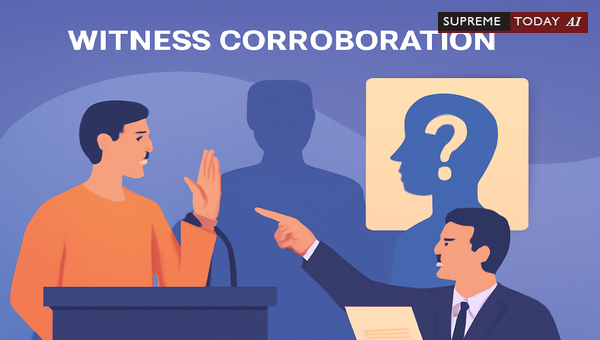
In high-stakes legal battles, witness testimonies often form the backbone of a case. But what happens when those witnesses fail to align their stories? The legal question at the heart of many courtroom dramas is: Can a plaintiff get the benefit of witnesses not corroborating with each other? The short answer is generally no—courts typically view such discrepancies as a red flag, often extending the benefit of doubt to the defendant or accused. This principle underscores the critical role of consistency in evidence, particularly in Indian courts where reliability is paramount.

This blog post delves into the legal principles governing witness corroboration, the consequences of inconsistencies, real-world case examples, and practical recommendations for litigants. Whether you're a plaintiff building a case or a defendant defending one, understanding these nuances can make or break your outcome.

The Core Legal Principles on Witness Credibility and Corroboration

Courts place immense emphasis on the credibility and reliability of witness testimonies. A fundamental rule is that evidence from a single, wholly reliable witness can suffice for conviction or a favorable judgment, even if uncorroborated, as long as the testimony is clear, cogent, and unimpeachable Vithal Pundalik Zendge VS State of Maharashtra - Supreme Court (2008)Monoj Roy VS STATE OF WEST BENGAL - Calcutta (2007).

However, this exception applies only to exceptional cases. When witnesses are neither wholly reliable nor wholly unreliable, or when their accounts are partial or inconsistent, corroboration becomes essential to substantiate the case Jagdish Prasad: Bawan Kumar VS State Of M. P. - Supreme Court (1992)Minaram Sonowal VS State of Assam - Gauhati (2003). Without it, the prosecution's or plaintiff's case crumbles under scrutiny.

Impact of Lack of Corroboration

The absence of corroborating evidence is particularly damaging when:- Witnesses turn hostile.- Testimonies conflict on key facts.

In such scenarios, courts are inclined to grant the benefit of doubt to the accused Akloo Sahani VS State Of Bihar - Patna (2001)Chamansab Mohammad Gouse VS State of Karnataka - Karnataka (2022)Anil Yadav, Son of Sri Chatradhari Yadav VS State of Bihar - Patna (2018)Swapan Bhowmick VS State of Assam - Gauhati (2012). The prosecution's failure to explain discrepancies or provide independent corroboration frequently leads to acquittal Akloo Sahani VS State Of Bihar - Patna (2001)Swapan Bhowmick VS State of Assam - Gauhati (2012)Ojing Tasing VS State of Arunachal Pradesh - Gauhati (2008).

Witness Hostility and Inconsistencies: A Recipe for Doubt

Hostile witnesses—those who retract or contradict earlier statements—pose a significant hurdle. Courts view non-supporting or inconsistent testimonies as undermining the entire case, often resulting in acquittal or benefit of doubt Akloo Sahani VS State Of Bihar - Patna (2001)Chamansab Mohammad Gouse VS State of Karnataka - Karnataka (2022)Swapan Bhowmick VS State of Assam - Gauhati (2012).

Consider this from judicial observations: In one case, the court noted, Testimonies of all the eye witnesses are not corroborating each other State VS Fakar - 2019 Supreme(Del) 2238, leading to acquittal under IPC Sections 324/307/34. Similarly, where eyewitnesses failed to mention each other's presence at the scene, the prosecution witnesses were deemed not to corroborate one another, resulting in acquittal for murder and related offenses State of Maharashtra VS Dnyaneshwar - 2015 Supreme(Bom) 775. The court emphasized, these witnesses have not stated anything about each other's presence on the spot of the occurrence... the prosecution witnesses are not corroborating the evidence of each other.

In another instance involving fake currency, while witnesses did corroborate, the court stressed the need for proof beyond reasonable doubt, highlighting how missing elements like knowledge of forgery led to reversal of conviction Shaikh Nazir Shaikh Failu VS State of Maharashtra - 2018 Supreme(Bom) 1450. Conversely, consistent testimonies strengthened cases, as seen where All the prosecution witnesses were corroborating with each other Gopal VS State of Maharashtra - 2020 Supreme(Bom) 1018; Subhash alias Chabu Mahsuji Nikalje VS State of Maharashtra - 2018 Supreme(Bom) 896.

Exceptions: When Uncorroborated Testimony Suffices

Courts exercise judicial discretion based on the evidence's nature. Conviction may stand on uncorroborated testimony if the witness is wholly reliable STATE OF KERALA VS CHOYUNNI - Kerala (1979)Monoj Roy VS STATE OF WEST BENGAL - Calcutta (2007)Vithal Pundalik Zendge VS State of Maharashtra - Supreme Court (2008). For example, in civil contexts, parties and witnesses are treated similarly under the Civil Procedure Code, 1908 (Order XVI Rule 21, Order XVIII Rule 3A) and Indian Evidence Act, 1872 (Sections 137-139, 154-155). Witnesses and parties to a suit, for the purposes of adducing evidence... are on same footing Mohammed Abdul Wahid VS Nilofer - 2023 8 Supreme 487.

Yet, even here, production of documents during cross-examination must align with pleadings, and lack of confrontation without prior filing can limit evidence Mohammed Abdul Wahid VS Nilofer - 2023 8 Supreme 487.

Insights from Landmark Cases and Broader Contexts

Drawing from diverse judgments:- In a POCSO Act case, consistent witness accounts and school records proved guilt beyond doubt, upholding convictions under IPC Sections 354-A, 363, 511 r/w 34 and Section 8 POCSO Gopal VS State of Maharashtra - 2020 Supreme(Bom) 1018. The court noted natural presence of witnesses corroborated the narrative.- Murder appeals succeeded where child witnesses and circumstantial evidence aligned perfectly: The evidence of these three witnesses is corroborating with each other Subhash alias Chabu Mahsuji Nikalje VS State of Maharashtra - 2018 Supreme(Bom) 896.- Fraud cases warn that parties cannot benefit from their own wrongdoing, as in A plaintiff cannot... Looh Keo @ Looh Lim Teng & Anor vs Looh Chee Peng & Ors, tying into credibility issues.- Criminal trials aren't games; judges aren't umpires who reward omissions: A criminal trial is not a game where one side is entitled to claim the benefit of any omission... Harold Rex Jansen vs The Hon. Attorney General - 2024 Supreme(SRI)(CA) 1.

These examples illustrate that while corroboration isn't always mandatory, its absence amplifies doubts, especially with improvements or contradictions in testimony State VS Fakar - 2019 Supreme(Del) 2238.

Practical Recommendations for Litigants

To avoid pitfalls:- Prioritize corroborative evidence: Bolster witness statements with documents, forensics, or independent witnesses.- Address inconsistencies proactively: Explain discrepancies in filings or during examination.- Vet witness reliability: Highlight credibility where corroboration lacks—clear, consistent, unimpeachable accounts.- Prepare for hostility: Anticipate turncoats and have fallback evidence.

In civil suits, ensure parties as witnesses don't face undue barriers, but plead facts exhaustively Mohammed Abdul Wahid VS Nilofer - 2023 8 Supreme 487.

Key Takeaways and Conclusion

  • Plaintiffs generally cannot rely solely on non-corroborating witnesses unless wholly reliable.
  • Lack of corroboration favors benefit of doubt, especially with hostile or inconsistent testimonies.
  • Courts wield discretion, but consistency remains key to credibility and success.

In summary, witness corroboration is the glue holding cases together. Discrepancies invite skepticism, often tipping scales toward defendants. This is general information drawn from judicial precedents and not specific legal advice—consult a qualified attorney for your circumstances.

By fortifying your evidence with reliable, aligning testimonies, you position your case for stronger judicial reception. Stay informed, corroborate diligently, and let consistency be your ally in court.

#WitnessCorroboration #BenefitOfDoubt #LegalEvidence
Chat Download
Chat Print
Chat R ALL
Landmark
Strategy
Argument
Risk
Chat Voice Bottom Icon
Chat Sent Bottom Icon
SupremeToday Portrait Ad
logo-black

An indispensable Tool for Legal Professionals, Endorsed by Various High Court and Judicial Officers

Please visit our Training & Support
Center or Contact Us for assistance

qr

Scan Me!

India’s Legal research and Law Firm App, Download now!

For Daily Legal Updates, Join us on :

whatsapp-icon telegram-icon
whatsapp-icon Back to top