


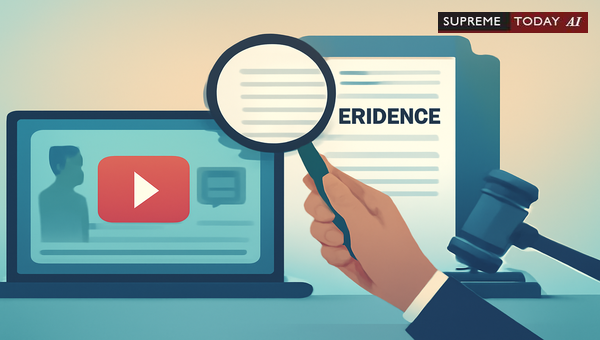
Can YouTube Interviews Be Used in Court ?
In today's digital era, where social media platforms like YouTube dominate public discourse, a common question arises: can an interview on a YouTube video be used in ? With videos going viral and influencing opinions, courts are increasingly grappling with the of such content as evidence. This blog explores the legal framework, key requirements, and judicial insights, primarily under Indian law, to help you understand when and how YouTube interviews can play a role in litigation.
Whether you're involved in a defamation suit, political dispute, or civil claim, knowing the rules for digital evidence is crucial. We'll break down the criteria, processes, and real-world precedents.
Understanding Digital Evidence in Modern Courts
Digital evidence, including YouTube videos, falls under electronic records. Courts recognize their probative value but demand strict verification to prevent tampering or fabrication. In India, the governs this through , which allow electronic records as evidence if accompanied by a certificate authenticating their origin and integrity. further supports expert opinions on authenticity. 2024 0 Supreme(Mad) 59
For a YouTube interview to be admissible:- Relevance: It must pertain to the case facts, such as defamatory statements or witness credibility.- : Prove it's unaltered via metadata, , or .- : Document how the video was obtained, stored, and presented.
Failure in these areas can lead to exclusion, even if the content seems damning.
of YouTube Videos for
Once authenticated, YouTube interviews can be introduced during trials and used in to impeach witnesses, test credibility, or establish facts. For instance, a video showing contradictory statements can be played to challenge a witness's testimony.
In defamation cases, courts have routinely considered YouTube content. In one ruling, a defendant was ordered to pay Rs. 50 lakhs in damages for a defamatory video in Youtube in the form of interview, highlighting how such videos are treated as material evidence when they tarnish reputation.
The court noted: Merely under pretext of freedom of expression one cannot make interview intruding privacy of others.
Similarly, specific YouTube videos dated , , , and were referenced in proceedings, underscoring their evidentiary role. 2024 Supreme(Online)(MAD) 34069
Key Steps for Introducing YouTube Evidence
- Obtain Section 65B Certificate: A mandatory affidavit from the device owner or custodian confirming the record's accuracy.
- Preserve Originals: Download via official tools to retain metadata; avoid screenshots.
- Expert Verification: Forensic analysis for edits, especially since platforms like YouTube allow uploads that may be edited. 2019 0 Supreme(Del) 1779
- Judicial Precedents: Courts have admitted social media videos post-verification, as in cases emphasizing relevance and authenticity akin to R. v. Mohan. 2024 0 Supreme(Mad) 60
Challenges and Judicial Scrutiny
Opposing parties often challenge YouTube evidence on grounds of editing, anonymity of uploaders, or lack of context. In a political defamation quash petition, a YouTube interview was scrutinized: The second respondent... submitted a complaint stating that A1 gave an interview for a YouTube channel run by A2... The language used by the petitioner right through the interview is quite rude, defamatory. Yet, proceedings were quashed as statements lacked criminal intent under . 2024 0 Supreme(Mad) 2594
Courts also address technical aspects, like geo-blocking or uploader identity on YouTube. 2019 0 Supreme(Del) 1779 In copyright disputes, YouTube channels have been central, with orders for content removal and accounts of profits. 2022 0 Supreme(Mad) 866
For specifically, video conferencing has been permitted to enhance access to justice, as affirmed under Electronic Video Linkage Rules. 2024 0 Supreme(Ker) 1621 However, physical is preferred when virtual modes prove ineffective, especially with voluminous evidence. 2021 0 Supreme(Ker) 913
Real-World Applications in Defamation and Civil Suits
YouTube interviews often surface in defamation claims. Courts direct parties to produce videos, implying acceptance subject to compliance. In one case, defamatory videos led to injunctions and damages, recognizing their impact on reputation. 2024 0 Supreme(Mad) 60
Even scandalous interviews are evaluated for intent: Statements made in interviews, though scandalous, do not constitute offences under Sections 504 and 505(2) of IPC without intent to provoke. 2024 0 Supreme(Mad) 2594
Practitioners should anticipate objections:- Tampering Claims: Use hash values or blockchain for integrity.- : Argue as .- Privacy Intrusions: Balance with public interest.
Conclusion and Key Takeaways
Yes, YouTube interviews can generally be used in if they meet standards under the Indian Evidence Act—proper , relevance, and procedural compliance like a Section 65B certificate. Courts are adapting to digital realities, treating videos as credible evidence when verified. 2024 0 Supreme(Mad) 59 2024 0 Supreme(Mad) 60
Key Takeaways:- Always secure a certificate and .- Prepare for against tampering claims.- Leverage precedents in defamation and political speech cases.- Consult counsel for case-specific strategies.
This post provides general information based on legal principles and precedents. It is not legal advice; consult a qualified attorney for your situation.
References
- 2024 0 Supreme(Mad) 60 – Judicial recognition of social media evidence.
- 2024 0 Supreme(Mad) 59 – and compliance.
– Damages for YouTube defamation.
- 2024 0 Supreme(Mad) 2594 – Quashing based on interview content.
- 2024 Supreme(Online)(MAD) 34069 – Specific video references.
Stay informed on evolving digital law—share your thoughts below!
#DigitalEvidence, #YouTubeLaw, #CrossExamination















