
 Back
Back





IN THE HIGH COURT OF KARNATAKA
Rajendra Badamikar, J.
Chowdanaika – Appellant
Versus
Narayana – Respondent
Regular Second Appeal No. 2401 of 2008 (INJ)
Decided On : 04-08-2023
INJUNCTION - PROPERTY DISPUTE - REGISTRATION ACT, SECTIONS 17 & 49 - The court discussed the legal implications of the Registration Act, particularly Sections 17 and 49, which pertain to the registration of documents affecting immovable property. The court interpreted these provisions to conclude that the unregistered exchange deed (Ex.P2) was inadmissible as evidence of a partition, thereby influencing the decision to dismiss the plaintiff's claim for injunction. The court emphasized the necessity of proving genealogical ties and the validity of the partition to establish ownership rights.
Fact of the Case:
The plaintiff filed a suit for permanent injunction against the defendants, claiming ancestral rights over certain properties based on an oral partition and an exchange deed. The defendants denied the plaintiff's claims, asserting that he was not related to them and that the properties were self-acquired.
Finding of the Court:
The trial court initially ruled in favor of the plaintiff, but the first appellate court reversed this decision, finding that the plaintiff failed to establish his connection to the defendants' family and the validity of the exchange deed.
Issues: Whether the plaintiff is a member of the joint family of the defendants and whether the exchange deed (Ex.P2) can be considered valid despite being unregistered.
Ratio Decidendi: The court held that the plaintiff did not prove his status as a member of the joint family and that the unregistered exchange deed could not substantiate his claims, as it was not a valid partition document under the Registration Act.
Final Decision: The appeal was dismissed, affirming the first appellate court's decision to set aside the trial court's judgment.
JUDGMENT
1. This appeal is filed by the plaintiff challenging the judgment and decree dtd. 14/8/2008 passed by the Civil Judge (Sr.Dn.), Sagar, confirming the judgment and decree dtd. 25/1/2001 passed by the Additional Judge (Jr.Dn.) & JMFC, Sagar, in OS No.341/1999 (Old No.72/1997).
2. For the sake of convenience, the parties herein are referred with the original ranks occupied by them before the trial Court.
3. The brief factual matrix leading to the case are that, the plaintiff has filed a suit for permanent injunction against the defendants from interfering in his peaceful possession and enjoyment over the suit schedule properties situated in Hosur Village, Avinahalli Hobli of Sagar Taluk. The plaintiff asserts that the suit schedule properties are ancestral and joint family properties of the plaintiff and defendants and as per oral partition under Jubani Hissa dtd. 24/1/1997, the suit schedule properties are fallen to his share and accordingly, the mutation entries were effected. It is asserted that the defendants without any right, title and interest, interfering in his peaceful possession and as such, he filed a suit for injunction.
4. Defendant Nos. 1 to 6 have appeared and defendants- 1 to 5 disputed the claim of the plaintiff, while Defendant No.6-Smt. Susheelamma though disputed interference, she admitted the claim of the plaintiff.Defendants - 1 to 6 denied the entire case of the plaintiff and asserted that the plaintiff is no way concerned to the joint family of the defendants and he has nowhere pleaded in what way he is connected with the joint family of defendants. It is asserted that, there is no blood relationship between the plaintiff and defendants. It is also asserted that the suit schedule properties are self-acquired properties of one Late Hampa Naika and it is asserted that the said late Hampa Naika has acquired the suit schedule properties under tenancy and the plaintiff has also acquired the separate properties through tenancy. It is asserted that Defendant No.6 is now sailing with the plaintiff and the Defendants have obtained injunction in O.S. No.67/1997 against Defendant No.6 and denied Jubani Hissa as asserted and contended that it is a concocted document. It is the specific assertion that the plaintiff and defendants are never members of the joint family and disputed the claim of the plaintiff and sought for dismissal of the suit.
5. On the basis of the pleadings, the trial Court has framed the following issues:-
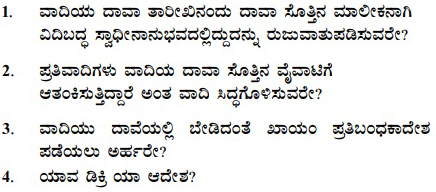
6. In support of plaintiff's case, his grand son was examined as PW.1 as his Power of Attorney and he has also got examined as PW.2. The plaintiff has also relied on seven documents marked at Exs.P1 to P7. Defendant No.5 was examined as DW.5 and defendants have produced Ex.D1.
7. After perusing the oral and documentary evidence, the trial Court has answered issue Nos. 1 to 3 in the affirmative and decreed the suit of the plaintiff. Being aggrieved by this judgment of the trial Court, the defendants 1 to 5 have approached the learned Senior Civil Judge, Sagar, in RA No.61/2001. The learned Senior Civil Judge, after re-appreciating the oral and documentary evidence, has allowed the appeal by setting the judgment and decree passed by the trial Court and dismissed the suit of the plaintiff. Being aggrieved by this divergent finding, the plaintiff is before the Court.
8. Heard the arguments advanced by the learned counsel the appellant and the learned counsel for the respondent. Perused the records.
9. Learned counsel for the appellant-Chowdanaika (Respondent No.1(a) in this appeal) would contend that the trial Court has properly appreciated the oral and documentary evidence. But, the First Appellate Court has failed to appreciate the oral and documentary evidence in proper perspective. It is also further contended that the Lower Appellate Court has not considered the Ex.P2 in proper perspective and it is not justified in reversing the findings of the trial Court and hence, it is prayed for al
AI
A party claiming rights over property must establish their genealogical connection to the family and the validity of any documents purporting to affect ownership, particularly in light of registratio....

The main legal point established is that the plaintiff's possession was proved through various documents, and the first defendant had no standing to dispute the partition.

The central legal point established in the judgment is the determination of the nature of the property in question, considering the implications of the Land Ceiling Act and the validity of the family....
The burden of proof in establishing title and possession lies with the plaintiff, and the absence of documentary evidence can weaken the claim. Court auction sales are valid unless challenged.
A claimant must establish legal ownership to obtain an injunction; granting an injunction based on a dismissed declaration suit is contrary to established legal principles.

The burden of proof to establish joint family property lies with the plaintiffs, which remains unchanged even when defendants do not contest the suit.

The plaintiffs must prove that the property is ancestral joint family property, failing which their claim for partition will be dismissed.



An indispensable Tool for Legal Professionals, Endorsed by Various High Court and Judicial Officers
Please visit our Training & Support
Center or Contact Us for assistance

Scan Me!
India’s Legal research and Law Firm App, Download now!


For Daily Legal Updates, Join us on :



 Back to top


