Back
Back





2023 Supreme(Kar) 1209
IN THE HIGH COURT OF KARNATAKA
G.Narendar, C.M.Poonacha, JJ.
Saibanna – Appellant
Versus
Union of India – Respondent
Writ Petition No. 3297 of 2013 (GM-RES)
Decided On : 17-08-2023
H.Jayakara Shetty, Advocate, Vikram Huilgol, Advocate, Kiran Kumar, Advocate, Ragini Ahuja, Advocate, Urmila Pullat, Advocate, B.N.Jagadeesha, Advocate
The judgment establishes that excessive delays in mercy petition consideration and unlawful solitary confinement can lead to the commutation of a death sentence to life imprisonment, reinforcing the necessity of judicial discretion and adherence to constitutional rights.
Headnote:
MERCY PETITION - Death Penalty Commutation - Indian Penal Code, Sec. 303; Constitution of India, Article 21; Prisons Act, 1894, Sec. 30 - The court discussed the unconstitutionality of mandatory death sentences under Sec. 303 of IPC, referencing the Mithu and Bachan Singh cases. It emphasized the importance of judicial discretion in sentencing and the impact of inordinate delays in mercy petition consideration, which violated the petitioner's rights under Article 21. The court also addressed the illegality of solitary confinement without proper legal sanction, leading to the decision to commute the death sentence to life imprisonment.
Fact of the Case:
The petitioner, a 70-year-old death row convict, challenged the rejection of his mercy petition by the President of India. He was convicted for the murder of his wife and daughter, with the trial judge relying on a now-unconstitutional provision of the IPC to impose the death penalty. The petitioner argued that the delay in considering his mercy petition and the conditions of his solitary confinement constituted grounds for commutation of his sentence.
Finding of the Court:
The court found that the delay in the consideration of the mercy petition was excessive and unexplained, violating the petitioner's rights. It also determined that the solitary confinement imposed on the petitioner was illegal and constituted an additional punishment not sanctioned by law. These factors led the court to conclude that the death sentence should be commuted to life imprisonment.
Issues: 1. Whether the inordinate delay in the consideration of the mercy petition constituted a violation of the petitioner's rights. 2. Whether the solitary confinement of the petitioner was lawful and justified. 3. Whether the death sentence should be commuted to life imprisonment based on the circumstances presented.
Ratio Decidendi: The court held that an unexplained and inordinate delay in the consideration of a mercy petition can infringe upon a convict's rights under Article 21 of the Constitution. Additionally, solitary confinement without legal sanction is impermissible and can serve as a basis for commutation of a death sentence.
Final Decision: The court commuted the death sentence of the petitioner to life imprisonment, allowing him the liberty to apply for remission after serving a minimum of 30 years.
JUDGMENT
G.NARENDAR, J. - Heard the learned counsel Smt. Ragini Ahuja appearing on behalf of the petitioner, the learned HCGP Sri Kiran Kumar for respondent Nos.2 to 4, learned CGC Sri Jayakara Shetty for respondent No.1 and the learned Senior counsel Sri Vikram A Huilgol, Amicus Curiae.
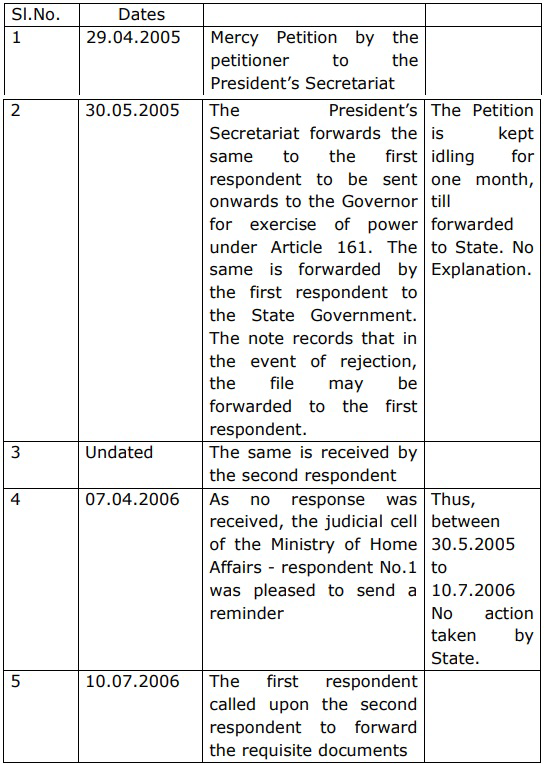
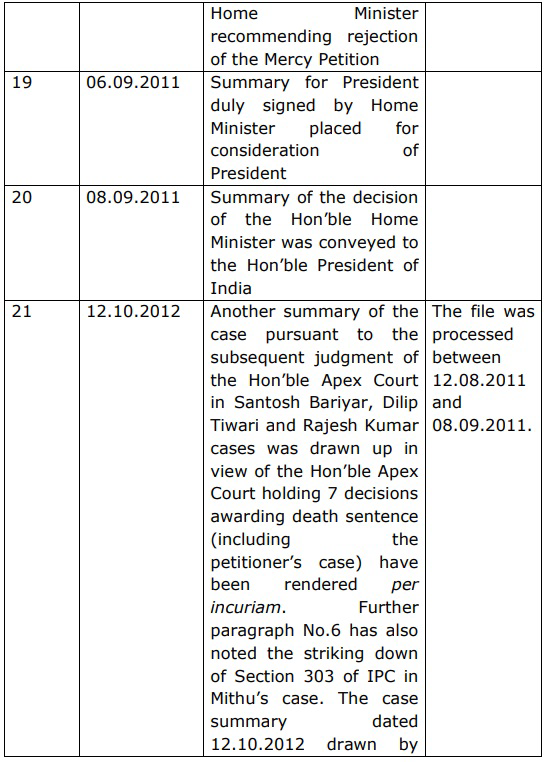
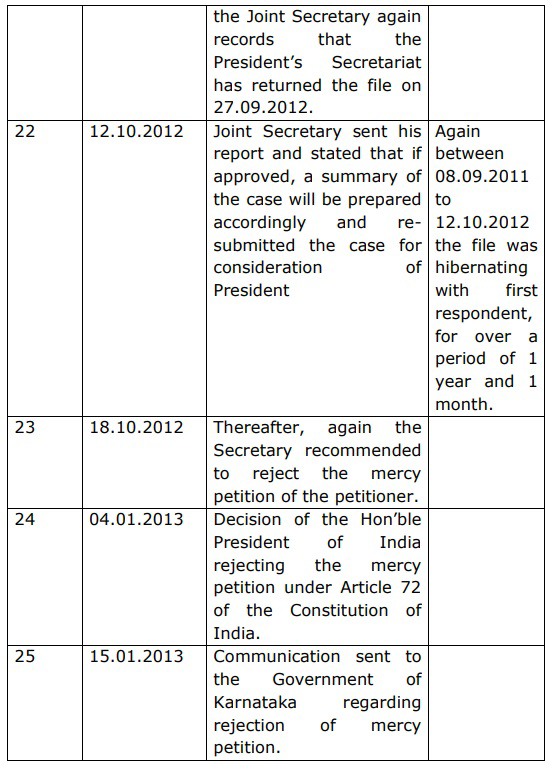
2. Facts in brief - are that the petitioner, a 70 years old death row convict has approached this Court being aggrieved by the rejection of his Mercy Petition dtd. 29/4/2005 by proceedings of His Excellency the President of India dtd. 4/1/2013.
3. The factual matrix of the case is that the petitioner appeared before the jurisdictional Afzalpur Police Station on 9/1/1988 and lodged an FIR stating that he had killed his wife Malkawwa as she was in an illicit relationship with another man and that had greatly disturbed him. The police effected arrest and completed the formalities and he was sent to judicial custody and during his stay, he came in contact with PW-1, one Dattu, who offered the hand of his daughter in marriage after his release. The petitioner was released on bail in S.C.No.32/1988 somewhere around July 1988 and during his stay on bail, the marriage with one Nagamma, daughter of PW-1 ensued and out of the marriage, the petitioner and the said Nagamma begot one girl child by name Vijayalakshmi.
4. On 2/2/1993, the petitioner was convicted and sentenced to undergo imprisonment for life in S.C.No.32/1988. On 19/8/1994, the petitioner was released from prison on parole for a period of one month. On 13/9/1994, the wife Nagamma and daughter Vijayalakshmi were found murdered and the petitioner was found lying on the floor with five life threatening or near fatal injuries, including a grievous injury on the head. The petitioner was admitted to hospital with head injury and stab injury in the abdomen. The petitioner was discharged on 26/9/1994 and the petitioner was arrested and the case came to be registered as S.C.No.11/1995.
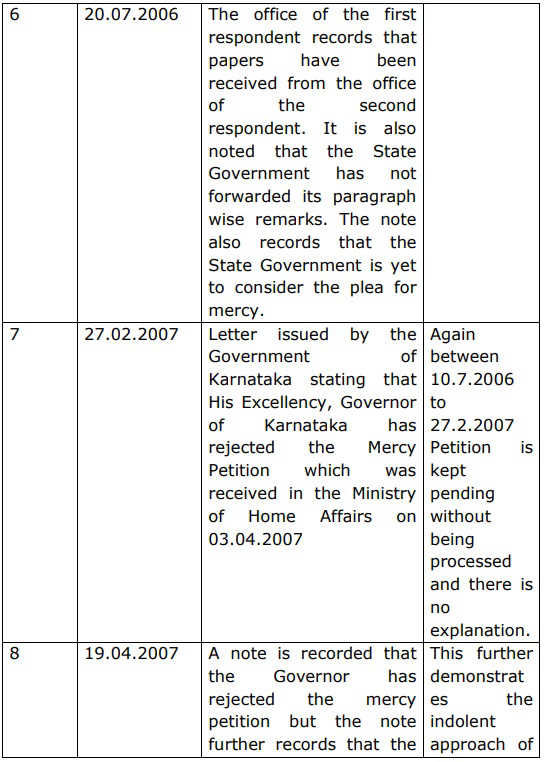
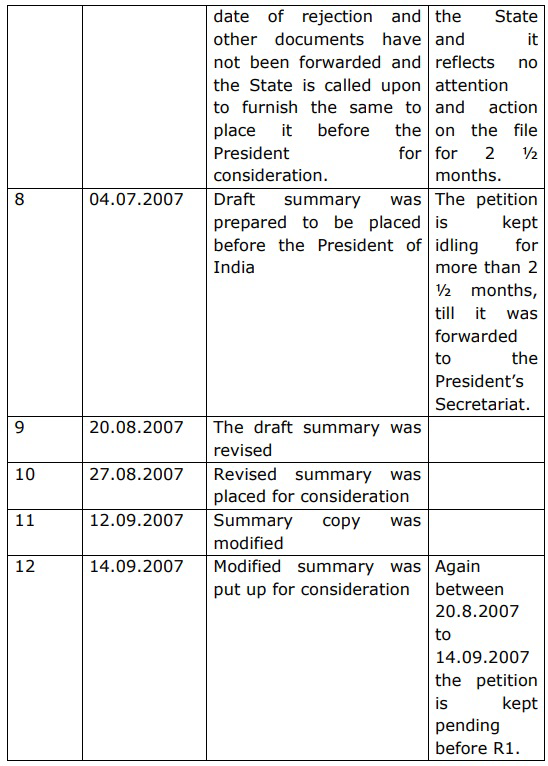
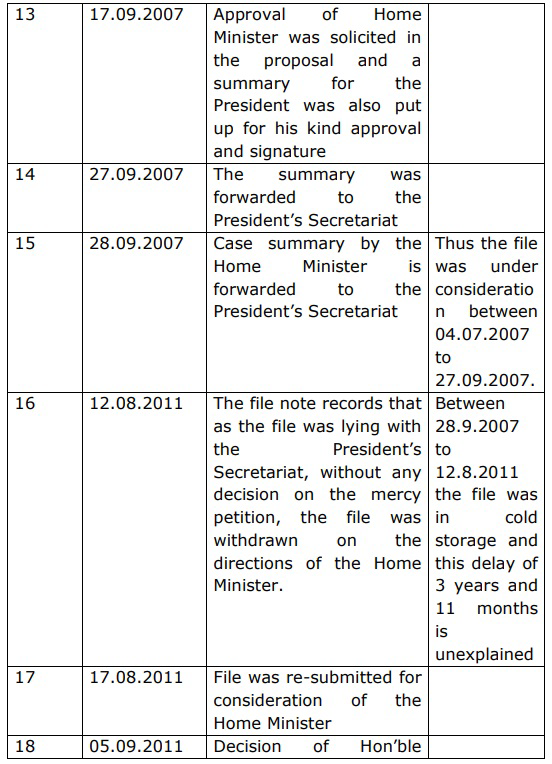
5. Thereafter, trial commenced and a singular charge under Sec. 303 of Indian Penal Code was framed despite the fact that the provision had already been struck down on 7/4/1983 by a Constitutional Bench in Mithu vs. State of Punjab, (1983) 2 SCC 277. During the time of sentencing on 8/1/2003, this fact was brought to the notice of the Trial Judge in S.C.No.11/1995. Nevertheless, the Trial Judge continued to place reliance on the provisions of Sec. 303 of IPC and proceeded to impose the maximum penalty of death sentence in terms of a non-existent provision of law. The Criminal Appeal No.497/2003 was preferred by the petitioner while in custody and hence, the Division Bench appointed an Amicus Curiae and after hearing, the Bench delivered the unanimous verdict with regard to the guilt but delivered a split verdict while answering the reference in Crl. R. C. No.2/2003. While the Senior Judge opined that it was not one of the rarest of rare case, the Companion Judge opined otherwise and upheld the imposition of the maximum punishment of death sentence. The matter was referred to a third Judge and the learned third Judge, after hearing, was pleased to pass a judgment affirming the view of the Companion Judge. Pursuant to the views of the third Judge, the Criminal Reference case No.02/2003 came to be answered in the affirmative on 10/10/2003 and the judgment of conviction and the death sentence passed by the learned Sessions Judge, Gulbarga came to be upheld and the Criminal Appeal came to be rejected. Further, the sentence was suspended by four months and leave was granted to appeal in the Hon'ble Apex Court. The Hon'ble Apex Court was pleased to dismiss the petitioner's appeal on 21/4/2005 and the case came to be reported in (2005) 4 SCC 165.
6. The petitioner addressed a Mercy Petition on 29/4/2005. It was inadvertently addressed to the Union Government and the Union Government sent the Mercy Petition back on 30/5/2005 as the Mercy Petition was first required to be looked into by the Governor of the State. The mercy petit