
 Back
Back





IN THE HIGH COURT OF KARNATAKA
Rajendra Badamikar, J.
Anthuriah – Appellant
Versus
Revanna – Respondent
Regular Second Appeal No. 2362 of 2008(Dec)
Decided On : 05-09-2023
PROPERTY DISPUTE - OWNERSHIP AND INJUNCTION - Transfer of Property Act, 1882 - Sec. 123; Indian Evidence Act, 1872 - Sec. 90; Code of Civil Procedure, 1908 - Sec. 100 - The court analyzed the legal requirements for a valid gift under Sec. 123 of the Transfer of Property Act, emphasizing the necessity of acceptance by the donee and the need for the original gift deed to establish its validity. The court found that the plaintiff failed to produce the original gift deed and did not demonstrate acceptance, leading to the conclusion that the gift was not legally valid. The court also highlighted the importance of proper evidence in establishing ownership and possession, ultimately influencing its decision to dismiss the plaintiff's suit.
Fact of the Case:
The plaintiff sought a declaration of ownership and permanent injunction against the defendants regarding a property claimed to be part of his family's ancestral land. The defendants contended that the property was their ancestral property and had been sold to a third party. The trial court ruled in favor of the plaintiff, which was upheld by the appellate court, prompting the defendants to appeal.
Finding of the Court:
The court found that the plaintiff failed to prove the validity of the gift deed on which his claim was based. The absence of the original gift deed and the lack of evidence regarding acceptance of the gift led to the conclusion that the plaintiff could not establish his ownership or right to the property.
Issues: Whether the courts below were justified in decreeing the suit based on the gift deed when the plaintiff failed to prove its validity and acceptance.
Ratio Decidendi: The court held that the burden of proof lies with the plaintiff to establish his claim. The failure to produce the original gift deed and the lack of evidence regarding acceptance rendered the claim invalid. The courts below erred in their appreciation of evidence, leading to a miscarriage of justice.
Final Decision: The appeal was allowed, and the judgments of the lower courts were set aside, resulting in the dismissal of the plaintiff's suit.
JUDGMENT
1. This Regular Second Appeal is filed by the defendants under Sec. 100 of the Code of Civil Procedure, 1908 challenging the judgment and decree passed by Civil Judge, (Jr.Dn.), Tumkur in O.S.No.781/1993 and confirmed by the Presiding Officer, Fast Track Court-III, Tumkur in R.A.No.7/2007.
2. For the sake of convenience, the parties herein are referred with original ranks occupied by them before the trial Court.
3. The brief factual matrix leading to the case are as under: The plaintiff has filed the suit seeking declaration that he is the owner of the suit schedule property and FOR permanent injunction against defendants. According to the plaintiff, the suit schedule property is 1 acre 3 guntas out of 3 acres 6 guntas situated in Sy.No.5/1A in Kesaramadu Village with specific boundaries referred in the schedule. That the plaintiff is in possession and enjoyment of the suit schedule property and it is the property of his family. That suit property was originally in possession of the family of the plaintiff and after the death of his father, he is in possession. It is asserted that the suit property was earlier was part of Sy.No.5 and it was totally measuring 4 acres and 7 guntas and on 1/2/1958 Karesiddaiah and Revaiah sons of Ananthuraiah gifted an extent of 2 acres and 3 guntas out of the said land in favour of brother of the father of the plaintiff. It is asserted that since, the date of the gift, father of the plaintiff and his uncle were in possession of the gifted land and they sold 1 acre 3 guntas out of the gifted land in favour of one Jayanarasimhaiah and remaining land in Sy.No.5 was partitioned between Revaiah and Karesiddiah together in respect of 3 acres 6 guntas of land was given new Sy.No.5/1A. It is asserted that the property was partitioned between the father of the plaintiff and his uncle and suit property has fallen to the share of the plaintiffs. He asserts that the defendant has no right, title or interest over the suit schedule property. By taking advantage of the fact that the defendants possess some small portion in suit survey number colluding with each other trying to evict the plaintiff from the suit property. The defendants have no right, title or interest to sell the suit schedule property to defendant No.6 and sale deed executed by defendant Nos.1 to 5 in favour of defendant No.6 is not binding on the plaintiff. Hence, plaintiff claims that he is compelled to file this suit. Initially, the suit for bare injunction was filed, but subsequently, the plaint was got amended by incorporating the relief of declaration.
4. After registration of the suit, the suit summons have been issued to the defendants and defendants have appeared through their counsel and filed their written statement denying the allegations and assertions made in the plaint. It is denied that the plaintiff is in possession of the suit schedule property and it is asserted that the suit schedule property is the ancestral property of defendants No.1 to 5 and they acquired the same as legal heirs. It is asserted that defendants No.1 to 5 sold the suit schedule property in favour of defendant No.6 and they were in possession of the same till the sale and thereafter, defendant No.6 is in possession and sale deed was executed on 24/8/1993. It is asserted that the defendant No.6 after purchase submitted an application to revenue authorities to enter his name, which was objected by the plaintiff and matter is pending. It is asserted that the plaintiff is no way concerned with the family of the defendants and hence, they have sought for dismissal of the suit.
5. On the basis of these pleading, the trial court framed the following four issues and two additional issues:
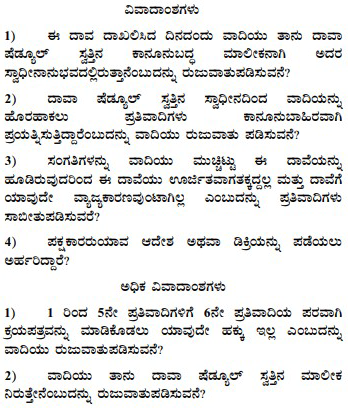
6. The plaintiff was got examined himself as PW1 and two witnesses were examined on behalf of the plaintiff as PW2 and PW3 and plaintiff has placed reliance on 20 documents marked at Ex.P1 to Ex.P20. Thereafter, defendant No.4 was examined as DW1 and one witness was exami
AI
A gift under Sec. 123 of the Transfer of Property Act requires acceptance by the donee and the original gift deed must be produced to establish its validity; failure to do so undermines the claim of ....

In a suit for declaration of title, the burden of proof lies on the plaintiff to establish a clear case for granting such relief, not on the weaknesses of the defendant's case.

Title and ownership claims in property disputes necessitate credible documentation; statutory presumptions apply to documents over 30 years old.

The court established that an oral gift requires clear proof of declaration, acceptance, and delivery of possession to be valid, which was not met in this case.
The jurisdiction of the High Court in second appeals is limited to substantial questions of law, and it will not interfere with concurrent findings of fact unless such questions arise.
A gift deed is ineffective if the donor lacks title to the property, as established by evidence indicating a prior family partition.
The plaintiff must succeed on his own strength and not on the weaknesses of the defendant.
Ownership established through title documentation is pivotal in determining rightful possession; injunctions are warranted when prima facie evidence supports legal entitlement.
The plaintiff failed to prove joint ownership of the property or contribution to its acquisition, affirming that self-acquired property cannot be claimed as joint without evidence.



An indispensable Tool for Legal Professionals, Endorsed by Various High Court and Judicial Officers
Please visit our Training & Support
Center or Contact Us for assistance

Scan Me!
India’s Legal research and Law Firm App, Download now!


For Daily Legal Updates, Join us on :



 Back to top


