
 Back
Back





IN THE HIGH COURT OF KARNATAKA BENCH AT KALABURAGI BENCH
E.S.Indiresh, J.
Uttam & Anr. – Appellants
Versus
Dattatreya & Ors. – Respondents
Regular Second Appeal No. 200339 of 2019
Decided On : 12-02-2024
PROPERTY LAW - Partition and Share in Ancestral Property - CPC Section 100 - The court examined the legal provisions regarding the sale of joint family property and the necessity for such sales. It highlighted that a sale by a family member must be for legal and family necessities to be valid against other family members. The court found that the sales in question were not justified as necessary, leading to the conclusion that the plaintiffs were entitled to their shares in the ancestral property.
Fact of the Case:
The plaintiffs, children of defendant No.1, claimed entitlement to a share in ancestral properties after defendants No.2 and 4 entered their names in the record of rights. The plaintiffs sought partition and separate possession, asserting that the properties were ancestral and that the sales made by defendant No.1 were not for legal necessity.
Finding of the Court:
The trial court ruled in favor of the plaintiffs, granting them a 1/5th share each in the properties. The appellate court confirmed this decision, finding that the sales by defendant No.1 were not justified as being for family or legal necessities.
Issues: Whether the properties sold by defendant No.1 were for family and legal necessities, and whether the lower courts were justified in their findings regarding the sales.
Ratio Decidendi: The court emphasized that a sale of joint family property must be for legal necessity to be valid against other family members. The evidence presented did not support the claim that the sales were necessary, as defendant No.1 had cleared a loan shortly before the sales, indicating financial stability.
Final Decision: The Regular Second Appeal was dismissed, affirming the lower courts' decisions that the plaintiffs were entitled to their shares in the ancestral property.
JUDGMENT
1. This appeal is filed by the defendant No.2 and 4 challenging the Judgment and Decree dated 11.07.2019 passed in R.A.No.53 of 2016 on the file of Senior Civil Judge and JMFC, Indi, Vijayapura District, confirming the Judgment and Decree dated 01.10.2016 in O.S.No.313 of 2009 on the file of Civil Judge and JMFC, Indi, holding that the plaintiffs No.1 to 4 are entitled for 1/5th share each in respect of suit lands.
2. For the sake of convenience, the parties in this appeal shall be referred to in terms of their status and ranking before the trial Court.
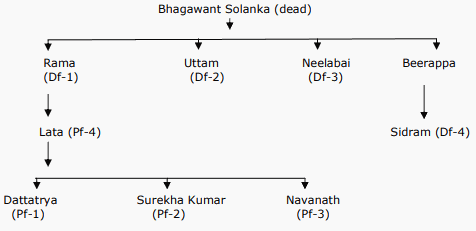
3. The plaint averments are that plaintiffs No.1 to 3 are the children of defendant No.1 and plaintiff No.4. It is the case of the plaintiffs that the suit schedule properties are the ancestral properties of plaintiffs. It is further stated that, the contesting defendants No.2 and 3 who are the brother and sister of defendant No.1, got entered their names in the record of rights. It is also stated that the defendant No.4 also managed to get enter his name in the record of rights and feeling aggrieved by the same, the plaintiffs have filed suit in O.S. No.313 of 2009 seeking relief of partition and separate possession in respect of suit schedule properties.
4. After service of notice, the defendant Nos. 1 and 4 entered appearance and filed written statement. Defendant Nos. 2 and 3 have not appeared and placed ex-parte. It is the specific case of defendant No.1 that the defendant No.1 was suffering from tuberculosis and was on prolonged treatment and as such, the defendant No.1 sold the schedule property in favour of defendant Nos.2 and 4 and accordingly, they sought for dismissal of the suit.
5. On the basis of the rival pleadings, the trial Court has formulated issues for its consideration.
6. In order to establish their case, plaintiff No.1 was examined as PW1 and got marked 09 documents as Exs.P1 to P9. On the other hand, defendants have examined two witnesses as DW1 and DW2 and produced 20 documents as Exs.D1 to D20.
7. The Trial Court, after considering the material on record, by its Judgment and Decree dated 01.10.2016 decreed the suit of the plaintiffs holding that the plaintiff Nos.1 to 4 are entitled for 1/5th share each in the suit schedule properties and being aggrieved by the same, the defendants Nos.2 and 4 have preferred Regular Appeal in R.A.No.53 of 2016 on the file of First Appellate Court. The said appeal was resisted by the plaintiffs. The First Appellate Court, after re-appreciating the facts on record, by its Judgment and Decree dated 11.07.2019, dismissed the appeal and confirmed the Judgment and Decree passed by the Trial Court in O.S.No.313 of 2009. Being aggrieved by the same, the appellants/defendant No.2 and 4 have preferred this Regular Second Appeal under Section 100 of CPC.
8. This Court vide order dated 29.01.2024 formulated the following substantial question of law for its consideration:
"(i) Whether the properties sold by defendant No.1 in favour of defendants No.2 and 4 is for family and legal necessities?
(ii) Whether both the Courts below were justified in arriving at a finding that the lands in question are not sold for family and legal necessities?"
9. I have heard Sri. D.P. Ambekar, learned counsel appearing for the appellants and respondents are served but remained absent.
10. Sri D.P. Ambekar, learned counsel for the appellants contended that both the Courts below have not properly appreciated the evidence on record that the schedule properties were sold by defendant No.1 for his legal and family necessity and in this regard the medical documents have been produced before the Trial Court and therefore, he contended that the impugned Judgment and Decree passed by the Courts below requires to be interfered with.
He further submitted that, the defendant No.1 being the Kharta of the family has every right to alienate the joint family properties for legal necessity of his medical treatment and accordingly, he sought for interference of this Court.
AI
A sale of joint family property by a family member must be for legal necessity to be valid against other family members; failure to establish such necessity invalidates the sale.

Equal birth rights of daughters in ancestral properties and the burden of proving legal necessity for property transactions.

The burden of proving legal necessity for the alienation of ancestral property lies on the alienee, and the transaction must be for the family's benefit, binding all undivided family members.
The Karta's sale of joint family property for legal necessity is binding on all family members, limiting liability to the specific item sold.
The validity of a sale deed executed by a Hindu Undivided Family member is upheld when legal necessity is demonstrated, despite claims of ancestral rights by co-parceners.

In joint family property disputes, a guardian may transact on behalf of minors without court sanction, provided sales serve family interests.

The main legal point established is the application of Sec. 41 of the Transfer of Property Act, the exclusion of contrary evidence, and the principles of Hindu Law regarding co-parcenary property and....
The court reaffirmed that a sale deed executed for family and legal necessity by a joint family member is binding, barring challenge by family members after significant delay without sufficient cause....

An alienation of joint family property by the Karta is void ab initio in absence of legal necessity, necessitating partition among all co-sharers.



An indispensable Tool for Legal Professionals, Endorsed by Various High Court and Judicial Officers
Please visit our Training & Support
Center or Contact Us for assistance

Scan Me!
India’s Legal research and Law Firm App, Download now!


For Daily Legal Updates, Join us on :



 Back to top


