
 Back
Back





IN THE HIGH COURT OF KARNATAKA
P.S. Dinesh Kumar, C.M. Poonacha , JJ.
Sumithramma and ors. - Appellants
Versus
N. Venkataraman and ors. – Respondents
R.F.A No.2009 of 2011 (PAR)
Decided On : 31-08-2023
| Table of Content |
|---|
| 1. factual background of inheritance and partition (Para 3 , 4 , 5 , 6) |
| 2. defendants' resistance and claims against plaintiffs (Para 7 , 9 , 10 , 11) |
| 3. trial court's rationale for dismissing the suit (Para 18 , 19 , 24) |
| 4. recognition of daughters as coparceners (Para 31 , 32) |
| 5. decision to allow appeal and grant shares (Para 35 , 36) |
JUDGMENT :
P.S. Dinesh Kumar, J.
This appeal by the plaintiffs is directed against the judgment and decree dated September 09, 2011 in O.S. No. 6319/1994 passed by the I Additional City Civil and Sessions Judge, Bangalore, dismissing the suit for partition and separate possession.
2. For the sake of convenience, parties shall be referred as per their status before the Trial Court.
3. Plaintiff's case is, one Adappa was the propostius of the family. He had three sons namely Ashwathappa, Narayanaswamappa and Hanumanthappa. After Adappa's death, the joint family properties were divided among his sons vide partition deed dated October 24, 1957. The family tree is as follows:
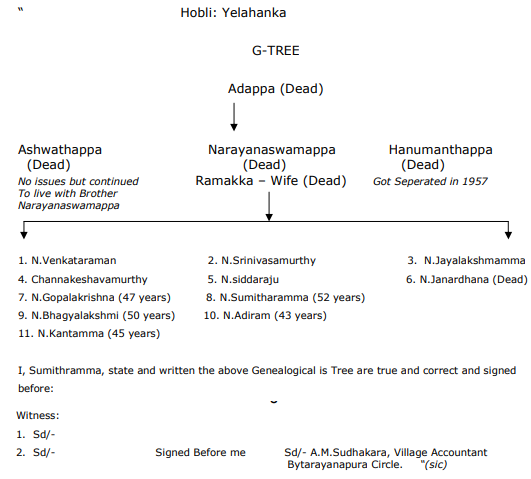
I, Sumithramma, state and written the above Genealogical is Tree are true and correct and signed before:
Witness:
1. Sd/-
2. Sd/-
Signed Before me
Sd/- A.M.Sudhakara, Village Accountant
Bytarayanapura Circle. "(sic)
4. Aswathappa and Narayanaswamappa continued to enjoy their share in properties jointly whereas Hanumanthappa separated himself from the joint family. Plaintiff No.1 and Defendants No. 1 to 6 are the sons of Narayanswamappa and Plaintiffs No. 2 to 5 are his daughters. Ashwathappa had two wives namely Gangamma and Venkatanarasamma, and they had no issues.
5. Narayanswamappa and Ashwathappa died intestate on December 25, 1975 and July 21, 1978 respectively. Gangamma and Venkatanarasamma died on March 2, 1985 and October 03, 1991 respectively. The first defendant namely N.Venkatram acted as Karta of the joint family and he was managing the suit properties.
6. When the plaintiffs demanded partition of the properties jointly belonging to Ashwathappa and Narayanswamappa, the first defendant did not accede to their demand. Defendants No. 1 to 5 were making efforts to alienate the schedule properties and deprive plaintiffs of their legitimate shares. Hence, plaintiffs brought the instant suit for partition and separate possession.
7. The first defendant resisted the suit by filing written statement. In the written statement he has admitted the relationship between the parties and also the partition dated October 24, 1957. He has contented inter alia that the suit properties are coparcenery family properties of the first plaintiff and the defendants. As a kartha of the joint family, he had managed the properties till April 13, 1985 and thereafter parties were living separately. He has denied the allegation that he and other defendants had deprived the plaintiffs of their share in the property. He could not accept the demand for partition by the plaintiffs as he had ceased to be the Karta and his attempts to partition the joint family properties were opposed by other defendants.
8. His further case is, item No.22 of the schedule property is the self-acquired property of Ashwathappa and subsequent to his death, his wives Gangamma and Venkatanarasamma have filed a declaration, by virtue of which he had become the absolute owner of the said property. Item No.9 of the schedule property was sold by first defendant for the benefit of family and the said sale was within the knowledge of the first and seventh plaintiffs. First defendant is the absolute owner of Items No. 3, 9, 17 and 24.
9. The second and fourth defendants filed a common written statement resisting the suit. The relationship between the parties and partition in the year 1957 is admitted. They have denied that, subsequent to Ashwathappa's death, the properties of Ashwathappa and Narayanswamappa were enjoyed together as joint family properties. Plaintiffs No. 2 to 5 were married long time back and they are not members of joint family. The properties which belonged to Nara
AI
The main legal point established in the judgment is that unless prior partition is established, there shall be a presumption that the property is joint family property, and a family arrangement in th....
Previous family partition and lack of joint family status preclude the plaintiff from claiming coparcenary rights under Hindu law amendments.
Daughters have equal rights and shares in ancestral joint family properties under Section 6 of the Hindu Succession Act, 1956, as amended by the Hindu Succession (Amendment) Act, 2005.

Daughters have equal rights as coparceners in ancestral property under the Hindu Succession Act as amended in 2005, affecting share distribution in partition cases.

The court affirmed that ancestral property remains so despite partition, and daughters are entitled to equal shares under the Hindu Succession Act, 1956, as amended.

The court reaffirmed that daughters have equal rights as sons in ancestral properties, emphasizing the applicability of Section 6 of the Hindu Succession Act.



An indispensable Tool for Legal Professionals, Endorsed by Various High Court and Judicial Officers
Please visit our Training & Support
Center or Contact Us for assistance

Scan Me!
India’s Legal research and Law Firm App, Download now!


For Daily Legal Updates, Join us on :



 Back to top


