
 Back
Back





IN THE HIGH COURT OF KARNATAKA AT BENGALURU
K.S. Hemalekha, J.
P.C. Manjula W/O K. Narayan And Ors. - Appellants
Versus
Smt. Jayamma, W/o Late Kallaiah - Respondents
Regular First Appeal No.1704 of 2023 (PAR)
Decided On : 02-09-2025
JUDGMENT :
K.S. Hemalekha, J.
The present appeal is preferred by the plaintiffs assailing the judgment and decree dated 18.07.2023 in O.S.No.2161/2012 on the file of the VII Additional City Civil and Sessions Judge (CCH-19), Bengaluru (‘trial Court’ for short) in so far as rejecting their claim over suit item Nos. 2 to 5 of the suit schedule properties. By the judgment and decree, the trial Court decreed the suit of the plaintiff seeking relief of partition and separate possession in respect of item No.1 of the suit schedule properties.
Plaint averments
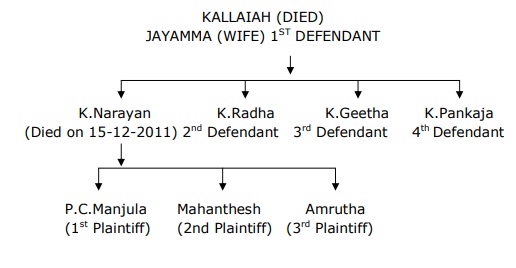
2. Plaintiff No.1 is the wife of Late K Narayan, plaintiffs 2 and 3 are their children. Narayan was the son of Late Kallaiah and Jayamma (defendant No.1). Defendants 2 to 4 (Radha, Geetha and Pankaja) are the daughters of Kallaiah and Jayamma. It is averred that Kallaiah had acquired several properties from joint family nucleus. Item No.1 was purchased in his name and is claimed to be the joint family property. Kallaiah died intestate, leaving behind his widow-defendant No.1 and four children (including Narayan) as his legal heirs. That item No.2 was sold by defendant No.1 under a registered sale deed dated 13.12.2006 in favour of defendant No.2 (Radha). Item No.3 was purchased in the name of defendant No.3 (Geetha) under a registered sale deed dated 16.10.2003, acquired from joint family income. Item No.4 was gifted by defendant No.1 to defendant No.4 (Pankaja) under a registered gift deed dated 11.12.2006. Plaintiffs assert that item Nos. 1 to 4 were all purchased from the income of joint family nucleus, and were enjoyed by Narayan along with defendants 1 to 4 as joint family properties. After Narayan’s death, plaintiffs and defendants 1 to 4 continue to enjoy them as joint family properties, and the plaintiffs are entitled to partition and separate possession of their share.
Written statement averments
3. The relationship between the parties is admitted. It is averred that Kallaiah died intestate in 1992, leaving behind his widow-Jayamma, his son Narayan (husband of plaintiff No.1), and daughters-Radha, Geetha and Pankaja (defendants 2 to 4). It is averred that at the time of death of Kallaiah, daughters were minors. Further, that except item No.1 property, there was no other immovable or movable properties left by Kallaiah. It is averred that defendant No.1 bore the entire responsibility of the family, she was working in household, raised her daughters and supported the family without any financial or mental support from others. That Narayan worked as an auto driver, but after his marriage, did not contribute a single paise to support defendant No.1 or the household. The relations between Narayan and plaintiff No.1 was strained, they lived separately near plaintiff No.1 mother’s house. That the plaintiffs are making false claim over the suit property. It is averred that item No.1 is Kallaiah’s property and item Nos. 2 and 3 are the self acquired property purchased from the own earnings of defendant No.2 and defendant No.3, defendant No.4 acquired item No.4 by a gift deed executed in her favour by defendant No.1. The defendants specifically averred that item Nos.2 to 4 do not form joint family estate, maintaining that they are self acquired by the defendants.
4. The trial Court held that,
(i) item No.1 was self acquired property of Kallaiah, devolving on his heirs under Section 8 of the Hindu Succession Act, 1956 (‘ HSA ’ for short) and the plaintiffs are entitled for 1/5th share therein.
(ii) item Nos. 2 to 4 were held not to be the joint family properties since plaintiffs failed to prove joint family nucleus.
(iii) item No.5 were also disbelieved for want of proof.
(iv) Mesne profits in respect of item No.1 were reserved for final decree enquiry.
Accordingly, the suit was partly decreed only in respect of item No.1.
5. Aggrieved, the plaintiffs are before this Court in so far as rejection of claim in respect of item Nos. 2 to 5.
6. Learned counsel appearing for the appellant submits tha
The establishment of a joint family nucleus shifts the burden of proof to defendants to demonstrate that properties were self-acquired and not purchased with joint family funds.

The burden of proof rests on the party claiming property as joint family property to establish its character, particularly where self-acquisition is asserted without evidence of blending with ancestr....


Properties registered in individual names may still be classified as joint family properties if purchased from joint family income, and the defendant bears the burden to prove otherwise.
In joint family property disputes, a claimant asserting self-acquisition must provide substantial proof, while joint ancestral claims are upheld unless clearly disproven.

The courts erred in determining property status, failing to recognize that once a joint family is established, the burden shifts to defendants to prove self-acquisition.
The presumption of joint family property applies unless proven otherwise, and the burden of proof lies on the party asserting separation.

The plaintiff must prove the existence of a joint family nucleus to establish claims over joint family properties; mere relation does not imply entitlement.

(1) Hindu Law – Partition – After joint family property has been distributed in accordance with law, it ceases to be joint family properties and shares of respective parties become their self-acquire....



An indispensable Tool for Legal Professionals, Endorsed by Various High Court and Judicial Officers
Please visit our Training & Support
Center or Contact Us for assistance

Scan Me!
India’s Legal research and Law Firm App, Download now!


For Daily Legal Updates, Join us on :



 Back to top


