
 Back
Back





IN THE HIGH COURT OF KERALA AT ERNAKULAM
EASWARAN S., J.
Haridasan S/o. Thekeveluthedath Bhavaniamma - Appellant
Vs.
Padmavathi Amma W/o. Thekeveluthedath Achuthan Nair - Respondent
RSA NO. 7 OF 2013
Decided On : 11-06-2025
| Table of Content |
|---|
| 1. background of partition suit and property claims. (Para 1 , 2 , 3 , 4 , 5) |
| 2. arguments presented by both parties regarding property ownership. (Para 6 , 7 , 8) |
| 3. court's analysis on joint family property and evidence. (Para 9 , 10 , 11 , 12 , 13 , 14 , 15 , 16 , 17 , 18 , 19 , 20) |
| 4. discussion on marumakkathayam law and property acquisition. (Para 21 , 22 , 23 , 24 , 25 , 26 , 27 , 28 , 29 , 30 , 31 , 32) |
| 5. final considerations and conclusions regarding property ownership. (Para 33 , 34 , 35 , 36 , 37 , 38) |
JUDGMENT :
EASWARAN S., J.
The plaintiff in a suit for partition concurrently non-suited by the Trial Court as well as the First appellate Court, is before this Court contending that both the courts appreciated the evidence and law involved in the case perversely, thereby giving rise to a substantial question of law for consideration of this Court.
Brief facts of the case.
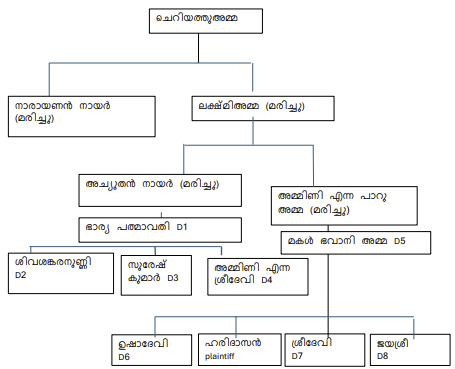
2. OS No.74 of 2005 was instituted by the appellant/plaintiff seeking partition of the plaint schedule properties. According to the plaintiff, item No.1 of the plaint B schedule property originally belongs to one Cheriyathu Amma. She was the great grandmother of the plaintiff, defendant Nos.6 to 8 and the mother of late Laskhmi Amma, who is the grandmother of 5th defendant. Smt. Laskhmi Amma had two children, Achuthan Nair and Ammini Amma. The 5th defendant Bhavani Amma is the daughter of Ammini Amma. Ammini Amma predeceased Lakshmi Amma. Item No.1 of the plaint schedule property was obtained by Laskshmi Amma as per the purchase certificate pursuant to the suo moto proceedings No.8770/1967 of the Land Tribunal, Ottappalam. Since item No.1 of the plaint B schedule is ancestral property as well as Thavazhi property, the plaintiff is entitled to the right over the same by birth. Item No.2 of the plaint schedule property was obtained by the father of the plaintiff, the 7th and 8th defendants and also by the husband of the 5th defendant, one Madhavan Nair. After the death of Madhavan Nair, item No.2 of the plaint schedule property jointly belongs to the plaintiff and defendant Nos. 5,7 and 8.
3. The defendants entered appearance and contested the suit by raising a contention that the plaintiff is not entitled to a decree for partition on item No.1 since the plaint schedule property had devolved upon Smt. Lakshmi Amma in her individual capacity and she did not possess the property for and on behalf of the Tharavadu. Since it is an independent acquisition of Smt. Laskhmi Amma and later devolved upon the 5th defendant by inheritance through Ammini Amma and also Ext.B1 Will on 20.9.1987, she is the absolute owner of the property. On behalf of the plaintiff, Exts.A1 to A7 documents were marked and PW1 was examined. On behalf of the defendants, Exts.B1 to B4 documents were marked and DW1 and DW2 were examined. The trial court on the basis of the pleadings and documents on record, framed the following issues:
1. Whether item No.1 in the plaint B-schedule is ancestral property?
2. Is there any genuine will in favour of D5 as claimed in the written statement?
3. Whether item No.1 in plaint B-schedule is partible? 4. Whether item No.2 in plaint B-schedule is partible?
5. What order as to relief and costs?
4. On consideration of the rival pleadings, the trial court held that the plaintiff failed to prove that item No.1 of plaint B schedule property was an ancestral property that devolved upon the Thavazhi of Lakshmi Amma. Accordingly, the suit was decreed in part, finding that item No.2 alone is partible. While arriving at such finding, the trial court found that the reliance placed by the plaintiff on Ext.A2, the report of the village officer which evidenced that Lakshmi Amma was the “Karanavathi”of the family was fraudulently prepared in as much as there was interpolation of the ink while entering the fact that deceased Lakshmi Amma was the “Karanavathi” of the family. Though, the plaintiff sought to prove Ext.A2 by producing the entire records relating to the
The courts erred in determining property status, failing to recognize that once a joint family is established, the burden shifts to defendants to prove self-acquisition.

The presumption of joint family property applies unless proven otherwise, and the burden of proof lies on the party asserting separation.

The plaintiff must prove the existence of a joint family nucleus to establish claims over joint family properties; mere relation does not imply entitlement.

Under Marumakkathayam law, property obtained by a female and her children in partition retains its tharwad characteristics, ensuring rights for future descendants.

The burden of proof lies on asserting self-acquisition when joint family property is claimed, as evidenced in the judgment affirming the trial court's findings on property character.


The court affirmed that partition of family properties had occurred prior to 1942, establishing individual ownership rights over properties acquired post-partition, thereby negating claims of joint f....



An indispensable Tool for Legal Professionals, Endorsed by Various High Court and Judicial Officers
Please visit our Training & Support
Center or Contact Us for assistance

Scan Me!
India’s Legal research and Law Firm App, Download now!


For Daily Legal Updates, Join us on :



 Back to top


