
 Back
Back





IN THE HIGH COURT OF KARNATAKA AT BENGALURU
V. SRISHANANDA, J.
Shivarudregowda @ Shivanna S/o Late Mallegowda - Appellant
Vs.
Mallappa S/o Late Channabasavaiah - Respondent
R.F.A.No.1320 of 2007
Decided On : 10-12-2025
| Table of Content |
|---|
| 1. factual background of property dispute (Para 2 , 4 , 5 , 6 , 8 , 9) |
| 2. defendants' arguments and counterclaims (Para 10 , 11 , 12 , 13 , 14) |
| 3. ratio decidendi related to mortgage and property claims (Para 49 , 61) |
| 4. court's reasoning on property ownership and limitations (Para 51 , 52 , 53 , 56 , 60 , 62 , 63 , 64) |
| 5. final order of dismissal (Para 67) |
JUDGMENT :
(PER: HON'BLE MR JUSTICE V SRISHANANDA)
Heard Sri Sumantha S., learned counsel representing Sri P.B. Appaiah, counsel for the appellants. None represents the respondents.
2. Unsuccessful plaintiffs are the appellants before this Court challenging the validity of judgment and decree passed by the Principal Civil Judge (Sr.Dn), Hassan in O.S.No.183/2001, dated 26.02.2007.
3. Parties are referred to as plaintiffs and defendants for the sake of convenience as per their original ranking before the trial Court.
4. Facts in the nutshell which are utmost necessary for disposal of the present regular first appeal are as under:
4.1. A suit for declaration came to be filed by the plaintiffs in respect of the following properties (hereinafter referred to as ‘suit properties’) and also holding that redemption of mortgage in favour of defendant No.2 in respect of suit property will not bind the plaintiffs. Further, declare that the sale deed dated 10.02.1976 in favour of defendant No.1 by defendant No.2 does bind the plaintiffs and also for possession.
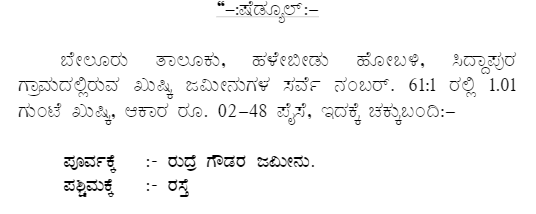
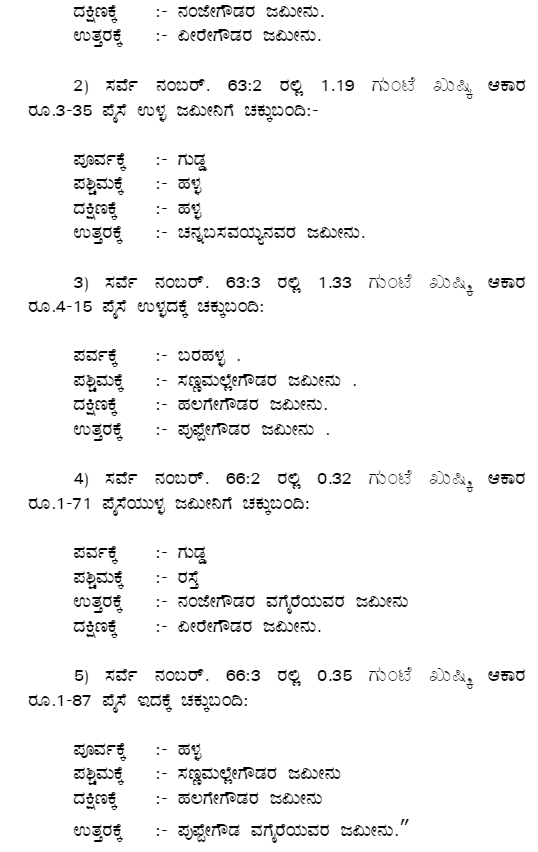
4.2. Suit properties are the agricultural land situated at Siddapura village, Halebeedu Hobli, Beluru Taluk, which belonged to the plaintiffs.
4.3. It is the contention of the plaintiffs that Veerabhadregowda - grandfather of the plaintiffs has got three sons by name Puppegowda, Channegowda and Mallegowda. First son Puppegowda died without marriage. Second son Channegowda is the father of defendant No.2 and third son Mallegowda has got two children namely, Shivarudregowda, who is plaintiff No.1 and Veerabhadregowda. Said Veerabhadregowda died as a bachelor.
5. Plaintiffs further contended that suit properties and three other items of properties had fallen to the share of father of plaintiff No.1 and Puppegowda in the year 1940-41. After death of Puppegowda, father of plaintiff No.1 and other plaintiffs and his brother Veerabhadregowda were jointly enjoying the suit properties.
6. Plaintiff No.1 and his brother Veerabhadregowda for their family necessity, executed a sale deed in favour of Mallegowda @ Kullegowda on 28.07.1952. According to plaintiffs, said sale deed was a nominal sale deed and it was executed for security for the loan amount borrowed by plaintiff No.1 and his brother Veerabhadregowda. Brother of plaintiff No.1 Veerabhadregowda was looking after the suit properties and three other properties. Veerabhadregowda again purchased the suit properties on 28.06.1954 from Mallegowda and he mortgaged the said property to one Sannamallegowda in a sum of Rs.200/-. Subsequently plaintiff No.1 and his brother discharged the loan and they are in possession and enjoyment of the said property.
7. Plaint averments further reveal that despite sufficient difficulty to discharge the loan, plaintiff No.1 for earning the money, left Bhandarikatte Village in young age and settled in Davanagere City and he worked in Oil Mill belonging to Basappa. Veerabhadre Gowda died subsequently intestate.
8. Plaint averments further reveal that defendant No.2 who is an elderly member of their family used to look after the properties left by Veerabhadregowda as plaintiff No.1 along with his family were residing at Davangere. Defendant No.2 used to give some money out of the crops grown in the suit properties to the plaintiffs and it was contented that plaintiff No.1 paid sum of Rs.200/- to defendant No.2 to discharge the mortgage money borrowed from Sannamallegowda. But, defendant No. 2 clandestinely got released the suit properties in his favour after paying the mortgage money to Sannamallegowda on 03.03.1972 and subsequently without the knowledge of p
AI
A suit to establish rights over ancestral properties can be dismissed as time-barred if filed after the limitation period, regardless of claims of joint family ownership.
The court ruled that plaintiffs failed to prove a mortgage, and the property was validly sold, negating their claims to the property as heirs.

The appellate court determined that the First Appellate Court erred in not properly evaluating the ownership evidence, resulting in incorrect distribution of property rights and affirming the Plainti....

The sale deed executed without valid payment consideration is deemed sham, preventing any title transfer, establishing that property ownership remains with original heirs under the valid Will.

A plaintiff must provide sufficient evidence to establish joint family ownership in partition cases; lack of such evidence leads to dismissal of claims.
The plaintiffs' suit was barred by law of limitation and estoppel, and the substantial questions of law raised by the plaintiffs were rejected.
The court reaffirmed that a sale deed executed for family and legal necessity by a joint family member is binding, barring challenge by family members after significant delay without sufficient cause....



An indispensable Tool for Legal Professionals, Endorsed by Various High Court and Judicial Officers
Please visit our Training & Support
Center or Contact Us for assistance

Scan Me!
India’s Legal research and Law Firm App, Download now!


For Daily Legal Updates, Join us on :



 Back to top


