
 Back
Back





IN THE HIGH COURT OF KARNATAKA AT BENGALURU
M.G.UMA, J.
Sri. Ramaiah @ Thammaiah, S/o. Narasimhaiah – Appellant
Versus
Sri. D. Nanjappa – Respondent
Regular Second Appeal No. 1368 Of 2009 (DEC/INJ)
Decided On : 28-11-2025
| Table of Content |
|---|
| 1. summary of case procedural posture. (Para 1 , 2) |
| 2. establishment of plaintiffs' claim to property. (Para 3 , 4) |
| 3. defendants' denial of plaintiffs' claims. (Para 5 , 6 , 7) |
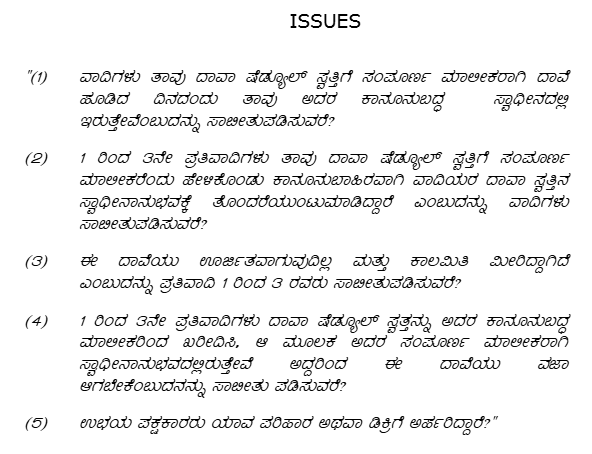
| 4. issues and appeal following trial court decision. (Para 10 , 11) |
| 5. legal questions framed by the appellate court. (Para 12 , 18) |
| 6. court's analysis of evidence and reasoning. (Para 13 , 14 , 15 , 16 , 17) |
JUDGMENT :
M. G. UMA, J.
1. Defendant Nos.1 to 3 in O.S.No.642/1994 on the file of the learned Principal Civil Judge (Jr.Dn) and JMFC at Tumkur (hereinafter referred to as 'the Trial Court', for short), are impugning the judgment and decree dated 16.09.2009 passed in RA.No.6/2006 (Old RA.No.144/2000) on the file of the Fast Track Court-II at Tumkur (hereinafter referred to as 'the First Appellate Court', for short), allowing the appeal with costs, by setting aside the judgment and decree dated 18.08.2000 passed by the Trial Court and thereby decreed the suit of the plaintiffs for declaration and for permanent injunction against defendant Nos.1 to 3, while dismissing the suit against defendant Nos.4 to 9 as they are not proper parties to the suit.
2. For the sake of convenience, the parties shall be referred to as per their rank and status before the Trial Court.
3. Facts of the case in brief are that, plaintiff Nos.1 to 3 have filed the suit O.S.No.642/1994 against defendant Nos.1 to 10 seeking declaration of their title to the suit properties and for permanent injunction restraining them from interfering with the plaintiffs' peaceful possession and enjoyment over the suit properties. Schedule attached to the plaint describes plot Nos.1 and 2 marked as 'ICKJ' and 'LMNH' in the accompanying rough sketch measuring 30 guntas and 10 1/2 guntas respectively with separate boundaries. The plaint rough sketch also identifies these two plots which form part of larger extent of land measuring 6.03 acres in Sy.No.25/2 situated at Puradakatte village, Hebbur Hobli, Tumkur Taluk.
4. It is the contention of the plaintiffs that, they are the children of one Kempaiah, who is the son of propositus-Kathri Huchaiah. The said Kathri Huchaiah was owning the land, who effected oral partition amongst his sons and each one of them got 1 acre 1/2 guntas in Sy.No.25/2. All the sons of Kathri Huchaiah were enjoying their respective shares. Dyamaiah, the father of the plaintiffs was also enjoyed 1 acre 1/2 guntas of land consisting of plot Nos.1 and 2 i.e. 30 guntas + 10 1/2 guntas. It is contended that defendant No.1 by playing fraud and misrepresenting the facts got the sale deeds from one Kempamma, the first wife, and Honnamma, the second wife of Kathri Huchaiah and her son Gangadharaiah, Lakshmamma, Doddamma and others. Defendant No.1 later sold the properties which he had purchased to his own son Ningappa i.e. defendant No.3. Defendant No.2 appears to have purchased 30 guntas of land from Doddamma. Defendant No.3 appears to have purchased 25 guntas from Huchaiah. In the revenue records, the name of father of the plaintiffs is not forthcoming though he was enjoying 1 acre 1/2 gunta of land. However, plaintiffs continued to cultivate the land being in possession and enjoyment of the same. Defendant Nos.1 to 3 alleging that they have purchased the properties including the schedule properties started interfering with the plaintiffs' possession and enjoyment. Therefore, they filed suit seeking declaration of their title and for permanent injunction.
5. Defendant Nos.1 to 3 have appeared before the Court and filed their written statement denying the contentions taken by the plaintiffs and contended that, the plaintiffs are not entitled for any reliefs.
6. It is contended that the plaintiffs have approached the Court with imaginary claim. It is contended that defendant No.2 had purchased 30 guntas of land from Doddamma, wife of Dyamaiah. Defendant No.3 purchased 25 guntas from Huchaiah. It is denied that the plaintiffs are enjoying 1 acre 1/2 gunta of land as shown in the
AI
Appellants must substantiate ownership and possession claims in property disputes, failing which relief due to declaration of title is not warranted.

In property disputes, a party asserting title must substantiate claims with documented evidence, and where prior adverse rulings exist, the new claim is untenable.

The central legal point established in the judgment is the importance of valid documentation and unchallenged possession in establishing ownership rights, as well as the requirement for legal challen....
An individual can only convey as much land as they legally own, with revenue entries providing presumptive evidence but not definitive ownership against established deeds.
Mere entries in revenue records do not confer title; to maintain a suit for declaration, a party must also seek possession.
A plaintiff can obtain a permanent injunction against defendants interfering with her possession if exclusive ownership is established through revenue records, even amidst claims of co-ownership.

In injunction suits, establishing possession suffices; title issues arise when challenged by defendants claiming rights, thus not necessitating formal title proof by plaintiffs.



An indispensable Tool for Legal Professionals, Endorsed by Various High Court and Judicial Officers
Please visit our Training & Support
Center or Contact Us for assistance

Scan Me!
India’s Legal research and Law Firm App, Download now!


For Daily Legal Updates, Join us on :



 Back to top


