


 Back
Back





2025 Supreme(Kar) 2437
IN THE HIGH COURT OF KARNATAKA,AT DHARWAD
C.M.JOSHI, J.
Smt. Sharadabai W/o. Fakkirappa Jorapur - Appellant
Vs.
Kum. Anand S/o. Gopal Jorapur - Respondent
Regular Second Appeal No.5291 of 2013 (PAR)
Decided On : 26-11-2025
Advocate Appeared:
For the Appellant :Sri. Sujeet S. Hiremath, Advocate For Sri. Jagadish Patil, Advocate
For the Respondent:Sri. Praveenkumar G. Kulkarni, Advocate
The burden of proof to establish property as self-acquired rests on the party asserting so, once a joint family nucleus is established, underscoring the necessity of evidence to support claims.
Headnote:(A) Code of Civil Procedure, 1908 - Order II Rule 2 - Res Judicata - Partition suit - Appeal arising from the concurrent findings of Trial and Appellate Courts that the suit properties are ancestral joint family properties - Concurrent findings upheld that plaintiffs are entitled to share in the properties acquired through joint family efforts - Testimonies of witnesses weighed in favor of the plaintiffs - Defendant's claims of self-acquisition rejected based on lack of evidence. (Paras 6, 12, 13, 19, 24, 28)
(B) Family Law - Joint Family Property - Burden of proof rests on the party asserting self-acquisition when joint family nucleus is established; testimony of witnesses crucial - Findings support that the properties in question were acquired through joint efforts and investments made by joint family members. (Paras 18, 23, 26)
(C) Evidence - Standard of evidence for joint family property differs from that required for self-acquired property; presumption of joint family property does not arise merely from existence of a joint family. (Paras 18, 19, 20)
| Table of Content |
|---|
| 1. factual background of joint family and property acquisition. (Para 2 , 3) |
| 2. arguments regarding joint property and res judicata. (Para 10 , 11) |
| 3. observations on the concept of joint family property. (Para 15 , 19) |
| 4. final conclusion on the joint acquisition of properties. (Para 24 , 25) |
| 5. final order dismissing the appeal. (Para 28 , 29) |
JUDGMENT :
(PER: THE HON'BLE MR. JUSTICE C M JOSHI)
This appeal arises out of the concurrent findings of the Trial Court and the First Appellate Court in O.S.No.185/2006 dated 06.03.2009 and R.A.No.62/2009 dated 18.01.2013 whereby the suit filed for partition came to be decreed.
2. The factual matrix that is necessary for the purpose of this appeal may be summarized as below:
a) The plaintiffs and the defendants are the descendents of one Dyamappa Jorapur. The family pedigree as depicted, which is not in dispute is as below:
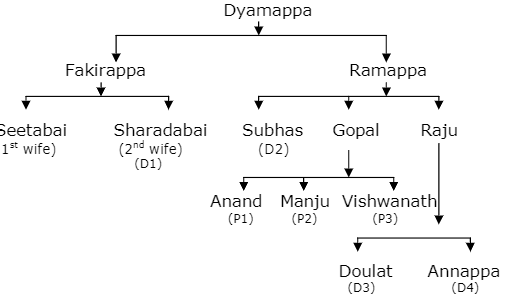
3. The case of the plaintiffs as per the pleadings is as follows:
a) The defendant No.1 happens to be the wife of Fakirappa, who was the first son of Dyamappa. Fakirappa had his first wife Sitabai, who is no more. Fakirappa and his first wife Sitabai and second wife-defendant No.1 were issueless. The brother of Fakirappa i.e., Ramappa predeceased him leaving behind his three sons i.e., Subhash, Gopal and Raju. Gopal died on 28.04.2006 leaving behind the plaintiff No.1 to 3. Raju, the third son of Ramappa, died leaving behind him his sons defendant No.3 to 4.
b) It is the case of the plaintiffs that Fakirappa and Ramappa were living together as a joint family and were doing mutton vending business. Out of their exertion, they purchased the properties in the names of elder brother-Fakirappa, who was the manager of the family. When Ramappa died, it was Fakirappa, who was looking after the affairs of the family.
c) Since Fakirappa did not have any children, he had great love and affection towards the sons of Ramappa. When Fakirappa died, the defendant No.1 at the instance and instigation of others and their parental family, diverted her mind and started causing trouble to the father of the plaintiffs i.e. Gopal. Even she went to the extent of denying the relationship with the branch of Ramappa and started asserting that the properties were self-acquired properties of Fakirappa and as such, she alone had succeeded to them. She sold some of the properties by taking advantage of entry of her name in the records and diverted the mind to her parental hous and she even built a separate house suppressing the same from the plaintiffs and their father-Gopal. The said Gopal and the plaintiffs were residing in one of the joint family house though their name was not appearing in respect of the same and the defendant No.1 attempted drive the plaintiffs and Gopal out of the said house. Therefore, the father of the plaintiffs, Gopal, filed O.S.No.493/2003 for injunction against the defendants before the III-Additional Civil Judge (Jr.Dn) Hubballi and obtained an injunction. The said suit came to be decreed and the R.A.No.64/2004 filed by the defendant No.5 therein also came to be dismissed.
d) Thereafter, the defendant No.1 filed a suit against the Gopal and others in O.S.No.306/2006 seeking possession of the property on the ground that Gopal and the plaintiffs were only licencees in occupation of the property. The said suit came to be decreed and on the basis of the same, the plaintiffs and Gopal were dispossessed from the property. Gopal met with an untimely death leaving his widow and the plaintiffs, who were minor children. Being stripped of any partition in the joint family properties, they being earned by the sweat and labour of their grandfather and Ramappa and Fakirappa, the plaintiffs had to file the present suit for partition.
e) The defendant No.2-Subhash, the father of defendant No.3 and 4 and Raju have relinquished their right by giving consent in writing in favour of the plaintiffs and as such they are also entitled to get share in all the suit schedule properties. 4.












