Back
Back





2024 Supreme(Bom) 894
IN THE HIGH COURT OF BOMBAY AT GOA
M.S. KARNIK, VALMIKI MENEZES, JJ.
Phonographic Performance Limited – Petitioner
Versus
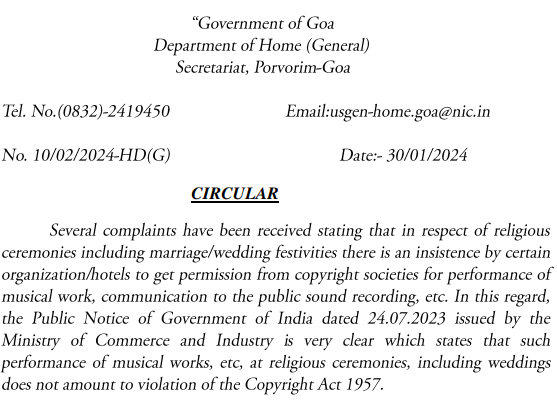
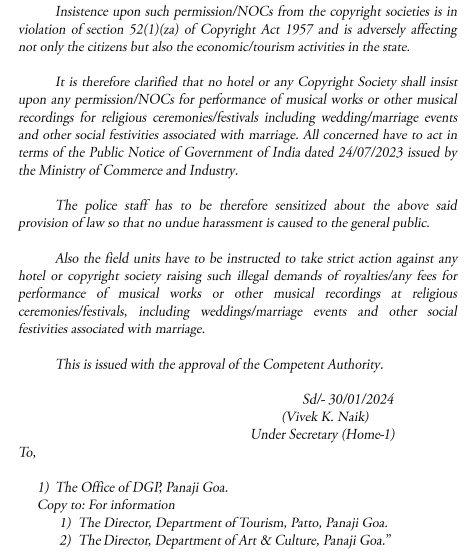
State of Goa – Respondent
Writ Petition Nos. 253, 254 of 2024
Decided On : 13-08-2024
Advocate Appeared:
For the Petitioners: Nitin Sardessai, Pulkit Bandodkar, Ankur Sangal, Sucheta Roy, Tarun Rebello, S. Sardessai, Ankit Arvind.
For the Respondents: Deep Shirodkar, Y.V. Nadkarni, Shailesh Redkar, S. Khadilkar.
IMPORTANT POINT
The court established that executive actions cannot expand statutory provisions beyond their intended scope, particularly in copyright law, which requires careful interpretation.
Headnote:
Copyright - Circular Quashing - Copyright Act Sections 51, 52(1)(za), 55 - The court interpreted the provisions of the Copyright Act, emphasizing the balance between copyright protection and public interest, ultimately ruling that the impugned Circular unlawfully expanded the scope of exceptions under Section 52(1)(za).
Fact of the Case:
The petitioner, a copyright owner of public performance rights, challenged a Circular issued by the State of Goa that restricted its ability to collect royalties for sound recordings played during religious ceremonies, claiming it violated the Copyright Act.
Finding of the Court:
The court found that the Circular exceeded its authority by misinterpreting Section 52(1)(za) of the Copyright Act, which allows certain performances during bona fide religious ceremonies to be exempt from copyright infringement, thus infringing on the petitioner's rights.
Issues: Whether the Circular issued by the State of Goa unlawfully expanded the scope of Section 52(1)(za) of the Copyright Act and infringed upon the petitioner's rights to collect royalties for public performances.
Ratio Decidendi: The court held that the Circular distorted the provisions of the Copyright Act by improperly interpreting the exceptions under Section 52(1)(za), which should be determined on a case-by-case basis.
Result: The impugned Circular dated 30.01.2024 is quashed and set aside.
JUDGMENT :
M.S. KARNIK, J.
1. The issues raised in the petitions are decided by a common judgment. We refer to the facts in Writ Petition No. 253 of 2024.
2. The petitioner Phonographic Performance Limited in this petition under Article 226 of the Constitution of India seeks quashing and setting aside the impugned Circular dated 30.01.2024 issued by respondent No. 1.
3. The petitioner is a company registered under the Companies Act, 1956. The petitioner is one of the foremost organisations in the world which provides a ‘single window’ for consumers to get access to the petitioner’s voluminous repertoire and was originally known as the Indian Phonographic Industry (IPI). The petitioner owns and/or controls the public performance rights of 400+ music labels, with more than 40 lakh international and domestic sound recordings. The petitioner is the copyright owner of the public performance rights in the sound recordings in its repertoire on the basis of assignment of the relevant copyrights in its favour by music labels who have assigned/licensed the said right. These assignors of the petitioner have executed an assignment deed under Section 18 of the Copyright Act, 1957 (Copyright Act for short) in respect of its sound recordings with the petitioner wherein they have assigned the public performance rights of the sound recordings to the petitioner and in view of the same, the petitioner is the owner/controller of the sound recordings to the extent of public performance of the same and therefore is exclusively entitled to grant licenses for communication to the public/public performance of its repertoire of sound recordings. The list of sound recordings in which the petitioner has copyright is available on petitioner’s website (petitioner’s copyrighted works), which provides express notice of petitioner’s rights in the sound recordings to any user.
4. Between 07.05.1996 and 21.06.2014 the petitioner’s company was a registered copyright society under Section 33 of the Copyright Act and thereafter in 2014, due to the amendment brought in the Copyright Act, the petitioner surrendered its registration as there was a statutory requirement for all the registered Copyright Societies to re- register themselves. Since 2014, the petitioner has been assigned the right of public performance of sound recordings by various music labels and issuing license in respect of the same as an owner.
5. The petitioner issues licenses under Section 30 of the Copyright Act for communication/public performance of its vast repertoire of sound recordings. The petitioner grants licenses authorizing the use of its entire repertoire, on an as-is-where basis to its licensees. The petitioner’s right to grant licenses for sound recordings in its repertoire has been recognized by various courts in India including Delhi High Court and Bombay High Court.
6. The petitioner serves a useful public utility of acting as a ‘single window’ to various parties seeking to take a license for authorized use of sound recordings and brings together the copyright owners and users across various parts of India, for better convenience in licensing. Any communication to the public/public performance of sound recordings forming a part of the petitioner’s repertoire without an appropriate licence would amount to an infringement of copyright under Section 51 of the Copyright Act. The petitioner also actively prosecutes the violators of its copyright in civil as well as criminal Courts as per the remedies available under the Copyright Act.
7. The cause for filing these petitions is a Circular dated 30.01.2024 issued by respondent No. 1-State of Goa, addressed to the office of the DGP, Panaji Goa. By a legal notice dated 27.02.2024, the petitioner called upon the respondent No. 1 to withdraw the impugned Circular within two days and if not withdrawn, informed that the petitioner would be compelled to take appropriate legal action. There was no response received to the legal notice.
8. Learned Senior