


 Back
Back





2025 Supreme(Bom) 1397
IN THE HIGH COURT OF JUDICATURE AT BOMBAY, NAGPUR BENCH
Urmila Joshi-Phalke, Nandesh S.Deshpande, JJ.
Shri Vishwas @ Guddu Rajesh Dahiwale and ors. - Appellants
Versus
State of Maharashtra - Respondent
Criminal Appeal No.626 of 2019
Decided On : 01-12-2025
For the Appellant : Shri Aniruddha Jaltare, Shri C.F.Bhagwani
For the Respondent: Shri N.B.Jawade, Additional Public Prosecutor
Conviction for murder under Section 302 established through credible eyewitness testimony and medical evidence, despite minor inconsistencies and investigation delays.
Headnote:(A) Indian Penal Code, 1860 - Section 302 read with Section 34 - Conviction for murder - Accused persons convicted and sentenced to life imprisonment for the murder of Rakesh Ramteke, with a fine of Rs. 50,000/- - Event occurred during a quarrel, resulting in grievous injuries from wooden weapons - Evidence from eyewitnesses deemed credible despite minor inconsistencies. (Paras 2, 68)
(B) Evidence - Eyewitness accounts - The testimonies of the deceased's family and independent witnesses were coherent and corroborative, establishing the involvement of the accused in the commission of the offense. (Paras 19, 36)
(C) Medical Evidence - Postmortem findings confirmed that injuries sustained by the deceased were sufficient to cause death, affirming the court's decision. (Paras 15, 30)
(D) Investigation - Delays in evidence processing noted but deemed insufficient to undermine the prosecution's case when strong eyewitness testimony and circumstantial evidence were provided. (Paras 58, 62) (E) Common Intention - The court affirmed that the evidence established the shared common intention among the accused in the commission of the offense. (Paras 62, 66) (F)
Result: Appeal dismissed.
| Table of Content |
|---|
| 1. prosecution's factual basis of the case. (Para 3 , 4 , 6 , 10) |
| 2. court's findings on the medical evidence and its implications. (Para 8 , 14 , 15 , 16) |
| 3. arguments regarding the reliability of eyewitness testimonies. (Para 11 , 12 , 13) |
| 4. assessment of eyewitness credibility. (Para 32 , 33 , 36 , 39) |
| 5. common intention and shared culpability established. (Para 62 , 63 , 66) |
| 6. final judgment—appeal dismissed. (Para 67 , 68) |
JUDGMENT :
Urmila Joshi-Phalke, J.
1. By this appeal, the appellants (the accused persons) have challenged judgment and order dated 16.7.2019 passed by learned Additional Sessions Judge, Nagpur (learned Judge of the trial court), in Sessions Trial No.48/2016.
2. By the said judgment impugned in the appeal, the accused persons are convicted for offence punishable under Section 302 read with 34 of the IPC and sentenced to undergo imprisonment for life and to pay fine Rs.50,000/-, in default, to undergo further simple imprisonment for one year..
3. Brief facts of the prosecution case are as under:
On 28.9.2015, Rakesh Ramteke (the deceased) had a quarrel with the accused persons who are residents of the same locality. During the said quarrel, the deceased was threatened to kill. On 29.9.2016, at about 11:00 pm, after dinner, the complainant and her children were about to sleep and the deceased was standing outside the house. Around 11:30 pm, the complainant heard the shouts from outside^^ek# udk ek# udk** and, therefore, the complainant and her children immediately came out and witnessed that the accused persons are assaulting the deceased with log and wooden stumps in their hands. The complainant attempted to intervene, but she was threatened that if she intervenes, she has to face consequences. Accused Suraj gave blow of wooden rod on the head of the deceased. Whereas, accused Vishwas gave blow of log on the face of the deceased and accused Kamlesh also gave blow of wooden stumps on the head of the deceased. Due to the shouts, the complainant and her children and nearby residents gathered there. When the neighbours of the deceased made attempt to intervene, they were also assaulted. The accused persons gave 2-3 blows and, thereafter, they fled away. The deceased sustained bleeding injuries on the head and face. He was immediately taken to the hospital by neighbour Akshay and son Abhay, but he was declared dead. Therefore, the complainant has lodged the report.
4. After registration of the crime, wheels of investigation started rotating. The investigating officer has recorded complaint of the complainant. After registration of the crime, he has drawn spot panchanama and collected blood stained soil and simple soil from the spot of the incident. The accused persons were arrested. On the basis of the memorandum statement of the accused persons, incriminating weapons were recovered. The blood stained clothes of the deceased and the accused persons and blood stained weapons were forwarded to the Forensic Science Laboratory. After completion of the investigation, chargesheet was filed. As offence under Section 302 of the IPC is exclusively triable by the Court of Sessions, the case was committed to the Sessions Court. Learned Judge of the Court below has framed charge vide Exh.23. The contents of the charge are explained and read over to the accused persons. They pleaded not guilty and claimed to be tried. 5. In support of the prosecution case, the prosecution has examined in all 10 witnesses, as follows:
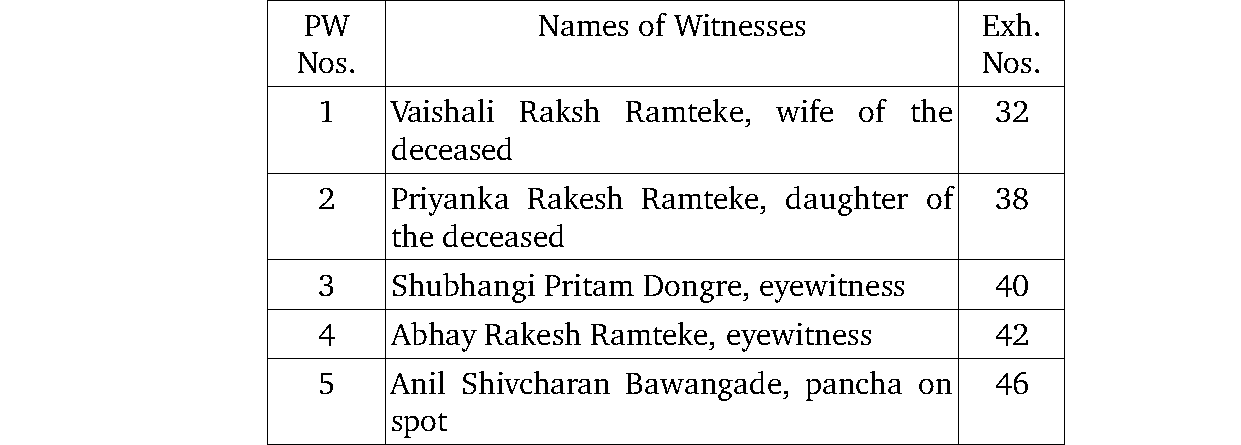
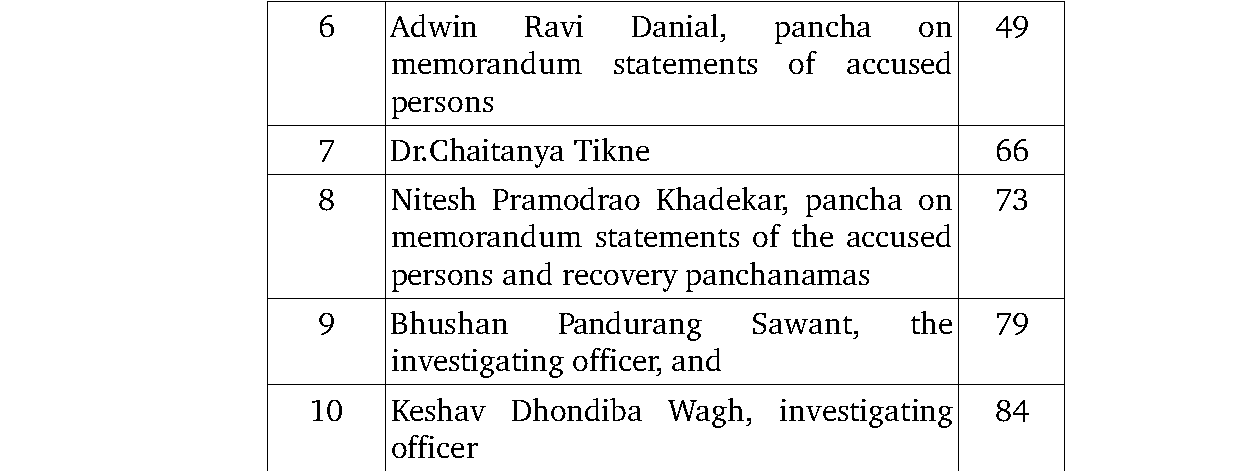
6. Besides the oral evidence, prosecution placed reliance on report Exh.33, FIR Exh.34, spot panchanama Exh.49, seizure memo Exh.48, postmortem report Exh.67, requisition to the medical officer Exh.68, letter to C.A. Exh.81, arrest panchanamas Exhs.85, 88A, and 88B, memorandum statement of accused Vishwas Exh.86, recovery panchanama Exh.87, memorandum statement of accused Kamlesh Exh.89, recovery panchanama Exh.90, seizure memo Exh.91, memorandum statement of accused Suraj Exh.92, recovery panchanama












