
 Back
Back





IN THE HIGH COURT OF JUDICATURE AT BOMBAY, NAGPUR BENCH
URMILA JOSHI PHALKE, NANDESH S. DESHPANDE, JJ.
State of Maharashtra - Appellant
Vs.
Wariskhan S/o Kalekhan - Respondent
Criminal Appeal No. 651, 507 of 2004
Decided On : 17-10-2025
JUDGMENT :
( PER : URMILA JOSHI PHALKE , J.)
1. The present Appeals are directed against the judgment and order of sentence passed by Additional Sessions Judge, Achalpur Dist. Amravati in Sessions Trial No. 8/1996 dated 28.07.2004 convicting the accused No.1 Wariskhan of the offence punishable under Section 304-II of the INDIAN PENAL CODE (for short “IPC”) and sentenced to suffer Rigorous imprisonment for 10 years and to pay fine of Rs.1000/ in default to undergo simple imprisonment for one month and convicting the accused No.2 Majidkhan of the offence punishable under Section 323 of IPC and sentenced to suffer Rigorous imprisonment for 1 year and to pay fine of Rs.100/ in default to undergo simple imprisonment for 7 days.
2. Brief facts of the prosecution case emerges from Police papers and record and evidence are as under:
2(i). Criminal law is set in motion on the basis of the report lodged by Madhukar Kanetkar the uncle of the deceased at Paratwada Police Station alleging that he owns agricultural property and deceased Suhas, his nephew, was looking after the said property at Village Dhotarkheda. They have cultivated the Orange Plants in the field. Prior to two days of 30.10.1995 some unknown persons attempted to commit theft by plucking the Oranges from the trees with the help of ladder. Deceased attempted to catch them but they fled away. On 30.10.1995, the deceased Suhas alongwith Sanjay Babulal Harasule, a boy of 10 years was returning towards his house on his bicycle, at the relevant time, near the Rest House square at Achalpur the present accused persons obstructed them and accused Wariskhan assaulted the deceased with the help of wooden rip, whereas the other accused Majid Khan assaulted Sanjay who was alongwith the deceased by fist and kick blows. Due to the assault, Suhas fell down and sustained injuries and during treatment succumbed to death, whereas Sanjay sustained the injuries. On the basis of the said report Police have registered the crime against the accused persons.
2(ii). After registration of the crime Investigating Officer has drawn the spot panchnama. Attempt was made to record the statement of deceased but he was unconscious, therefore his statement could not be recorded. On the same day, he reported to be dead. Therefore, the inquest panchnama was drawn. The clothes of the deceased and accused were seized. Weapon was seized from the place near the spot of incident, having blood stains on it. All the incriminating articles are forwarded to CA. After completion of the investigation the charge-sheet was filed against the accused persons.
2(iii). The learned Sessions Judge framed the charge vide Exh. 38. The contents of the charge are read over and explained to the accused persons in vernacular. They pleaded not guilty and claimed to be tried. In support of the prosecution case, the prosecution had examined in all 17 witnesses which are as follows:
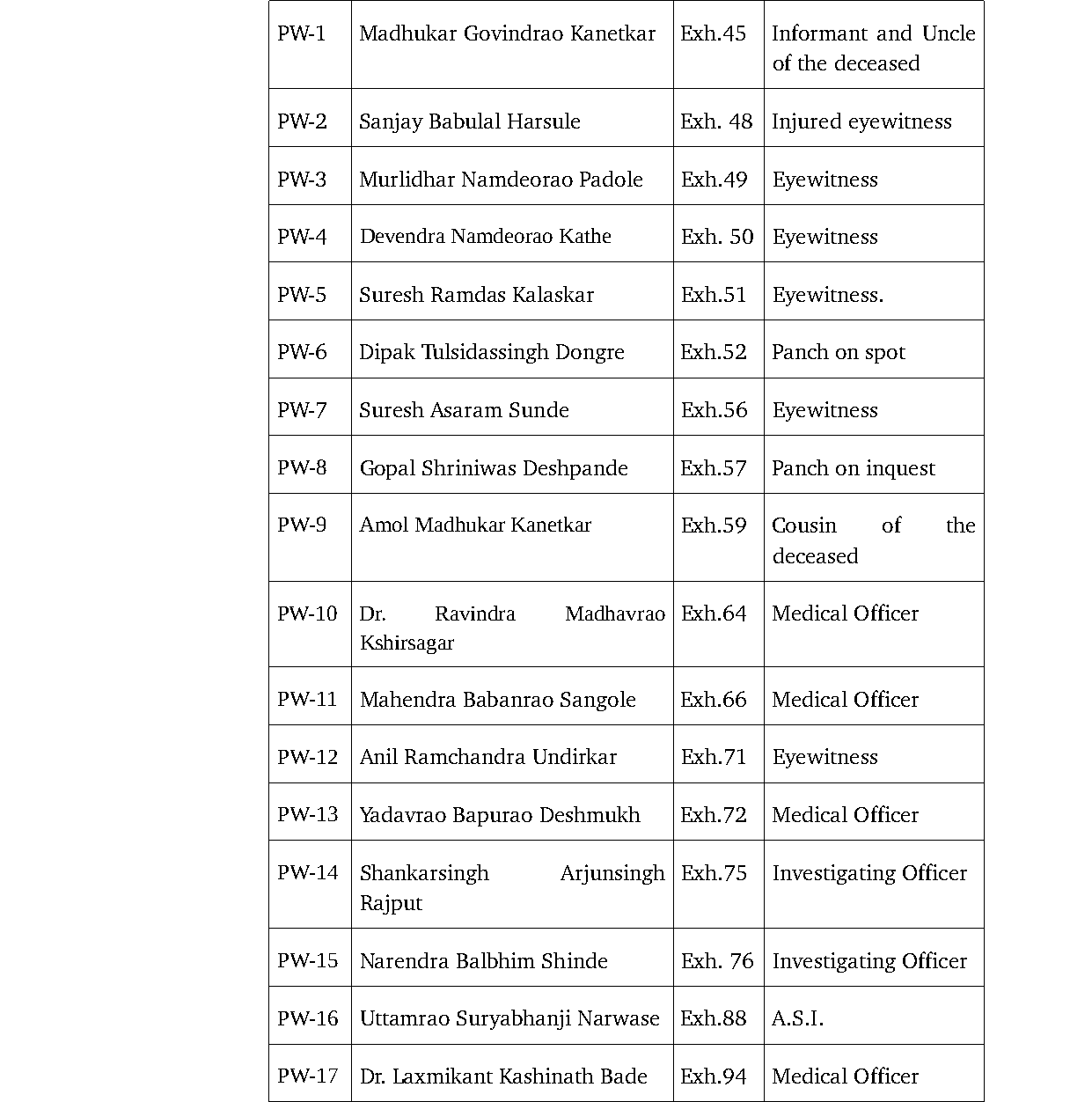
2(iv). Besides oral evidence prosecution placed reliance on Report-Exh.46, FIR Exh.-47, Spot panchnama-Exh. 53, Seizure memos-Exhs. 54 & 55, Inquest panchnama-Exh. 58, Seizure memo-Exh. 63, Intimation to Police by Medical Officer-Exh. 67, Requisition by Police to Medical Officer-Exh. 68, Seizure memos-Exhs. 77 to 79, CA Reports-Exhs. 80 to 83, Seizure memo-Exhs. 84 & 85 and PM Report Exh.95.
2(v). All the incriminating evidence is put to the accused persons to obtain their explanation regarding evidence appearing against them by recording their statements under Section 313 of the Code of Criminal Procedure (for short “Cr.P.C.”). The defence of the accused persons is of a total denial and of a false implication. The learned Trial Court after appreciating the evidence held present accused/appellants guilty and convicted them as aforestated.
2(vi). Being aggrieved and dissatisfied with the same, the State has preferred an Appeal for enhancement of the sentence bearing Appeal No. 651/2004, whereas the accused preferred the Appeal bearing No. 507/2004 for quashing and
AI
Culpable homicide distinguished from murder based on intention and knowledge; knowledge suffices for conviction under Section 304(II) of IPC, while failure to explain accused injuries does not negate....

Intention in culpable homicide is inferred from the nature of the weapon used, the location of injuries, and conduct indicating a purposeful act to achieve a harmful outcome.
The distinction between murder and culpable homicide hinges on intention and circumstances, with the court applying Exception-4 of Section 300 IPC in cases of sudden quarrel.


The court affirmed the conviction for murder under Section 302 IPC, highlighting that the accused acted with sufficient intent, despite claims of provocation, based on consistent eyewitness testimoni....


Section 106 of the Evidence Act reads Burden of proving fact especially within knowledge – When any fact is especially within the knowledge of any person, the burden of proving that fact is upon him.

The central legal point established in the judgment is the application of the Fourth Exception of Section 300 IPC, considering the absence of premeditation, sudden fight, and influence of intoxicatio....

The court ruled that solitary eyewitness testimony can suffice for conviction in murder cases, especially when corroborated by medical evidence. The culpable act did not fall under provocation except....



An indispensable Tool for Legal Professionals, Endorsed by Various High Court and Judicial Officers
Please visit our Training & Support
Center or Contact Us for assistance

Scan Me!
India’s Legal research and Law Firm App, Download now!


For Daily Legal Updates, Join us on :



 Back to top


