
 Back
Back





IN THE HIGH COURT OF JUDICATURE AT BOMBAY
G.S. KULKARNI, AARTI SATHE, JJ.
Kalyan Dombivli Municipal Corporation and Another – Appellants
Versus
Nandkishor Govind Sane and Others – Respondents
Letters Patent Appeal Nos. 321, 322, 323, 324, 325, 326 of 2011, Writ Petition Nos. 1787, 1788, 1789, 1790, 1791, 1793 of 2011, Civil Application (L.) Nos. 384, 385, 386, 387, 388, 389 of 2011
Decided On : 16-01-2026
| Table of Content |
|---|
| 1. challenge to the impugned order about settlement implementation. (Para 1 , 2 , 3) |
| 2. complaints filed under mrtu & pulp act regarding wage revision. (Para 4 , 5 , 6) |
| 3. analysis of legal provisions about binding settlements. (Para 7 , 12 , 13 , 14 , 15 , 16 , 17 , 18) |
| 4. arguments regarding maintainability and limitation on complaints. (Para 10 , 11) |
| 5. court's rejection of appeal and confirmation of lower court's ruling. (Para 19 , 20) |
JUDGMENT :
G.S. KULKARNI, J.
1. These Letters Patent Appeals challenge the judgment and order dated 18 July, 2011 passed by the learned Single Judge on a batch of Writ Petitions filed by the appellant – Kalyan Dombivli Municipal Corporation (for short “KDMC”). By the impugned judgment, the learned Single Judge while dismissing the Writ Petitions filed by the KDMC confirmed the orders dated 29 April, 2010 passed by the learned Member, Industrial Court, Thane allowing the complaints filed by the respondent-workmen. It is thus the concurrent findings of both such forums are being assailed by the KDMC.
2. The facts lie in a narrow compass:-
The respondents are the original complainants, being “workmen” (hereinafter referred to as “the complainants”) employed with the KDMC. The complainants filed applications/complaints under Section 28 read with Items 5 and 9 of Schedule IV to the MAHARASHTRA RECOGNITION OF TRADE UNIONS AND PREVENTION OF UNFAIR LABOUR PRACTICES ACT , 1971 (for short “the MRTU & PULP” Act), seeking directions to the KDMC to implement the settlement agreement dated 3 January, 1996 arrived between the KDMC and the two Workers Unions, namely, Municipal Mazdoor Union Maharashtra and Akhil Bharatiya Safai Mazdoor Congress, and more particularly what was provided for in Clause (1) of the said settlement agreement, which primarily pertained to the implementation of the 5th Pay Commission recommendations. The relevant extract of the settlement agreement is required to be noted, which reads thus:
(Translation of a photocopy of a Marked portion, typewritten in Marathi)
AGREEMENT
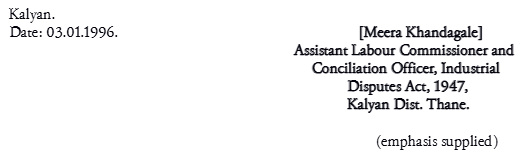
Date : 3rd January, 1996.
Agreement entered into as per Section 18 (1) of the Industrial Disputes Act, 1947 and Rule 62 of the Industrial Disputes Mumbai Rules, 1947.
1) Kalyan Municipal Corporation, Kalyan [Hereinafter, shall be referred to as Municipal Corporation]
2) A] Municipal Mazdoor Union, Maharashtra, Dhobiali, Tembhinaka, Thane.
B] Akhil Bharatiya Safai Mazdoor Congress, Ashirwad, Joshi Baug, Kalyan.
(Hereinafter, shall be referred to as Labour Unions]
The Commissioner Shri T. Chandrashekhar, Deputy Commissioner Shri G.C. Mangale and the Labour Officer Shri V.N. Hanmane on behalf of the Municipal Corporation whereas Shri Madhu Joshi and Shri Charansingh Tank on behalf of the Labour Union took part in the discussions.
BACKGROUND OF THE AGREEMENT
Municipal Mazdoor Union, Maharashtra, Akhil Bharatiya Safai Mazdoor Congress had served Notice on the Municipal Corporation for going on strike on the dates 18.12.1995 and 21.12.1995 respectively for their 16 and 20 demands respectively. On the date 30.12.1995, both the Labour Unions, in order to get their demands granted, had jointly staged One Day’s Symbolic Strike and had organized a March to the Municipal Corporation. The Delegation of the said March had held detailed discussion with the Commissioner of the Municipal Corporation. During the course of this discussion, the Municipal Commissioner accepted some demands of the Labour Unions and as regards other demands, assured them to hold a discussion for the same and to take a decision in respect thereof at the earliest.
In the meantime, the Assistant Labour Commissioner and Conciliation Officer, Kalyan, had called both the Parties on the date 29.12.1995 for preliminary discussion. Both the Parties met the Conciliation Officer and informed that discussion was going on between both the Parties regarding the demands of the Labourers. As the services of the Municipal Corporation come under the Emergency Services, the

AI
Settlements reached in conciliation proceedings bind all employees, not limited to union members, ensuring rights to unimplemented agreements.

Settlement agreements under Section 18 of the Industrial Disputes Act bind only parties to those agreements; unrecognized unions cannot enforce them or claim benefits without evidence of participatio....

The court ruled individual workmen can settle disputes but such settlements are not binding on the union or non-signatory workmen, reaffirming the importance of collective bargaining.

The settlement under Section 18(3)(d) of the Industrial Disputes Act, 1947, must be just and fair and cannot bind workmen if it does not meet this standard.

The main legal point established in the judgment is that settlements entered into in Industrial Disputes are valid and legal, even though provisions similar to Order XXIII Rule 3 CPC do not exist in ....

Industrial settlements are binding package deals promoting peace; fraud requires specific proof and timely protest; employee status continues post suspension notice assuring protection until valid vo....

The Settlement executed with the recognized Union becomes binding on all workmen, and the employer cannot deny the benefits of the Settlement to non-members of the recognized union. The recurring cau....
The main legal point established in the judgment is the validity and binding nature of settlements in industrial disputes, even if not confirmed by both parties, under Section 18(1) of the ID Act.
Settlements under the Payment of Wages Act and the Industrial Disputes Act are binding, even if not acknowledged by one party, provided they are legally sound and voluntarily entered into.
Settlements of wage disputes outside conciliation are valid and binding; a workman's absence in confirming does not invalidate the agreement.



An indispensable Tool for Legal Professionals, Endorsed by Various High Court and Judicial Officers
Please visit our Training & Support
Center or Contact Us for assistance

Scan Me!
India’s Legal research and Law Firm App, Download now!


For Daily Legal Updates, Join us on :



 Back to top


