
 Back
Back





IN THE HIGH COURT OF JUDICATURE AT PATNA
SUNIL DUTTA MISHRA, J.
Kauleshwar Pd. Singh Son of Shri Gulab Pd. Singh alias Mohit Narain Singh - Appellants
Versus
Smt. Pamila Devi D/o Late Baleshwar Prasad Singh, W/o Sri Shambhu Singh -Respondent
First Appeal No.254 of 1987
Decided on : 21-03-2025
| Table of Content |
|---|
| 1. partition in joint family property (Para 1 , 3 , 4 , 5) |
| 2. initial appeal filed regarding partition of family property. (Para 2) |
| 3. defendants contest unity of title and possession (Para 6 , 7 , 8) |
| 4. support by co-plaintiffs for partition claim (Para 9 , 10) |
| 5. trial court issues and evidence consideration (Para 11 , 12 , 13 , 14 , 15) |
| 6. appellants argue against trial court findings (Para 18 , 19 , 20 , 21) |
| 7. onus of proof in joint family property claims (Para 22 , 23 , 24 , 25 , 26) |
| 8. foundational facts for self-acquired property (Para 27 , 28 , 29 , 30 , 31 , 32) |
| 9. unity in title and possession established (Para 33 , 34 , 35 , 36) |
| 10. court delineates evidence standards required to prove partition. (Para 46) |
| 11. confirmation of trial court's decree (Para 52 , 54) |
JUDGMENT :
SUNIL DUTTA MISHRA, J.
This First Appeal has been filed by the appellants herein (defendant no.2 and his sons defendant nos.9 and 10 in the suit) against the preliminary decree dated 31.03.1987 passed by the learned Sub Judge VI, Patna in Title (Partition) Suit No.218 of 1974/46 of 1986 decreeing the suit on contest with cost against defendant nos.1 to 11 wherein a preliminary decree was passed for 1/3rd share of the plaintiffs and 1/3rd share of co-plaintiff nos.4 to 6 and also 1/3rd share of the defendant nos.1 to 11. It was further held that after preparation of preliminary decree, on separate petition of the plaintiffs, a Survey Knowing Pleader Commissioner will be appointed to carve out separate takhta of 1/3rd share each of the parties as per the terms of the preliminary decree.
2. For the sake of convenience, the parties where required shall be referred to in terms of their status before the learned trial Court.
3. The facts, in brief, are that the plaintiffs filed suit for partition being Title (Partition) Suit No.218 of 1974 (46 of 1986) seeking 1/3rd share in the joint family property as the parties to the suit are Joint Hindu Family governed by the Mitakshara School of Hindu Law and are related to each other as shown in the Genealogical Table given below:
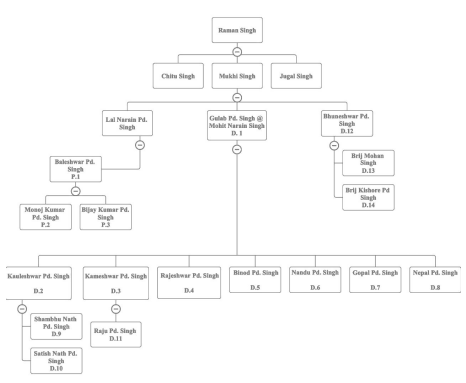
4. Raman Singh was the common ancestor of the parties who had three sons namely Chitu Singh, Mukhi Singh and Jugal Singh out of which Chitu Singh and Jugal Singh died either issueless or unmarried. Mukhi Singh died leaving behind him his three sons namely Lal Narain Pd. Singh, Gulab Pd. Singh alias Mohit Narain Singh (D-1)and Bhuneshwar Pd. Singh (D- 12). Lal Narain Pd. Singh also died leaving behind his son Baleshwar Pd. Singh (P-1) and two grand sons Monoj Kumar Pd. Singh (P-2) and Bijay Kumar Pd. Singh (P-3). Gulab Pd. Singh alias Mohit Narain Singh has got seven sons Kauleshwar Pd. Singh (D-2), Kameshwar Pd. Singh (D-3), Rajeshwar Pd. Singh (D-4), Binod Pd. Singh (D-5), Nandu Pd. Singh (D-6), Gopal Pd. Singh (D-7) and Nepal Pd. Singh (D-8). Kauleshwar Pd. Singh has got two sons namely Shambhu Nath Pd. Singh (D-9) and Satish Pd. Singh (D-10). Kameshwar Pd. Singh has one son namely Raju Pd. Singh (D-11). Bhuneshwar Pd. Singh (D-12) has got two sons namely Brij Mohan Pd. Singh (D-13) and Braj Kishore Pd. Singh (D-14). After the death of both Jugal Singh and Chitu Singh, who were issueless, sons of Mukhi Singh being the nearest heir came in possession of the entire property by rule of survivorship. In last Survey Record of Right the names of Chitu Singh, Mukhi Singh and Jugal Singh were recorded. Gulab Pd. Singh alias Mohit Pd. Singh (defendant no. 1) being the eldest member of the family became karta of the joint family of plaintiffs and defendants. The plaintiffs have given description of their ancestral lands and also the acquired properties in Schedule I of their plaint in detail. Schedule II of the plaint describes the details of movable properties including cattle and ornaments. Some lands were acquired by purchase by Mukhi Singh and other family members from the joint family fund in the name of different family members. Though, different rent receipts in the name of individual f
AI
A joint Hindu family's property remains joint unless the asserting party proves separation or prior partition; the burden of proof lies with the party claiming such separation.

A joint Hindu family property remains joint unless proven otherwise; the burden of proof lies on the party claiming separate ownership, requiring credible evidence.

A party claiming self-acquisition of property within a joint family must provide substantial evidence; failure to do so, combined with existing partition evidence, undermines their claims.

A claim of partition in Hindu joint family property must be substantiated with credible evidence; conjecture does not suffice.

There can be partial partition between coparceners of a Hindu joint family – It is always open to members of joint Hindu family to divide some properties of family and to keep remaining undivided.
Joint family property retains its character unless proven otherwise; sales by co-parceners without all parties' consent do not extinguish shared rights.

The burden of proof lies on the person claiming property as self-acquired to establish that it was acquired without the aid of joint family funds.



An indispensable Tool for Legal Professionals, Endorsed by Various High Court and Judicial Officers
Please visit our Training & Support
Center or Contact Us for assistance

Scan Me!
India’s Legal research and Law Firm App, Download now!


For Daily Legal Updates, Join us on :



 Back to top


