
 Back
Back





IN THE HIGH COURT OF JUDICATURE AT PATNA
SUDHIR SINGH, RAJESH KUMAR VERMA, JJ.
Jhalku Sah S/O Late Rangi Lal Sah - Appellant
Versus
The State of Bihar - Respondents
CRIMINAL APPEAL (DB) No.203 of 2025
Decided on : 10-09-2025
| Table of Content |
|---|
| 1. factual background of the case (Para 1 , 3 , 4 , 5) |
| 2. court's analysis of evidence and inconsistencies (Para 6 , 10 , 11 , 12 , 13 , 14 , 15 , 16) |
| 3. arguments for the appeal and defense (Para 7 , 8) |
| 4. standards for appeals against acquittal (Para 17 , 18 , 19 , 20) |
| 5. conclusion and order of dismissal (Para 22 , 23 , 24) |
JUDGMENT :
SUDHIR SINGH, J.
1. The present criminal appeal has been preferred under Section 413 of Bharatiya Nagarik Suraksha Sanhita, 2023 against judgment of acquittal dated 20.06.2024 passed by the learned Additional District and Sessions Judge-9th, Saran, Chapra in Sessions Trial No. 242 of 2010, arising out of Masrakh P.S. Case No. 198 of 2004, whereby Respondent No. 2 has been acquitted by the learned Trial Court from the charge of Sections 302 /34, 201/34 of Indian Penal Code.
2. Vide order dated 03.04.2025, notices were issued to the Respondent No. 2, upon which he appeared by filing Vakalatnama through learned Advocate, Mr. Manoj Kumar Yadav.
3. The prosecution case, as per fardbeyan of the informant, in brief, is that the informant used to sell fruits and vegetables in Siliguri. On 11.09.2004 at about 09:00 p.m., the daughter-in-law of the informant told the informant, that the father of the informant had gone with the wife of Respondent No. 2 to see her ailing buffalo last evening but had not returned. The informant and his mother came to their village from Siliguri and made a hectic search of his father(the deceased) but all the efforts went in vain. On 14.09.2004, at about 14:00 p.m., on the information about a foul smell near the Baans-Kathi of Heeralal Ram, the informant and others went there and found the dead body of his father in a decomposed condition, which was identified from the piece of dhoti and chappal. The informant raised suspicion that the wife of Respondent No. 2 with the help of others has committed the alleged occurrence and threw the dead body near the Baans-Kathi.
4. On the basis of fardbeyan report of the informant, Masrakh P.S. Case No. 198 of 2004 was instituted under Sections 302 /34, 201/34 of Indian Penal Code and investigation was taken up by the Police. The Police after investigation submitted charge-sheet against Respondent No. 2 and, accordingly, cognizance was taken. Thereafter the case was committed to the Court of Sessions. Charges were framed against the accused persons under /34, 201/34 of Indian Penal Code to which they pleaded not guilty and claimed to be tried.
5. During the trial, the prosecution examined altogether eight prosecution witnesses i.e. PW1 Kamla Manjhi, PW2 Subhash Manjhi, PW3 Sudama Devi, PW4 Ganesh Sah, PW5 Ashrafi Sah, PW6 Jhalku Sah (informant), PW7 Champa Devi and PW8 Dr. Pankaj Kumar. The prosecution has also produced certain documents which were marked as ‘Exhibits’ i.e., Identification of Signature of the informant on fardbeyan, Identification of Signature of the informant on protest petition, Identification of Signature of the informant on application and Identification of Signature of the Doctor on Bone Injury Report. No witness has been examined on behalf of the defence. After closure of prosecution evidence, the statements of the accused persons were recorded under Section 313 Cr.P.C. and after conclusion of trial, learned Trial Court has acquitted the accused persons.
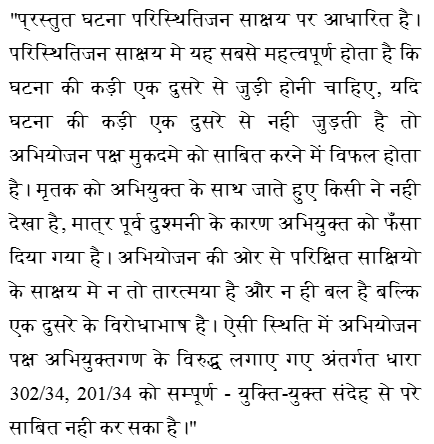
6. The learned Trial Court on the basis of the materials available on record, and the evidence produced before the Court, acquitted the accused persons observing that the alleged occurrence is based on circumstantial evidence and, in the cases of circumstantial evidence, it is most important that the links of the incident should be connected to each other. The Trial Court has further observed that no one has seen the deceased going with the accused and the accused has been implicated only due to past enmity. The relevant part of the impugned order under Paragraph-19 is reproduced as under:
7. Learned counsel for the appellant submits that the learned Tria
AI
The prosecution must establish guilt beyond a reasonable doubt, and acquittals are reviewed under strict guidelines favoring the presumption of innocence.

The prosecution's failure to establish a conclusive chain of circumstantial evidence warranted the acquittal of the accused, as inconsistencies in witness testimonies created reasonable doubt.

Appeals against acquittal warrant interference only if trial findings perverse or impossible; circumstantial case fails without complete chain excluding innocence, as here due to witness inconsistenc....
In criminal cases, guilt must be established beyond reasonable doubt, and circumstantial evidence must conclusively exclude any hypothesis of innocence.


The presumption of innocence remains unless the prosecution proves guilt beyond a reasonable doubt, especially in appeals against acquittal.


The prosecution must establish a complete chain of circumstantial evidence beyond reasonable doubt for a conviction; reasonable doubts justify acquittal.



An indispensable Tool for Legal Professionals, Endorsed by Various High Court and Judicial Officers
Please visit our Training & Support
Center or Contact Us for assistance

Scan Me!
India’s Legal research and Law Firm App, Download now!


For Daily Legal Updates, Join us on :



 Back to top


