
 Back
Back





HIGH COURT OF CHHATTISGARH AT BILASPUR
RAMESH SINHA, CJ., RAVINDRA KUMAR AGRAWAL, J.
Kamalnarayan Sahu, S/o. Late Jagluram – Appellant
Versus
State of Chhattisgarh, Through P.S. Daundilohara, District Balod (C.G.) - Respondent
CRA No. 371 of 2024, CRA No. 670 of 2024
Decided On : 02-02-2026
Judgment :
Ramesh Sinha, CJ.
1. Since both the above-captioned appeals arise out of a common incident and common factual matrix, this Court is disposing of both these appeals by a common judgment.
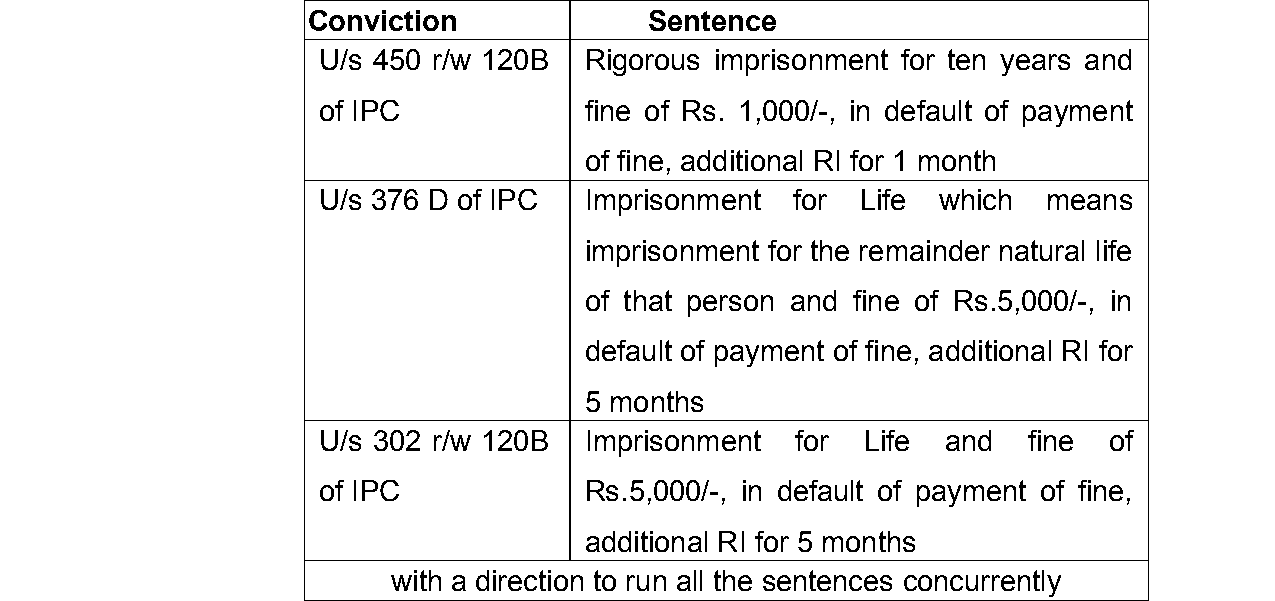
2. Both these criminal appeals have been filed by the accused/appellants under Section 374(2) of the Code of Criminal Procedure, 1973 (for short, ‘the CrPC’) against the impugned judgment of conviction and order of sentence dated 25.01.2024 passed by the learned 1st Additional Sessions Judge / FTC, Balod, District – Balod (C.G.) in Sessions Case No. 04/2022, by which the appellants have been convicted and sentenced in the following manner :-
3. Case of the prosecution, in brief, is that on 12.06.2021, the deceased/victim's brother-in-law (HkkbZ cgw) who was her neighbor, filed a written report at the Doondilhora police station stating that she had an 8th-grade education and worked in the household and agriculture. On 12.06.2021, she went to the field at 5:00 a.m. to fill water from the borewell for her home. By the time she returned, it was 6:00 a.m. Her neighbor, the deceased/victim, who usually woke up at 5:00-6:00 a.m., had not woken up. She knocked on her door two or three times, calling out, "Didi-Didi", but when she didn't wake up, she pushed the door open. It was locked from the inside. She wondered why the deceased/victim hadn't woken up, and went to her sister-in-law in the neighborhood and told her that the deceased/victim had still not woken up. Afterward, they knocked on the victim's door again, but she didn't open it. They peered through the hole in the door and saw the victim's neck and head lying on the bed, asleep. She then let her younger daughter in through a small broken curtain at the back of the house. Then her daughter went inside and unlocked the door. By then, Laleshwari and Uttarabai had also arrived. When they all went inside the room, they saw that the deceased/victim was lying face down on the cot. She was bare of clothing below her waist. Her nightgown had slipped from her waist. The deceased/victim had suffered injuries to her face and neck. Blood oozed from her mouth. Both hands were tied behind her back with a towel. Everyone called out to the deceased/victim, but she remained silent. She had died. An unknown person had entered the house between 6:00 PM on 11.06.2021 and 6:00 AM on 12.06.2021, murdered the deceased/victim, and then fled.
4. On the above information, the Doondilhora police station registered the rural intimation and rural complaint crime and registered the information register number- 31/2020 of untimely and accidental death and took the case into investigation panchnama proceedings. During the inquest, after preparing the map of the incident spot and giving notice to the witnesses, the inquest over the dead body of the deceased/victim was prepared and to know the exact cause of death, the post-mortem of the dead body of the deceased/victim was done, in which the doctor found the death of the deceased/victim to be of "homicidal in nature”, then the Doondilhora police station registered a case bearing Crime No. 0106/2021 against unknown persons and the case was taken up for investigation.
5. During the investigation, the deceased's vaginal slide, her clothes, and blood sample were preserved and sent to the FSL in Raipur for chemical testing. The report revealed the presence of human semen in the slide and swab, leading to the addition of Section 376 of the Indian Penal Code. During the investigation, it was learned that the deceased/victim had been in a relationship with the accused, Kamalnarayan Sahu, for 10-12 years, a fact known to the villagers. On the date of the incident, some villagers saw the accused, Kamlesh Kumar Shrivas and Uttam Kumar Raote, wandering towards the deceased/victim's house at night, arousing suspicion. Based on this suspicion, the accused were questioned. Blood samples were taken from the accused, and the semen found on the vaginal slide was subjected to DNA testing.
AI
Circumstantial evidence, including reliable DNA findings, can substantiate convictions in serious crimes even without eyewitness testimony.
Conviction based on circumstantial evidence requires a complete chain proving guilt beyond reasonable doubt; mere suspicion is insufficient.

Circumstantial evidence must form a conclusive chain linked to the accused, establishing guilt beyond reasonable doubt, with no viable alternative explanations for innocence.

(1) Rape and murder – In view of Section 357(A), Cr.P.C., family members of deceased-victim would be entitled to compensation even though accused have been acquitted.(2) Extra-Judicial confession – C....


The conviction was based on circumstantial evidence, with DNA and witness testimonies establishing the accused's guilt, affirming the death sentence as the case fell within the rarest of rare categor....


(1) DNA report is substantive piece of evidence and same could not have been tendered in evidence through affidavit – Only evidence of formal nature can be given on affidavits.(2) Circumstantial evid....



An indispensable Tool for Legal Professionals, Endorsed by Various High Court and Judicial Officers
Please visit our Training & Support
Center or Contact Us for assistance

Scan Me!
India’s Legal research and Law Firm App, Download now!


For Daily Legal Updates, Join us on :



 Back to top


