
 Back
Back





IN THE HIGH COURT OF CHHATTISGARH AT BILASPUR
RAJANI DUBEY, AMITENDRA KISHORE PRASAD, JJ.
Adarsh Vidyalay Higher Secondary School – Appellant
Versus
State of Chhattisgarh – Respondent
WPL Nos. 1048, 1517, 1666, 2387, 7177 of 2009, WPL No. 5029 of 2010, WPL Nos. 1327, 3263, 6237 of 2011, WPL No. 159 of 2012, WPL No. 128 of 2013, WPL No. 78 of 2017
Decided On : 10-09-2025
JUDGMENT :
AMITENDRA KISHORE PRASAD, J.
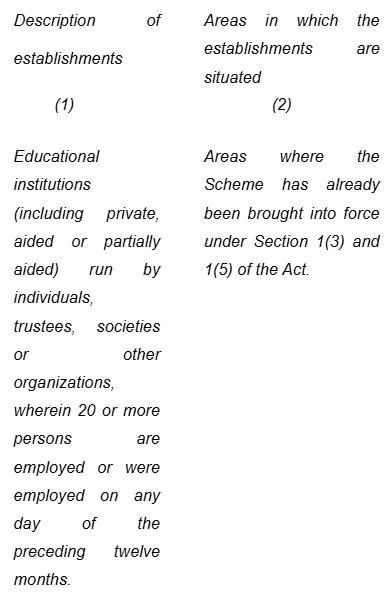
1. In these bunch of cases, the petitioners have challenged the notification dated 27.10.2005 (Annexure P-1) published in Chhattisgarh Gazette under section 1 (5) of the Employees State Insurance Act, 1948 and the entire proceedings initiated by respondent no. 2 by its notice dated 27/28.01.2011 (Annexure P-2).
2. Heard Mr. K.R. Nair, Mr. Sourabh Sharma & Mr. Vinod Deshmukh, Counsel for the petitioners. Mr. Atanu Ghosh, Dy. G.A. for the State and Mr. Pranav Saxena, Counsel for the respondent-Employees State Insurance Corporation.
3. The petitioners, educational institutions operated by a registered society, challenge the applicability of the Employees State Insurance Act, 1948 (ESI Act) to its establishment following a notification issued by the State Government under Section 1(5) of the Act, published on 28.11.2005, making the Act applicable to educational institutions from 01.04.2006. Pursuant to this, a demand notice dated 27/28.01.2011 was issued by the authorities seeking contribution amounting to Rs. 13,83,168/- for specified periods between 2008 and 2010. The petitioners contend that the said notification is arbitrary, illegal, and beyond the scope of the Act, asserting that an educational institution is not an "establishment" within the meaning of Section 2(5) of the ESI Act, as it does not engage in any manufacturing or commercial activity. The institution’s sole purpose is to impart education, which involves moral, intellectual, and physical development of students and cannot be equated with profit-making activities or business enterprises. As such, the petitioners argue that extending the ESI Act to cover educational institutions is a misapplication of the law and seeks quashing of both the notification and the consequential recovery notices.
4. Since all the petitioners have filed separate petitions while raising a common grievance. Therefore, these petitions are being clubbed together, heard together, and decided together by this common order.
5. The reliefs prayed for by the petitioners in all the writ petitions are same and one with certain variations, however, in order to adjudicate these petitions, WPL No. 1327/2011 ( Adarsh Vidyalay vs. State of Chhattisgarh and Others ) has been taken as lead petition for deciding the issues involved in these cases.
6. The reliefs sought in the said petition are quoted hereinbelow:-
“10.1 That the Hon'ble court may kindly be pleased to issue a writ, writs, order, orders or direction etc. for quashing the notification dated 27.10.2005 (Annexure P-1) issued by respondent no.1 and the entire proceeding initiated by respondent no.2 by its notice dated 27/28.01.2011 (Annexure P-2) demanding the petitioner to pay contribution of a sum of Rs.13,83,168/- and declare them as void and inoperative in law.
10.2 Any other relief or relief(s) which this Hon'ble Court may think proper in view of the facts and circumstances of the case may also kindly be granted."
7. The petitioner in WPL No. 1327/2011, Adarsh Vidyalay Higher Secondary Schools in Raipur, managed by Raipur Kerala Samajam, challenges the validity of a State Government notification dated 27.10.2005, which extended the provisions of the Employees State Insurance Act, 1948 (hereinafter referred to as ‘ESI Act’) to educational institutions, including the petitioner schools, effective from 01.04.2006. The petitioner contests the demand notice issued by Respondent No. 2 on 27/28.01.2011, requiring payment of contributions totaling Rs. 13,83,168/- for the period between March 2008 and November 2010, asserting that educational institutions do not qualify as “establishments” under Section 1(5) of the ESI Act, and that imparting education is neither a commercial nor industrial activity but a charitable and societal service recognized by the Hon’ble Supreme Court in landmark cases such as Unni Krishnan and P.A. Inamdar. The petitioner argues that the Act, originally meant for factories and industrial establ

AI
Educational institutions qualify as 'establishments' under the Employees State Insurance Act, ensuring employee social security benefits, regardless of their non-commercial status.

The Employees State Insurance Act, 1948 applies to educational institutions, affirming their classification as 'establishments' to provide social security benefits to employees, regardless of the ins....

Educational institutions are liable to ESI contributions, but interest for certain periods can be waived due to interim stays and delays caused by litigation.

An appeal against recovery proceedings under the E.S.I. Act is not maintainable without first challenging the correctness of the preceding order under Section 45-A.

(1) ESI Act should be given liberal interpretation and should be interpreted in such a manner so that social security can be given to employees.(2) ESI contributions – For demand notices for period a....


Writ jurisdiction is discretionary and should not be exercised when an efficacious statutory remedy exists, especially for disputes involving complex factual determinations. Courts should defer to sp....

The main legal point established in the judgment is the entitlement to exemption under Section 16(1)(b) of the Act of 1952, based on the recognition of educational institutions by the State Governmen....

The interpretation of statutory notifications and the principle of giving full effect to every word in the notification were central to the judgment.

Coverage of establishments under Employees’ State Insurance Act, 1948 can be expanded by State Notification.



An indispensable Tool for Legal Professionals, Endorsed by Various High Court and Judicial Officers
Please visit our Training & Support
Center or Contact Us for assistance

Scan Me!
India’s Legal research and Law Firm App, Download now!


For Daily Legal Updates, Join us on :



 Back to top


