
 Back
Back





IN THE HIGH COURT OF GUJARAT AT AHMEDABAD
M. K. Thakker, J.
State Of Gujarat - Appellant
Vs.
Daya Hamir Sadiya - Respondent
SPECIAL CIVIL APPLICATION NO. 6785 of 2017 With CIVIL APPLICATION (FOR VACATING STAY) NO. 1 of 2019In R/SPECIAL CIVIL APPLICATION NO. 6785 of 2017 With R/SPECIAL CIVIL APPLICATION NO. 6786 of 2017 With CIVIL APPLICATION (FOR VACATING STAY) NO. 1 of 2019 In R/SPECIAL CIVIL APPLICATION NO. 6786 of 2017 With R/SPECIAL CIVIL APPLICATION NO. 6787 of 2017 With CIVIL APPLICATION (FOR VACATING STAY) NO. 1 of 2019 In R/SPECIAL CIVIL APPLICATION NO. 6787 of 2017 With R/SPECIAL CIVIL APPLICATION NO. 6813 of 2017 With CIVIL APPLICATION (FOR VACATING STAY) NO. 1 of 2019 In R/SPECIAL CIVIL APPLICATION NO. 6813 of 2017 With R/SPECIAL CIVIL APPLICATION NO. 6814 of 2017 With CIVIL APPLICATION (FOR VACATING STAY) NO. 1 of 2019 In R/SPECIAL CIVIL APPLICATION NO. 6814 of 2017 With R/SPECIAL CIVIL APPLICATION NO. 6844 of 2017 With CIVIL APPLICATION (FOR VACATING STAY) NO. 1 of 2019 In R/SPECIAL CIVIL APPLICATION NO. 6844 of 2017 With R/SPECIAL CIVIL APPLICATION NO. 6847 of 2017 With CIVIL APPLICATION (FOR VACATING STAY) NO. 1 of 2019 In R/SPECIAL CIVIL APPLICATION NO. 6847 of 2017 With R/SPECIAL CIVIL APPLICATION NO. 6850 of 2017 With CIVIL APPLICATION (FOR VACATING STAY) NO. 1 of 2019 In R/SPECIAL CIVIL APPLICATION NO. 6850 of 2017 With R/SPECIAL CIVIL APPLICATION NO. 6920 of 2017 With CIVIL APPLICATION (FOR VACATING STAY) NO. 1 of 2019 In R/SPECIAL CIVIL APPLICATION NO. 6920 of 2017 With R/SPECIAL CIVIL APPLICATION NO. 6926 of 2017 With CIVIL APPLICATION (FOR VACATING STAY) NO. 1 of 2019 In R/SPECIAL CIVIL APPLICATION NO. 6926 of 2017 With R/SPECIAL CIVIL APPLICATION NO. 8024 of 2017 With CIVIL APPLICATION (FOR VACATING STAY) NO. 1 of 2019 In R/SPECIAL CIVIL APPLICATION NO. 8024 of 2017 With R/SPECIAL CIVIL APPLICATION NO. 10139 of 2017 With R/SPECIAL CIVIL APPLICATION NO. 10141 of 2017
Decided On : 26-11-2024
(A) Constitution of India - Articles 226 and 227 - Industrial Disputes Act - Reference to Industrial Tribunal - Challenge to judgment and award regarding regularization of service of employees after 240 days of continuous service - Tribunal's directions upheld as just and reasonable, despite arguments regarding backdoor entry and lack of sanctioned posts. (Paras 7, 21, 23)
(B) Employment Law - Rights of employees - Continuous service for over 20 years warrants regularization despite initial irregularities in appointment - Unfair labor practices by employer highlighted. (Paras 21, 23)
Facts of the case:
The petitions challenge the judgment and award of the Industrial Tribunal that directed the regularization of employees who completed 240 days of continuous service. The petitioner argued against this direction citing lack of sanctioned posts and the principle against backdoor entry.
Findings of Court:
The Tribunal's decision was justified as the respondents had served continuously for over 20 years, demonstrating a need for regularization.
Issues: Whether the Tribunal was correct in directing regularization despite arguments about backdoor entry and absence of sanctioned posts.
Ratio Decidendi: The court affirmed that the long-term service of employees necessitates regularization, countering claims of unfair labor practices and emphasizing the importance of equitable treatment for employees.
Result: Petitions dismissed.
JUDGMENT :
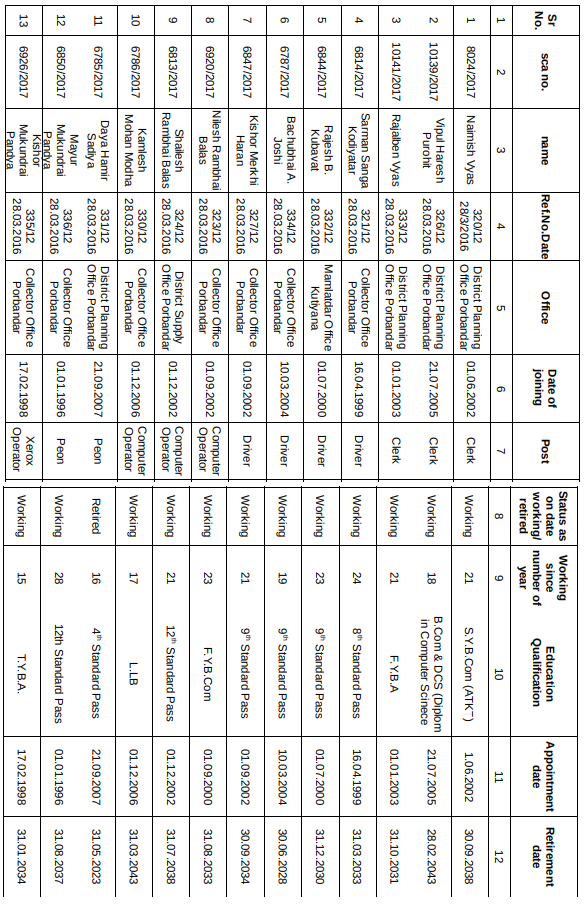
1. Present petitions are filed under Articles 226 and 227 of the Constitution of India challenging the judgment and award dated 28.03.2016 passed by the learned Industrial Tribunal, Jamnagar in various References on same date, the details of which are stated as under:
2. Special Civil Application No.6786 of 2017 is filed against the judgment and award dated 28.03.2016 passed by the learned Industrial Tribunal, Jamnagar in Reference (IT) No.330 of 2012, whereby the directions were issued to consider the service of the respondent herein as a permanent employee from the date when the respondent completed 240 days of continuous service after joining of the respondent in the year 2006. The respondent sangh issued the demand notice for 14 persons for the purpose of making them permanent employees and giving the benefits of permanency from the date on which they completed 240 days of continuous service. This notice was issued on 21.02.2011 and thereafter on 03.03.2011 the respondents were orally instructed not to resume the duties and their services were terminated. On raising the dispute before the Assistant Labour Commissioner, the dispute remained pending and during that period of time the petitions were filed before this Court being Special Civil Application No.4060 of 2011 and this Court vide order dated 29.03.2011 directed the petitioner not to relieve the respondents till 18.04.2011. Thereafter, the respondents were permitted to resume the duty. The State has challenged the aforesaid order by preferring the Letters Patent Appeal before this Court and this Court has again issued the directions vide order dated 18.04.2011 directing to continue the respondent upto 02.05.2011. On submissions of the failure report of the Assistant Labour Commissioner, the dispute was referred to the Deputy Labour Commissioner, Rajkot and thereafter the dispute was referred before the Industrial Tribunal, Rajkot. Thereafter on 12.07.2011, the complaint came to be filed before the Industrial Tribunal, Rajkot and the Industrial Tribunal Rajkot has passed an order dated 26.09.2011 directing the present petitioner to maintain the status quo till the final disposal of the Reference.
3. Again, petitions were filed before this Court being Special Civil Application No.16032 of 2012 and allied matters and the same was disposed of vide oral order dated 04.12.2012 on the statement of the learned AGP that the respondents are already relieved. Again the State has approached before the Apex Court by way of preferring the Special Leave Petitions, which were also dismissed at the stage of condonaton of delay on 21.07.2012. Learned Industrial Tribunal after considering the pursis filed by the respondent-workman and the endorsement made by the learned advocate for the State regarding continuous service has allowed the Reference on merits on 28.03.2016, which is the subject matter of challenge before this Court.
4. The facts arising out of other allied matters submitted by the learned AGP are relevant to be reproduced hereinbelow:
4.1. In SCA No. 8024/2017, the present petition has been arisen from IT Reference no. 320/2012, respondent (employee) Naimish Vyas was posted as a clerk with District Planning office, Collector Office Porbandar (employer) from the date 18/04/2004 (date of joining) and he was orally terminated on 03/03/2011.
4.2. In SCA No. 10139/2017, the present petition has been arisen from IT Reference no. 326/2012, respondent (employee) Vipul Haresh Purohit was posted as a clerk with District Planning office, Collector Office Porbandar (employer) from the date 21/07/2005 (date of joining) and he was orally terminated on 03.03.2011.
4.3. In SCA No. 10141/2017, the present petition has been arisen from IT Reference no. 333/2012, respondent (employee) Rajalben Vyas was posted as a clerk with District Planning office, Collector Office Porbandar (employer) from the date 01/01/2002 (date of joining) and he was orally terminated on 03/03/2011.
4.4. In SCA No
AI
Long-term continuous service of employees necessitates regularization despite initial irregularities, highlighting unfair labor practices by employers.

Prolonged continuous service of employees necessitates regularization irrespective of absence of sanctioned posts, reinforcing the obligation of fair employment practices by the state.


Regularization of service requires proof of unfair labor practices; long service alone does not confer entitlement without due procedure.
Part-time employees cannot claim regularization or parity in salary with regular employees without a sanctioned post, regardless of the length of service.
Long-term engagement of employees for over 240 days establishes entitlement to regularization, reinforcing the principle against unfair labor practices applicable to public sector employment.
Employers cannot deny regularization to employees engaged in perennial work, regardless of claims of temporary employment, as such practices violate statutory obligations and constitute unfair labor ....
Private companies cannot use discretion to justify unfair labour practices, and past financial status as a sick unit does not prevent directions of permanency that may increase financial burden.

Long-serving employees in essential roles are entitled to consideration for regularization despite initial irregular appointments, ensuring fairness and adherence to constitutional principles.
The obligation of the employer to regularise the service of workmen and the prohibition against unfair labour practices under Section 25T of the Industrial Disputes Act 1947.



An indispensable Tool for Legal Professionals, Endorsed by Various High Court and Judicial Officers
Please visit our Training & Support
Center or Contact Us for assistance

Scan Me!
India’s Legal research and Law Firm App, Download now!


For Daily Legal Updates, Join us on :



 Back to top


