
 Back
Back





THE GAUHATI HIGH COURT (HIGH COURT OF ASSAM, NAGALAND, MIZORAM AND ARUNACHAL PRADESH)
Kalyan Rai Surana, J.
Jitul Ali, S/O Yasin Ali – Petitioner
Versus
The Union Of India Represented By The Narcotic Control Bureau – Respondent
Bail Appln. 1635 of 2025
Decided On : 16-06-2025
| Table of Content |
|---|
| 1. case background and procedural history of the bail application. (Para 1 , 2 , 3) |
| 2. parties' arguments on procedure and trial delay. (Para 4 , 5 , 6) |
| 3. analysis of constitutional and statutory requirements regarding communication of arrest grounds. (Para 7 , 8 , 9 , 10 , 11 , 12 , 13 , 14) |
| 4. sufficiency of a 'memorandum of arrest' to satisfy mandatory statutory compliance for informing an accused of arrest grounds. (Para 15 , 16 , 17 , 18 , 19 , 20 , 21 , 22 , 23 , 24 , 25) |
| 5. application of the twin conditions of section 37 ndps act and assessment of trial delay for bail. (Para 26 , 27 , 28) |
| 6. formal rejection of the bail application. (Para 29) |
ORDER :
KALYAN RAI SURANA, J.
Heard Mr. Y.S. Mannan, learned counsel for the petitioner. Also heard Mr. S.C. Keyal, learned standing counsel for the NCB.
2. On 18.12.2022, the petitioner was arrested in connection with NCB Guwahati Case No. 24/2022 under Section 8(c)/20(b)(ii)(C) and Section 29 of the NDPS Act along with two others. On 19.12.2022, he was produced before the Court of learned Chief Judicial Magistrate, Amingaon, Kamrup. The petitioner was sent to one day NCB remand. After his medical examination, the petitioner was produced before the Court of learned Sessions Judge, Amingaon, Kamrup.
3. The earlier prayer for bail for the petitioner was rejected by this Court by order dated 26.06.2024 passed in BA 4258/2023 as well as by order dated 20.11.2024 passed in BA 2732/2024. According to the learned counsel for the petitioner, this is a third application for bail before this Court by way of an application made under Section 483 of BNSS, 2023.
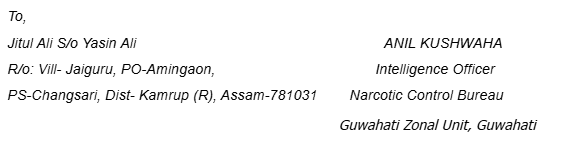
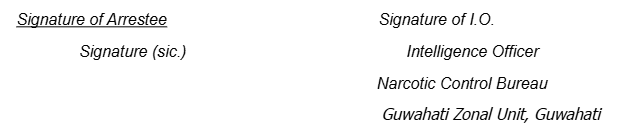
4. It is submitted that the new ground on which this bail application has been filed is that while arresting the petitioner, he was only served with a copy of notice under Section 50 of the CrPC. However, no grounds of arrest was served on the petitioner, which is in disregard to the provisions of Section 52 of the NDPS Act; Section 50 of the CrPC [now Section 47(1) of the BNSS, 2023]; and Article 22(1) of the Constitution of India. In support of his submission that for non-furnishing of the grounds of arrest, the petitioner would be entitled to bail, the learned counsel for the petitioner has cited the following cases, viz., (i) Madhu Limaye & Ors. v. Unknown, (1996) 1 SCC 292; (ii) Union Territory of Ladakh & Ors. v. Jammu & Kashmir National Conference & Anr., 2023 SCC Online SC 1140; (iii) Pankaj Bansal v. Union of India & Ors., 2024 (7) SCC 576; (iv) Prabir Purkayastha v. State (Nct of Delhi), (2024) 8 SCC 254; (v) Directorate of enforcement v. Subhash Sharma , 2025 SCC Online 240; (vi) Vihaan Kumar v. The State of Haryana & Anr., 2025 3 Supreme 363; (vii) Kanishk Sinha & Anr. v. The State of West Bengal & Anr., 2025 3 Supreme 117; and, (viii) Ashish Kakkar v. UT of Chandigarh , Crl. Appeal No. 1518/2025.
5. It is also submitted that out 12 witnesses, till date only 4 witnesses have only been examined and therefore, there is remote chance of an early trial.
6. Per contra, the learned standing counsel for the NCB has submitted that in consequence of recovery and seizure of 153.2 kg. of ganja, 179 grams of methamphetamine tablets, 1.020 kg. of brown colour substance suspected to be heroin, and 16 bottles of codeine based Anrex- CP cough syrup, the petitioner was arrested and he was provided with a memorandum of arrest, which contains the reasons of arresting the petitioner. Accordingly, it has been submitted that the same was in due compliance of the prescribed procedure. Moreover, it has been submitted that the intimation of his arrest was given by the petitioner to his wife on her mobile number xxxxx145 (phone number is masked in this order) after his arrest on 18.12.2022. In support of his submissions, the learned standing counsel for the NCB has cited the following cases, viz., (i) P Soul & Ors., v. the Union of India, Bail Appln. No. 1462/2025, decided on 04.06.2025; (ii) Md. Faruque Khan v. The Union of India , Bail Appln
AI


Failure to communicate arrest grounds does not automatically entitle a petitioner to bail involving serious narcotics charges under the NDPS Act.

Strict compliance with statutory provisions regarding notice to relatives during arrest is essential to safeguard the accused's rights under Article 21 of the Constitution.

Bail in NDPS commercial quantity cases requires satisfying Section 37 twin conditions. Red-handed contraband recovery obviates formal grounds of arrest communication if no prejudice shown via arrest ....

Compliance with Article 22(1) requires written grounds of arrest conveyed effectively to the arrested individual.

The failure to communicate grounds of arrest constitutes a violation of constitutional rights under Articles 21 and 22(1), rendering the arrest illegal and necessitating bail even amidst statutory re....
Compliance with Section 50 of the Cr.P.C. and the seriousness of charges under the NDPS Act negate the automatic entitlement to bail, despite prolonged incarceration.



An indispensable Tool for Legal Professionals, Endorsed by Various High Court and Judicial Officers
Please visit our Training & Support
Center or Contact Us for assistance

Scan Me!
India’s Legal research and Law Firm App, Download now!


For Daily Legal Updates, Join us on :



 Back to top


