
 Back
Back





IN THE GAUHATI HIGH COURT (HIGH COURT OF ASSAM, NAGALAND, MIZORAM AND ARUNACHAL PRADESH) AT KOHIMA BENCH
PRANJAL DAS, J.
Royal Sundaram G.I.C. Ltd. – Appellant
Versus
Bharati Bhuyan Konwar W/o Late Raghi Konwar – Respondent
I.A. (Civil) No. 210 of 2024
Decided On : 28-04-2026
| Table of Content |
|---|
| 1. establishing the factual background and timeline of the delay in filing the appeal. (Para 1 , 2 , 3 , 4) |
| 2. parties' arguments regarding whether 321 days constitutes sufficient cause for condonation of delay. (Para 5 , 6 , 7 , 8 , 9 , 10 , 11) |
| 3. resolution of conflicting precedents concerning whether merits of a case can be considered during delay condonation. (Para 12 , 13 , 14 , 15 , 16 , 17 , 18 , 19 , 20) |
| 4. requirement for realistic and bona fide explanation of delay, even for organizational litigants. (Para 21 , 22) |
| 5. application of legal principles to specific facts leading to the rejection of the delay condonation application. (Para 23 , 24 , 25 , 26 , 27) |
JUDGMENT :
PRANJAL DAS, J.
1. Heard Mr. Vikramjeet Devnath, learned counsel for the applicant. Also heard Mr. Tongpok Pongener, learned counsel and Mr. Laknyei Phom, learned counsel for the respondent nos. 1 and 2.
2. The applicant/Insurance company is seeking to file an appeal under Section 173 of the MV Act, 1988 against the Judgment and Award dated 16.10.2023 passed by the learned Member, MACT, Mokokchung in MAC case No. 40 of 2018, whereby the Tribunal was pleased to award a total compensation of Rs. 23,59,800/- (Twenty Three Lakhs Fifty Nine Thousand Eight Hundred) to the claimants (respondent no. 1 and 2 herein) along with interest of 7.5% per annum from the date of filing of the claim petition. However, there is stated to be a delay of 321 days in preferring the appeal and hence an application has been filed under Section 5 of the Limitation Act, 1963, thereby giving rise to the instant interlocutory proceeding.
3. The applicant/Insurance company has narrated the grounds of delay in para 7 thereof. The applicant has also filed an additional affidavit wherein also in paragraphs 2 and 3, narration regarding the delay and its explanation thereof has been given. The explanation regarding the delay, including the various dates that emerges from para 7 of the delay condonation petition and para 2 and 3 of the additional affidavit may be enumerated in the following tabular format:-
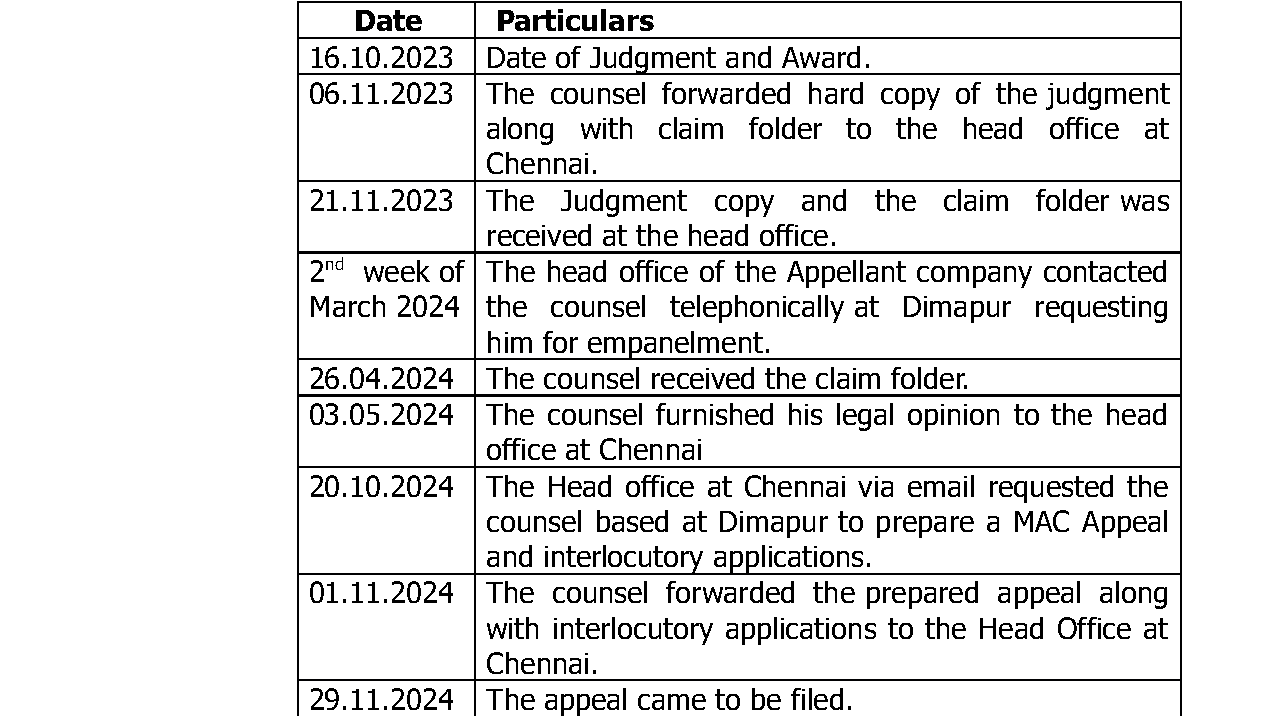
4. In the affidavit-in-opposition filed by the respondent Nos. 1 and 2, it is stated that 5 months and 19 days lapsed from the date of receipt of the Judgment by the Panel Lawyer and processing of the same at the Head Office of the applicant at Chennai. It is also stated that though legal opinion was given on 03.05.2024 to the Head Office, but after 5 months and 19 days, the Head Office on 20.10.2024 instructed the counsel to prepare the MAC Appeal.
5. It is stated and submitted that there was delay on the part of the applicant at every stage and except for mentioning the dates and the decisions taken, there was no explanation as to why the delay had occasioned. In this backdrop, the respondent Nos. 1 and 2, contends that the said statements should not be accepted as showing sufficient cause for condoning the delay of 321 days. It is also stated and contended that the applicant has taken a casual and negligent attitude and that, except mentioning dates, the applicant has failed to give any cogent reasons to condone the delay, which is also on the higher side.
6. The learned counsel for the applicant drawing attention to Paragraph 7 of the main application, and Paragraph 2 of the additional affidavit, has submitted that the said paragraphs have enumerated the explanations for the delay that occurred in filing the appeal. It is submitted that when the impugned judgment was rendered, he was not yet empanelled by the Insurance Company and only subsequently, he came to be empanelled and that this also contributed to the delay. It is submitted that in several decisions, the Hon’ble Supreme Court has indicated that a liberal approach should be adopted on the question of delay condonation.
7. He further submits that in the impugned judgment, though the claim petition was filed under Section 163A of the MV Act 1988, but the learned Tribunal stating that the 2019 amendment had abolished the
AI


Point of Law : LPA is 916 days and as such the consideration to condone can be made only if there is reasonable explanation and the condonation cannot be merely because the appellant is public body. ....

The main legal point established in the judgment is the requirement of 'sufficient cause' for condoning delay in filing appeals under Section 173 of the Motor Vehicles Act, 1988.
Point of law: claim on account of impersonal machinery and inherited bureaucratic methodology of making several notes cannot be accepted in view of the modern technologies being used and available. T....

The court determined that internal miscommunication within the insurer does not justify a delay of over 300 days in filing an appeal, emphasizing statutory obligations to act with diligence.

The court held that mere excuses do not constitute sufficient cause for condoning a significant delay in filing an appeal, emphasizing the need for diligence in pursuing legal remedies.

The Court must balance the need for substantial justice against the necessity of adhering to procedural timelines, requiring satisfactory explanations for delays.



An indispensable Tool for Legal Professionals, Endorsed by Various High Court and Judicial Officers
Please visit our Training & Support
Center or Contact Us for assistance

Scan Me!
India’s Legal research and Law Firm App, Download now!


For Daily Legal Updates, Join us on :



 Back to top


