
 Back
Back





IN THE HIGH COURT OF KERALA AT ERNAKULAM
SATHISH NINAN, P.V. BALAKRISHNAN, JJ.
P.J. John and Ors. – Appellants
Versus
P.J. George and Ors. - Respondents
R.F.A. Nos.313 & 362 of 2003
Decided On : 20-11-2024
(A) Transfer of Property Act - Section 6(a) - Partition suit - Claims for partition by the first plaintiff were dismissed based on a Settlement Deed (Ext.B1) executed by the father, establishing estoppel against future claims. The second plaintiff's claim was upheld as she was not a party to the prior partition deed (Ext.B2) and had not relinquished her rights. (Paras 23, 24)
(B) Estoppel - The court reiterated that estoppel applies when an expectant heir accepts consideration for relinquishing rights, preventing future claims. (Paras 10, 12)
Facts of the case:
The plaintiffs sought partition of properties belonging to their deceased father, Varu Joseph, with claims contested based on prior settlement and partition deeds.
Findings of Court:
The first plaintiff's claim was dismissed due to estoppel from the Settlement Deed, while the second plaintiff was entitled to her share as she had not relinquished her rights.
Issues: The court addressed the validity of the claims based on prior deeds and the application of estoppel.
Ratio Decidendi: The court held that acceptance of a settlement deed operates as estoppel against future claims, while lack of participation in a prior partition allows for subsequent claims.
Result: The appeal of the second plaintiff was allowed, granting her a share in the properties, while the first plaintiff's appeal was dismissed.
JUDGMENT :
(Sathish Ninan, J.)
These appeals are by the plaintiffs 1 and 2 respectively, in a suit for partition. The suit was dismissed by the trial court.
2. The properties sought to be partitioned belonged to late Varu Joseph(hereinafter referred to as “Varu”). The first plaintiff, and defendants 1 and 2, are the children born to Varu in his first wife Thresiyamma. The second plaintiff and defendants 3 to 7 are the children born to Varu in his second wife Annakutti. Varu died on 12.12.1972. Thresiyamma died on 10.08.1940. Annakutti died on 17.01.1975. The suit is filed seeking partition alleging intestate succession.
3. The suit was resisted by defendants 3, 4 and 7. In their written statement, the claim of the first plaintiff for partition was defended relying on Ext.B1 Settlement Deed dated 28.11.1959, executed by Varu Joseph in favour of the children born in the first marriage viz. the first plaintiff, first defendant and second defendant. It was contended that the settlement of properties under Ext.B1 was in lieu of their shares in the father's property. Having accepted Ext.B1, they are estopped from claiming any further rights over the plaint schedule properties which are the remaining properties of the father, was the contention.
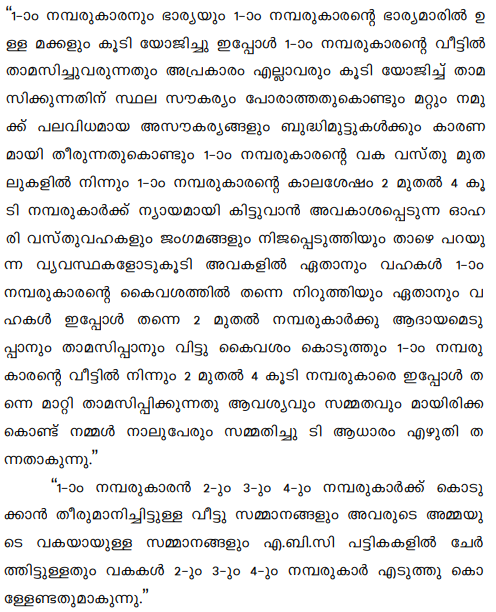
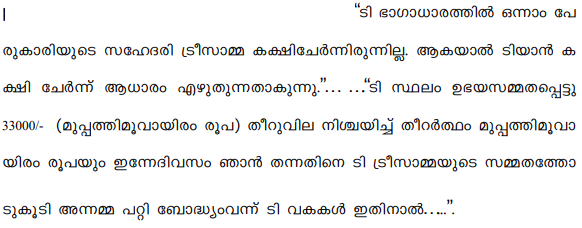
4. With regard to the claim of the second plaintiff, it was contended that the share due to her was provided at the time of her marriage. All the other children of Varu Joseph in the second marriage, viz. defendants 3 to 7, had executed Ext.B2 Partition Deed on 27.06.1981. Therein, the factum of the second plaintiff having been provided with her share and the consequent non-allotment of any properties to her was specifically narrated. The second plaintiff had acknowledged and affirmed the above in Ext.B3 Sale Deed executed by the 7th defendant in favour of a third party, who is impleaded in the suit as the 9th defendant. The second plaintiff had joined in Ext.B3 Sale Deed for such purpose. Therefore, the claim for partition by the second plaintiff cannot be sustained, it was contended. A plea of adverse possession and ouster was also urged. So also, a counterclaim was raised seeking partition of the properties covered under Ext.B1 claiming that, if Ext.B1 is found to be void the said properties are also liable to be partitioned.
5. The trial court held that, by virtue of Ext.B1, the claim of the first plaintiff cannot be sustained. The claim of the second plaintiff was negatived relying on the recitals in Exts.B2 and B3 documents. The suit and the counterclaim were dismissed. Plaintiffs 1 and 2 filed separate appeals. There is no appeal challenging the dismissal of the counterclaim.
6. We have heard Sri.George Varghese Perumpallikuttiyil, the learned counsel for the first plaintiff-appellant, Sri.Varghese Kuriakose, the learned counsel for the second plaintiff-appellant, Sri.George Cherian, the learned Senior Counsel, Sri. K. G. Balasubramaniyan and Sri. V.R.Kesava Kaimal on behalf of the contesting respondents.
7. The points that arise for determination in these appeals are: -
(i) Was the trial court right in having negatived the claim of the first plaintiff, by relying on Ext.B1 Settlement Deed?
(ii) Was the trial court right in upholding the relinquishment of rights under Ext.B1, in the light of Section 6(a) of the Transfer of Property Act?
(iii) Was the trial court right in having negatived the claim of the second plaintiff by holding that under Exts.B2 and B3 documents she had acknowledged relinquishment of her rights?
8. Ext.B1 is the Settlement Deed of the year 1959. It was executed by Varu, the father of the plaintiffs and defendants 1 to 7. It is executed in favour of the first plaintiff and defendants 1 and 2 who are the children born to him in his first wife. Ext.B1 recites that the properties thereunder are settled in favour of the first plaintiff and defendants 1 and 2 in lieu of the share which they would normally inherit from their father. Therefore, in the light of Ext.B1 settle


AI
Estoppel applies when an expectant heir accepts consideration for relinquishing rights, preventing future claims, while lack of participation in prior deeds allows for subsequent claims.
A family settlement prevents heirs from claiming rights by inheritance if they were part of the original settlement, establishing exclusive possession by one party.

The main legal point established in the judgment is the requirement for compulsory registration of family settlement documents under Section 17(1)(b) of the Registration Act, 1908, and the inadmissib....

An unregistered partition deed is inadmissible and requires registration to be binding, emphasizing the need for substantiation of partition claims.

The property in question ceased to be ancestral due to prior Release Deeds; plaintiffs failed to prove their claim for partition and their action was barred by limitation.
Documents executed under familial trust must meet legal standards of consent to avoid being deemed void; misrepresentation necessitates formal cancellation procedures.
The 1961 partition deed, once accepted, overrides earlier settlement claims, establishing statutory sanctity and barring challenges due to lack of timely action.
Suit for partition – Minor - Right of avoidance based on the inequality of the shares is a personal right of the minors and cannot be exercised by others - Power is not a conditional power in the se....



An indispensable Tool for Legal Professionals, Endorsed by Various High Court and Judicial Officers
Please visit our Training & Support
Center or Contact Us for assistance

Scan Me!
India’s Legal research and Law Firm App, Download now!


For Daily Legal Updates, Join us on :



 Back to top


