
 Back
Back





IN THE HIGH COURT OF KERALA AT ERNAKULAM
C. JAYACHANDRAN, J
Sidhique Chundakadan S/o Muhammed Kutty - Appellant
Versus
State Of Kerala - Respondent
CRL.MC NO. 8923 OF 2023
Decided On : 06-02-2025
(A) Juvenile Justice (Care and Protection of Children) Act, 2015 - Section 75 - Quashment of FIR and final report against accused for alleged supervisory lapse leading to minor's death - Allegations insufficient to constitute 'willful neglect' as defined under the Act - Supervisory lapse does not equate to intentional or deliberate neglect. (Paras 3 - 14 )
(B) Legal definition of 'willful' - Must be intentional and deliberate, not merely negligent. (Paras 10 - 12 )
Facts of the case:
Petitioner, accused of supervisory lapse in a case where a minor inmate died after being assaulted by others, sought to quash charges under Section 75 of the J.J. Act, arguing that mere supervisory failure does not amount to willful neglect.
Findings of Court:
The court found that the petitioner was not aware of the presence of major inmates with minors, and thus, the allegations constituted only a supervisory lapse.
Issues: Whether the petitioner's actions constituted 'willful neglect' under Section 75 of the J.J. Act.
Ratio Decidendi: The court held that 'willful neglect' necessitates intentional actions, and as the petitioner was unaware of the situation, charges under Section 75 could not stand.
Result: Crl.M.C. allowed; FIR and proceedings quashed against the petitioner.
ORDER :
The petitioner is the 7th accused in Crime no.54/2020 of Chevayur Police Station, Kozhikode, now pending before the IInd Additional Sessions Court, Kozhikode as S.C. No.860/2022. The petitioner seeks quashment of the said crime, as also, all further proceedings therefrom, on the premise that the offence alleged under Section 75 of the Juvenile Justice (Care and Protection of Children) Act, 2015 (for short, ‘J.J. Act’) will not lie in the given facts and circumstances.
2. Heard the learned Counsel for the petitioner and the learned Public Prosecutor. Perused the records.
3. The prosecution allegations are as follows:
One Ajin, aged 6 years, who was inmate of the Home for Mentally Deficient Children (HMDC) at Vellimadukunnu, Kozhikode, urinated while sleeping. Infuriated by the same, certain other inmates (accused nos.1 to 4) have assaulted the said Ajin and he succumbed to death. Accused nos.5 and 6 are the Multi Task Care Providers of the said institution, who permitted children who have attained majority to stay along with the minor children, contrary to specific instructions in this regard. The specific allegation against petitioner/A7 is that he has committed supervisory lapse in permitting major inmates to stay along with the minors. On such premise, the third accused, who was a major at the time of incident, was mulcted with charge under Section 302 of the Penal Code and accused nos.5 to 7, including the petitioner, was called upon to answer the charge under Section 75 of the J.J. Act.
4. Learned Counsel for the petitioner submits that, even going by the prosecution allegations, the only charge against the petitioner is with respect to supervisory lapse, which cannot attract the offence under Section 75 of the J.J. Act. Learned Counsel would submit that disciplinary action has already been initiated against the petitioner, which culminated in withholding two increments. Supervisory lapse alleged, simultaneous with absence of knowledge that inmates who have attained majority are staying with minor inmates, cannot amount to willful neglect in the context of Section 75 of the J.J. Act, is the argument advanced.
5. Refuting the above submissions, the learned Public Prosecutor would point out that, it was on account of the willful neglect of petitioner/A7 that the victim Ajin had to face the extreme fate of death, at the hands of accused nos.1 to 4, among whom, one has attained majority at the time of incident. It was pointed out that there were other major inmates, who were permitted to stay along with the minor inmates, contrary to the circular/instructions in this regard. Learned Public Prosecutor would point out that, if the person, who is having actual charge or control of the child, acts in a negligent manner, so as to cause unnecessary mental or physical suffering, the offence under Section 75 of the J.J. Act is committed.
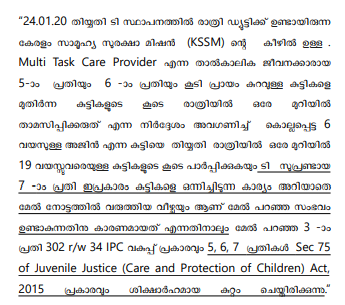
6. Having heard the learned Counsel appearing for the respective parties, this Court finds considerable force in the submissions made by the learned Counsel for the petitioner. That part of the final report, which constitute the allegations against the petitioner/A7 is extracted here below:
(underlined for emphasis)
7. It is clear from the above final report that, even as per the prosecution version, petitioner/A7 was not aware of the fact that the major inmates are also permitted to stay along with the minor inmates during night; and all what is seen alleged is supervisory lapse, albeit being unaware of the above fact.
8. This Court will now extract the offence under Section 75 of the J.J.Act.
“Whoever, having the actual charge of, or control over, a child, assaults, abandons, abuses, exposes or wilfully neglects the child or causes or procures the child to be assaulted, abandoned, abused, exposed or neglected in a manner likely to cause such child unnecessary mental or physical suffering, shall be punishable with imprisonment for a term which may extend to three years or with fine of one lakh rupees or
To constitute 'willful neglect' under Section 75 of the J.J. Act, actions must be intentional and deliberate, not merely negligent.
The conduct of reprimanding a child did not constitute cruelty under the Juvenile Justice Act.

The interpretation of 'actual charge of, or control over' a child under Section 75 of the J.J. Act, 2015 should be construed in a strict sense, and liability under the provision depends on the actual....

Disciplinary measures in schools, such as enforcing a uniform dress code, do not constitute cruelty under the Juvenile Justice Act.
Insufficient evidence was found to support charges under the Juvenile Justice Act against the petitioner as she was not in actual control of the children and her actions did not constitute abuse.

The legal responsibility of guardianship regarding child welfare under the Juvenile Justice Act and implications of abandonment.

A person must have actual charge or control over a child to be held liable under Section 75 of the Juvenile Justice Act. Mere managerial responsibility does not confer such control.
The court clarifies that abandonment under Section 75 of the JJ Act does not require the act of leaving a child to be 'wholly' neglectful as per Section 317 IPC.
The necessity for control over a minor under Section 75 of the Juvenile Justice Act for applicable charges.
The court emphasized the requirement of actual charge or control over a child for the offence under Section 75 of the Juvenile Justice (Care and Protection of Children) Act, 2015.



An indispensable Tool for Legal Professionals, Endorsed by Various High Court and Judicial Officers
Please visit our Training & Support
Center or Contact Us for assistance

Scan Me!
India’s Legal research and Law Firm App, Download now!


For Daily Legal Updates, Join us on :



 Back to top


