Back
Back





2025 Supreme(Ker) 756
IN THE HIGH COURT OF KERALA AT ERNAKULAM
C.S. DIAS, J.
Emy K. Kurian W/o Shobin Thomas - Petitioner
Versus
State of Kerala - Respondent
WP (C) No. 12884 of 2025
Decided On : 04-04-2025
Advocate Appeared:
For the Appellant : BY ADVS. SRI.ALEX K.JOHN SMT.JILCY JACOB SRI.NINAN THOMAS SRI.GEGO GEORGE
For the Respondent: BY SMT.VIDYA KURIAKOSE, GP
IMPORTANT POINT
The court affirmed the importance of reproductive autonomy and the Medical Board's role in assessing health risks in termination of pregnancy cases involving substantial foetal abnormalities.
Headnote:
(A) Medical Termination of Pregnancy Act, 1971 - Section 3 - Writ petition for termination of pregnancy at 28 weeks due to substantial foetal abnormalities - Medical Board recommended against termination despite abnormalities - Court emphasized the need for reproductive autonomy and the role of the Medical Board in assessing risks to health - The court directed the issuance of a certificate regarding foetal abnormalities and permitted the petitioner to seek termination at her own risk. (Paras 1 , 3 , 11 , 12 , 13 )
(B) Reproductive Rights - The right to make reproductive choices is a facet of Article 21 of the Constitution - Courts must consider the medical opinion of the Board regarding risks to health when deciding on termination requests. (Paras 9 , 11 )
Facts of the case:
The first petitioner, in her 24th week of gestation, sought permission to terminate her pregnancy due to substantial foetal abnormalities and risks to her health. The Medical Board found the foetus had serious abnormalities but recommended against termination due to survival chances.
Findings of Court:
The court allowed the writ petition, directing the Medical Board to issue a certificate of abnormalities and permitting the petitioner to seek termination at her own risk.
Issues: The main issues were the assessment of foetal abnormalities and the rights of the pregnant person regarding termination of pregnancy.
Ratio Decidendi: The court ruled that the Medical Board's opinion is crucial in determining the risks involved in continuing a pregnancy, and reproductive autonomy must be respected.
Result: Writ petition allowed.
JUDGMENT :
1. The 1st petitioner is in the 24th week of gestation. The foetus has substantial abnormalities. If the child is born, it would suffer from neurological problems. The 1st petitioner’s life also would be at risk. In view of the stringent provisions of the Medical Termination of Pregnancy Act, 1971 (‘Act’, in short) and as the gestation has reached 24 weeks, the competent authority will not permit the termination of pregnancy unless directed by this Court. Therefore, the 2nd respondent may be directed to terminate the 1st petitioner’s pregnancy. Hence, the writ petition.
2. When the writ petition came up for consideration on 28.03.2025, this Court had directed the 1st petitioner to appear before the Medical Board of the 2nd respondent.
3. In compliance with the directions of this Court, a Medical Board comprising of six doctors of the 2nd respondent had examined the 1st petitioner on 29.03.2025. The Medical Board has opined that the gestation is 28 weeks and the foetus has agenesis of corpus callosum. The 1st petitioner also has a cervical stitch in situ. The Pediatrician has opined that it is a non lethal anomaly with survival chances of 60%, if the termination is done at 28 weeks. Therefore, the Board has unanimously recommended not to terminate the pregnancy.
4. The termination of pregnancy is governed by the Medical Termination of Pregnancy Act, 1971 (‘Act’, in short) and the rules framed thereunder. The Act is a progressive legislation that regulates how pregnancies can be terminated.
5. Section 3 of the Act spells out the conditions to be satisfied to terminate a pregnancy, which reads as follows:
"S.3 - When pregnancies may be terminated by registered medical practitioners.
(1) Notwithstanding anything contained in the Indian Penal Code (45 of 1860), a registered medical practitioner shall not be guilty of any offence under that code or under any other law for the time being in force, if any pregnancy is terminated by him in accordance with the provisions of this Act.
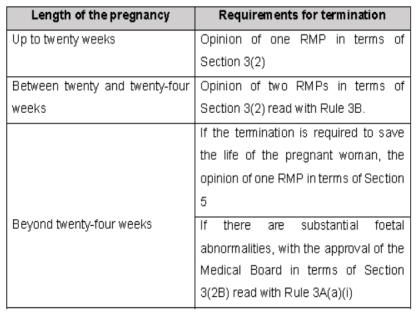
(2) Subject to the provisions of sub-section (4), a pregnancy may be terminated by a registered medical practitioner, ―
(a) where the length of the pregnancy does not exceed twenty weeks, if such medical practitioner, is or (b) where the length of the pregnancy exceeds twenty weeks but does not exceed twenty - four weeks in case of such category of woman as may be prescribed by rules made under this Act, if not less than two registered medical practitioners are, of the opinion, formed in good faith, that―
(i) the continuance of the pregnancy would involve a risk to the life of the pregnant woman or of grave injury to her physical or mental health; or (ii) there is a substantial risk that if the child were born, it would suffer from any serious physical or mental abnormality.
Explanation 1.―For the purposes of clause (a), where any pregnancy occurs as a result of failure of any device or method used by any woman or her partner for the purpose of limiting the number of children or preventing pregnancy, the anguish caused by such pregnancy may be presumed to constitute a grave injury to the mental health of the pregnant woman.
Explanation 2. ― For the purposes of clauses (a) and (b), where any pregnancy is alleged by the pregnant woman to have been caused by rape, the anguish caused by the pregnancy shall be presumed to constitute a grave injury to the mental health of the pregnant woman.
(2A) The norms for the registered medical practitioner whose opinion is required for termination of pregnancy at different gestational age shall be such as may be prescribed by rules made under this Act.
(2B) The provisions of sub-section (2) relating to the length of the pregnancy shall not apply to the termination of pregnancy by the medical practitioner where such termination is necessitated by the diagnosis of any of the substantial foetal abnormalities diagnosed by a Medical Board.
(2C) Every State Government or Union territory, as the case may be, shall, by notification in