
 Back
Back





IN THE HIGH COURT OF KERALA AT ERNAKULAM
SHOBA ANNAMMA EAPEN, J.
Rosamma Joseph W/o Anish Varghese - Appellant
Versus
State of Kerala - Respondent
W.P. (C) No. 19890 of 2025
Decided On : 03-06-2025
(A) Medical Termination of Pregnancy Act, 1971 - Section 3(2-B) - Petitioners sought medical termination of 26-week pregnancy due to multiple foetal anomalies - Medical Board approved termination citing poor postnatal prognosis - Court emphasized the importance of reproductive autonomy and health risks - The petitioners' readiness to care for the child if born was noted. (Paras 1, 4, 14, 16)
(B) Reproductive Rights - The right to make reproductive choices is a facet of Article 21 of the Constitution - Courts must consider medical opinions and the health risks to the pregnant person. (Paras 10, 12)
(C) Medical Board's Role - The Medical Board must assess substantial foetal abnormalities and the risks involved in continuing the pregnancy. (Paras 9, 12)
Facts of the case:
The petitioners, parents of two daughters, sought termination of pregnancy due to severe foetal anomalies identified in medical scans.
Findings of Court:
The court directed the Medical Team to proceed with the termination, emphasizing the need for immediate action based on medical advice.
Issues: The main issues included the assessment of health risks to the mother and the implications of substantial foetal abnormalities.
Ratio Decidendi: The court ruled that the Medical Board's assessment of foetal anomalies justified the termination, reinforcing the importance of reproductive rights and health considerations.
Result: Writ petition disposed of with directions for termination of pregnancy.
JUDGMENT :
1. The petitioners are wife and husband, who have been seeking medical termination of 26-weeks-old pregnancy as on 28.05.2025, after having found multiple anomalies to the foetus, viz., mesomelic shortening of bilateral forearm with absent/hypostatic radius and bilateral club hand - radial ray anomaly, crossed fused foetal kidneys in right side, cervical hemivertebrae, ccTGA and single umbilical artery. The petitioners are also parents of two daughters aged 6 and 3 years old. According to the petitioners, as per Exts.P5 and P7 scan reports, the doctors opined that the foetus suffers from multiple anomalies. The petitioners, therefore, seek for a direction to the respondents to permit the first petitioner to undergo medical termination of pregnancy.
2. Heard the learned counsel for the petitioners and the learned Government Pleader.
3. When the writ petition came up for consideration on 28.05.2025, this Court directed the fourth respondent to constitute a Medical Board for the purpose of assessing the following:-
a) Whether continuance of the first petitioner's pregnancy will involve risk to her life or grave injury to her physical or mental health?
b) Whether there is a substantial risk that if the child is born, it will suffer from such physical or mental abnormalities as to be seriously handicapped and if so, the nature of abnormalities.
c) Whether, having regard to the advanced stage of pregnancy, is there any danger (other than usual danger which arises even in spontaneous delivery at the end of full term) if the pregnant mother is permitted to terminate her pregnancy?
4. On 03.06.2025, the learned Government Pleader made available before this Court the report of the Medical Board dated 30.05.2025 comprising of two Professors of Obstetrics and Gynaecology Department, Assistant Professor of Psychiatry Department, Assistant Professor of Radiodiagnosis Department, Assistant Professor of Paediatrics (Neonatology) Department, Assistant Professor of Cardiology Department and Assistant Professor of Orthopedics Department of the Government Medical College Hospital, Kottayam. The Medical Board allowed termination of pregnancy, justifying the decision that postnatal prognosis for normal development of the child is poor and if the child is born, it will suffer from physical abnormalities that make the child seriously handicapped. The physical fitness of the first petitioner for termination of pregnancy is also answered in positive.
5. The Medical Report reveals that the first petitioner has completed 27 weeks. Learned counsel for the petitioners submits that the petitioners are prepared to proceed with the termination of pregnancy even by ‘C’ section at the Government Medical College, Kottayam. He placed reliance on the Government of India guidelines that are referred to by the Honourable Supreme Court in A (Mother of X) v. State of Maharashtra, (2024) 6 SCC 327 to support his submission.
6. The termination of pregnancy is governed by the Medical Termination of Pregnancy Act, 1971 (‘Act’ in short) and the rules framed thereunder. The Act is a progressive legislation that regulates how pregnancies can be terminated.
7. Section 3 of the Act spells out the conditions to be satisfied to terminate a pregnancy, which reads as follows:
"S.3 - When pregnancies may be terminated by registered medical practitioners.—
(1) Notwithstanding anything contained in the Indian Penal Code (45 of 1860), a registered medical practitioner shall not be guilty of any offence under that code or under any other law for the time being in force, if any pregnancy is terminated by him in accordance with the provisions of this Act.
(2) Subject to the provisions of sub-section (4), a pregnancy may be terminated by a registered medical practitioner ―
(a) where the length of the pregnancy does not exceed twenty weeks, if such medical practitioner, is or
(b) where the length of the pregnancy exceeds twenty weeks but does not exceed twenty - four weeks in case of such cate
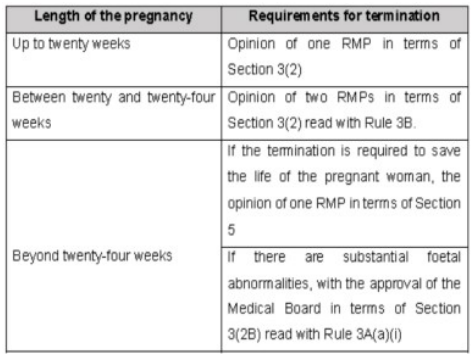
The court affirmed the right to terminate a pregnancy with substantial foetal abnormalities, emphasizing reproductive autonomy and health risks under the Medical Termination of Pregnancy Act.

The court affirmed the importance of reproductive autonomy and the Medical Board's role in assessing health risks in termination of pregnancy cases involving substantial foetal abnormalities.
The court affirmed the right to terminate a pregnancy with substantial foetal abnormalities, emphasizing the importance of medical opinion and reproductive autonomy under Article 21.
The judgment affirms the fundamental right to reproductive autonomy, emphasizing that termination of pregnancy is permissible based on substantial foetal abnormalities regardless of gestational age.

The right to terminate a pregnancy with substantial abnormalities is upheld under the Medical Termination of Pregnancy Act, emphasizing women's rights and health considerations.
The court reaffirmed the right to terminate a pregnancy based on substantial fetal abnormalities impacting health under the Medical Termination of Pregnancy Act.
The right to terminate a pregnancy beyond specified limits is upheld when substantial fetal abnormalities are confirmed.
The judgment underlines the importance of reproductive autonomy and medical advice in cases of severe foetal abnormalities, allowing termination beyond statutory limits if justified.
The judgment reaffirms the importance of reproductive rights and decisional autonomy of women, as well as the legal provisions under the Medical Termination of Pregnancy Act, 1971, and Article 21 of ....
The court affirmed reproductive autonomy and the legality of terminating pregnancies with substantial fetal abnormalities under the Medical Termination of Pregnancy Act.



An indispensable Tool for Legal Professionals, Endorsed by Various High Court and Judicial Officers
Please visit our Training & Support
Center or Contact Us for assistance

Scan Me!
India’s Legal research and Law Firm App, Download now!


For Daily Legal Updates, Join us on :



 Back to top


