
 Back
Back





IN THE HIGH COURT OF KERALA AT ERNAKULAM
ANIL K. NARENDRAN, MURALEE KRISHNA S., JJ.
Sree Akhora Shiva Temple - Petitioner
Versus
State of Kerala - Respondent
WP (C) No. 4326 of 2024
Decided On : 18-02-2025
(A) Madras Hindu Religious and Charitable Endowments Act, 1951 - Sections 39 and 41 - Writ petition filed by hereditary trustees challenging the appointment of non-hereditary trustees without maintaining proportion - Court held that appointment must follow statutory provisions and require notice and enquiry regarding management of the institution. (Paras 1 , 8 , 19 )
(B) Judicial Review - The court emphasized the necessity of adhering to statutory mandates in appointing trustees to ensure proper governance and representation. (Paras 19 , 20 )
Facts of the case:
The petitioner, a hereditary trustee, challenged a notification for appointing non-hereditary trustees, claiming it violated the Act and disrupted the administration of the temple.
Findings of Court:
The court set aside the notification and directed an enquiry before any fresh appointment of non-hereditary trustees, ensuring compliance with statutory requirements.
Issues: The main issues were whether the appointment of non-hereditary trustees was valid under the Act and the necessity of maintaining a proportionate representation of hereditary trustees.
Ratio Decidendi: The court ruled that the appointment of non-hereditary trustees must be based on a proper enquiry and cannot be made routinely, emphasizing the need for adherence to statutory provisions.
Result: Writ petition allowed, Ext.P5 notification quashed.
JUDGMENT :
Anil K. Narendran, J.
1. The petitioner and the additional 7th respondent are the hereditary trustees of Panthalayani Sree Akhora Shiva Temple, Koyilandi, which is a controlled institution under the 2nd respondent Malabar Devaswom Board. The petitioner has filed this writ petition under Article 226 of the Constitution of India, seeking a writ of certiorari to quash Ext.P5 notification dated 27.01.2024 issued by the 5th respondent Assistant Commissioner, Malabar Devaswom Board inviting applications for appointment as non-hereditary trustees in the Board of Trustees of Panthalayani Sree Akhora Shiva Temple. The petitioner has also sought for a declaration that respondents 5 and 6, namely, the Assistant Commissioner and the Area Committee of Malabar Devaswom Board, Kozhikode Division are bound to maintain an equal proportion between the number of hereditary and non- hereditary trustees in the Board of Trustees of Panthalayani Sree Akhora Shiva Temple, in order to ensure effective participation of both in the administration of the temple and also for transparency in administration; a writ of mandamus commanding the 4th respondent Deputy Commissioner to consider and pass orders on Ext.P3 representation dated 01.11.2023, within a time frame to be fixed by this Court, after affording an opportunity of being heard to the petitioner.
2. In the writ petition, it is averred that Panthalayani Sree Akhora Shiva Temple and Sree Kaliyambath Bhagavathi Temple are under the management of the same Board of Trustees. Non-hereditary trustees were being appointed to the above temples without maintaining proportion to the number of hereditary trustees, thereby making the hereditary trustees mere spectators in administration. In this writ petition, the petitioner seeks a declaration that respondents 4 and 5 are bound to maintain proportion in the number of hereditary and non-hereditary trustees. The 5th respondent Assistant Commissioner issued Ext.P5 notification dated 27.01.2024 for the appointment of non-hereditary trustees. Ext.P1 partition deed No.935/1958 shows that Panthalayani Sree Akhora Shiva Temple and Sree Kaliyambath Bhagavathi Temple were the family temples and the said document authorises the family members to maintain the temples.
3. On 05.02.2024, when this writ petition came up for admission, the matter was admitted on file. The learned Senior Government Pleader took notice for the 1st respondent State and the learned Standing Counsel for Malabar Devaswom Board for respondents 2 to 6. By a detailed order dated 05.02.2024, this Court granted an interim stay of Ext.P5 notification dated 27.01.2024 issued by the 5th respondent Assistant Commissioner, Kozhikode for a period of one month.
4. By the order dated 05.02.2024, the learned Standing Counsel for Malabar Devaswom Board was directed to make available for the perusal of this Court the files relating to Ext.P5 notification dated 27.01.2024 issued by the 5th respondent Assistant Commissioner and also the relevant files maintained in the office of the 3rd respondent Commissioner and the 6th respondent Area Committee regarding the appointment of non- hereditary trustees in Panthalayani Sree Akhora Shiva Temple.
5. On 23.10.2024, the learned Standing Counsel for Malabar Devaswom Board made available for the perusal of this Court the files relating to the appointment of the non-hereditary trustee in Panthalayani Sree Akhora Shiva Temple, originally made in the year 2017.
6. In the order dated 20.11.2024, after perusal of the said files, this Court noticed that the appointment of non- hereditary trustees for the first time in the year 2021 was made based on a request made by one among the hereditary trustees, namely, Vasudevan M.K., the additional 6th respondent herein. Ext.P5 notification is issued based on another request made by the said hereditary trustee. By the order dated 25.11.2024 in I.A.No.1 of 2024, notice was ordered to one Vasudevan Kaliyambath, the other hereditary trust
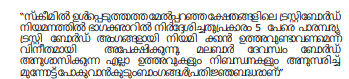
The appointment of non-hereditary trustees must comply with statutory provisions requiring notice and enquiry regarding the management of the institution.

The appointment of non-hereditary trustees must comply with statutory requirements, including notice to hereditary trustees and documented reasons for disqualification.
Point of Law : Temple or its precincts cannot be made a place where political parties should look forward to give political asylum to their workers.

The court ruled that the Madras Hindu Religious and Charitable Endowments Act does not permit the formation of a committee to oversee the actions of a hereditary trustee.
Trustees of religious institutions must manage affairs in accordance with trust terms and statutory mandates, ensuring proper administration and facilities for worship.
The appointment of non-hereditary trustees is valid under the Hindu Religious and Charitable Endowments Act when there is evidence of mismanagement by hereditary trustees, and full legal procedures a....
The appointment of non-hereditary trustees must adhere to established eligibility criteria, ensuring that active politicians are disqualified, and the process must be fair and transparent.
The court emphasized that active politicians are disqualified from being appointed as non-hereditary trustees, mandating adherence to established eligibility criteria and transparent selection proces....
Active politicians and office bearers are disqualified from being appointed as non-hereditary trustees under the relevant statutes.



An indispensable Tool for Legal Professionals, Endorsed by Various High Court and Judicial Officers
Please visit our Training & Support
Center or Contact Us for assistance

Scan Me!
India’s Legal research and Law Firm App, Download now!


For Daily Legal Updates, Join us on :



 Back to top


