
 Back
Back





IN THE HIGH COURT OF KERALA AT ERNAKULAM
P.B.SURESH KUMAR, JOBIN SEBASTIAN, JJ.
Naseema, W/o Shameer - Appellant
Versus
State Of Kerala - Respondent
WP(Crl.) No. 190 of 2025
Decided on : 26-05-2025
(A) Kerala Anti-Social Activities (Prevention) Act, 2007 - Section 3(1) - Detention order - The petitioner challenges the detention of her husband as a 'known rowdy' under KAA(P) Act, confirmed by the Government after Advisory Board's opinion - The detenu was in judicial custody for a recent offence, and the authority satisfied the triple test from Kamarunnissa v. Union of India for valid detention. (Paras 1, 5, 7, 8)
(B) Preventive Detention - Validity - An order of detention can be passed against a person in judicial custody if the authority is aware of the custody, believes in the possibility of bail, and that the detenu would indulge in prejudicial activities if released. (Paras 7, 8)
Facts of the case:
The petitioner is challenging the detention order against her husband, who was classified as a 'known rowdy' and detained for six months based on multiple criminal cases, including a recent one.
Findings of Court:
The court found that the jurisdictional authority complied with all procedural formalities and satisfied the triple test for detention.
Issues: Whether a detention order can be validly passed against a person in judicial custody for the last prejudicial activity.
Ratio Decidendi: The court ruled that a detention order can be validly passed against a person in judicial custody if the authority meets the triple test established in Kamarunnissa's case.
Result: Writ petition dismissed.
JUDGMENT :
Jobin Sebastian, J.
The petitioner herein is the wife of Shameer, S/o. Sulaiman ('detenu' for the sake of brevity) and her challenge in this Writ Petition is directed against Ext.P2 order of detention dated 26.11.2024 passed by the 2nd respondent under Section 3(1) of the Kerala Anti-Social Activities (Prevention) Act, 2007 (‘KAA(P) Act’ for brevity). The said order stands confirmed by the Government, vide order dated 31.01.2025, after obtaining the opinion of the Advisory Board, and the petitioner’s husband has been ordered to be detained for a period of six months with effect from the date of detention.
2. The records reveal that a proposal was submitted by the District Police Chief, Thrissur City, on 15.11.2024 seeking initiation of proceedings against the detenu under the KAA(P) Act before the jurisdictional authority, the 2nd respondent. For the purpose of initiation of the said proceedings, the detenu was classified as a 'known rowdy' as defined under Section 2(p)(iii) of the KAA(P) Act.
3. Altogether, 7 cases in which the detenu was involved have been considered by the jurisdictional authority for passing the order of detention. Out of the 7 cases considered, the case registered with respect to the last prejudicial activity is crime No.1298/2024 of Kunnamkulam Police Station, alleging the commission of offences punishable under Sections 115(2), 118(1), 110, 351(3) of Bharatiya Nyaya Sanhita (for short ‘BNS’) and Section 15(4) of KAA(P) Act.
4. We heard P.Mohamed Sabah, the learned counsel appearing for the petitioner and Sri. K.A. Anas, the learned Government Pleader.
5. The learned counsel for the petitioner would submit that Ext.P2 order is illegal, arbitrary, and was passed without proper application of mind. The main contention raised by the learned counsel for the petitioner is that as the detention order was passed while the detenu is in judicial custody in connection with the last prejudicial activity, the jurisdictional authority who passed the impugned order should have explained on the basis of what material it entered into a conclusion that there is possibility of the detenu being released on bail in connection with the last prejudicial activity. Relying on the decision in Kamarunnissa v. Union of India and another, [1991 (1) SCC 128] the learned counsel contended that an order of detention can be validly passed against a person who is already in judicial custody in connection with another case only on satisfaction of the triple test mentioned in Kamarunissa’s case (supra) by the Hon’ble Supreme Court.
6. In response, the learned Government Pleader submitted that Ext.P2 order of detention was passed by the jurisdictional authority after complying all the procedural formalities and after arriving on the requisite objective as well as subjective satisfaction. According to the Government Pleader, the impugned order of detention was passed by the jurisdictional authority after being satisfied that a detention order under Section 3(1) of KAA(P) Act is the only way out to deter the detenu from repeating criminal activities. It was further contended that the jurisdictional authority was fully aware of the fact that the detenu was in judicial custody in connection with the last prejudicial activity and it was on being satisfied that there is every chance that the detenu may approach higher courts for getting bail and if bail is granted, the detenu would in all probability indulge in prejudicial activities. According to the counsel, therefore, the order of detention will legally sustain irrespective of the fact that the detenu is under judicial custody in connection with the last prejudicial activity.
7. From the rival contentions raised, it is gatherable that the main question that revolves around this petition is whether an order of detention under Section 3(1) of KAA(P) Act can be validly passed against a person who is in judicial custody in connection with the last prejudicial activity. While answering the sai
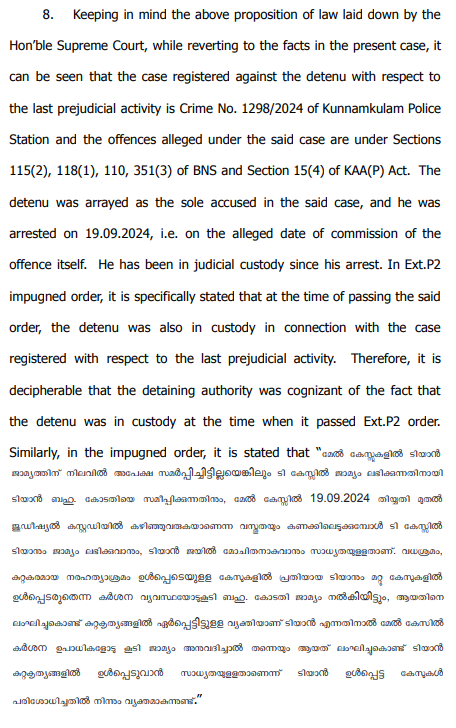
A detention order under the KAA(P) Act can be validly issued against a person in judicial custody if the authority satisfies the triple test regarding the possibility of bail and likelihood of engagi....
Detention orders under preventive laws require explicit justification of the possibility of bail and propensity for future offenses, especially when the individual is already under judicial custody.

Detention under preventive laws requires establishing conditions even if the detenu is in judicial custody.
Detention orders under the KAA(P) Act must satisfy the triple test established in Kamarunnissa v. Union of India, particularly regarding the possibility of release on bail while in judicial custody.

A detention order under the KAA(P) Act can be valid despite an individual being in judicial custody if specific satisfaction criteria are met regarding potential future criminal behavior.
Detention orders under preventive laws require evidence of imminent release and likelihood of further criminal activity for individuals in custody.
Detention orders can be validly issued under preventive laws even if the detenu is in judicial custody, provided specific criteria are met.
Detention under preventive laws can validly occur even if the detenu is in judicial custody, subject to specific conditions being satisfied.
A detention order under preventive detention laws is valid even if the individual is in custody, provided certain conditions are met.
Detention order valid if authority satisfies triple test: aware of custody, real bail possibility, likely prejudicial activity on release.



An indispensable Tool for Legal Professionals, Endorsed by Various High Court and Judicial Officers
Please visit our Training & Support
Center or Contact Us for assistance

Scan Me!
India’s Legal research and Law Firm App, Download now!


For Daily Legal Updates, Join us on :



 Back to top


