Back
Back





2025 Supreme(Ker) 2671
IN THE HIGH COURT OF KERALA AT ERNAKULAM
SATHISH NINAN, P. KRISHNA KUMAR, JJ.
Kizhakkayi Dasan, S/o.Late Krishnan - Appellant
Versus
Kuniyil Cheerootty, D/o.Korumban – Respondent
Mat.Appeal No.630 OF 2018 & R.P.(FC)No.126 OF 2020
Decided on : 29-09-2025
For the Appellant : SHRI.K.P.HAREENDRAN, SRI.PRAJIT RATNAKARAN
A customary divorce must be proven with strong evidence of antiquity, continuity, and certainty to be legally recognized, especially under the Hindu Marriage Act.
Headnote:(A) Hindu Marriage Act - Sections 4 and 29(2) - Customary divorce - Appellant’s marriage to the first respondent declared invalid as the respondents failed to prove the customary divorce within their community - Customary practices must meet the criteria of antiquity, continuity, and certainty to be recognized legally. (Paras 8, 9, 11, 20, 25, 30)
(B) Maintenance under Section 125 of the Code of Criminal Procedure - A woman who contracts marriage during subsistence of prior marriage is not entitled to maintenance - The finding of void marriage affects the maintenance order. (Paras 28, 30)
Facts of the case:
The wife and daughter sought to declare the appellant as their legally wedded husband and father after previously being driven out by him. The court initially upheld their claims, which were later reversed, leading to further evidence gathering.
Findings of Court:
The court concluded that evidence on customary divorce from the respondents was insufficient, thus invalidating the appellant's marriage to the first respondent, while addressing possible future alimony claims.
Issues: The court grappled with the validity of the customary divorce and the implications of void marriage on maintenance.
Ratio Decidendi: The court reaffirmed that customary divorce requires substantial evidence to be legally recognized and relevant statutory provisions clarify the status of the child from such a union.
Result: Appeal allowed in part; marriage declared void, maintenance order set aside.
| Table of Content |
|---|
| 1. challenge to decree of relationship. (Para 1 , 2) |
| 2. marriage and divorce claims asserted. (Para 3 , 4) |
| 3. court proceedings and remand explained. (Para 6 , 7) |
| 4. customary divorce and relevant statutory provisions. (Para 8 , 9) |
| 5. evidence requirements for establishing customs. (Para 10 , 11 , 12 , 13 , 14 , 15) |
| 6. requirement of specific details in custom claims. (Para 18 , 19 , 20) |
| 7. evidence presented regarding customary divorce. (Para 21 , 22 , 23) |
| 8. insufficient evidence to prove custom. (Para 24 , 25) |
| 9. effect of void marriage on legitimacy and maintenance. (Para 26 , 27 , 28) |
| 10. court's final orders on appeal and maintenance. (Para 30 , 31) |
JUDGMENT :
P.Krishna Kumar, J.
The decree declaring the respondents herein as the wife and daughter of the appellant, is under challenge in this appeal.
2. The respondents filed a suit against the appellant seeking a declaration that they are his wife and daughter. The suit was initially decreed in favour of the respondents, but was reversed in appeal. When the matter was taken up in second appeal, this Court set aside the judgments and, after framing additional issues, remanded the case for disposal based on findings on those additional issues. The parties were also permitted to amend their pleadings and adduce further evidence. Meanwhile, with the establishment of the Family Court, Thalassery, the case was transferred to that court. By the judgment now under challenge, the Family Court allowed the claim of the respondents.
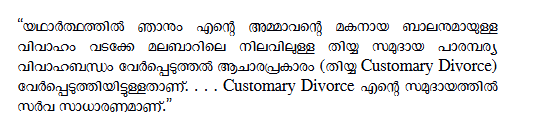
3. The brief facts necessary for the disposal of this case are as follows: The parties belong to the Hindu Thiyya community. The respondents contended that the first among them, Cheerootty, married the appellant, Dasan, on 23.10.1988, in accordance with the religious customs prevailing in their community, and that the second respondent was born in the wedlock on 30.11.1989. They alleged that Cheerootty and her daughter were later driven out of the matrimonial home by the appellant and his family members, and that he failed to maintain them. It was further stated that Cheerootty was married to one Balan when she was about 12 years old, and that the marriage was dissolved about six months later by a customary divorce, on observing the then prevalent formalities and rituals. A declaration was sought that the first respondent is the legally wedded wife of Dasan and that the second respondent is their daughter.
4. The appellant denied the above averments in his pleadings. He contended that there was no marriage between him and Cheerootty, that they had never lived together, and that the second respondent was not his child. He further argued that, since the marriage between Cheerootty and Balan was not dissolved in accordance with law, she could not claim to be his legally wedded wife. It was also pleaded that no such customary dissolution of marriage, as pleaded, existed in their community.
5. The evidence in this case consists of the oral testimony of PW1 to PW9, DW1 to DW6, RW7 and RW8, and Exts. A1 to A6, B1 to B18, and X1 and X2 series. After the remand, apart from recalling PW1, PW9 was examined. Ext.X6 was marked in evidence on the side of the first respondent. On the side of the appellant, RW7 and RW8, who are his present wife and child, were examined.
6. We have heard the learned counsel for the appellant. In spite of service of notice on the respondents, they remained absent.
7. In the earlier round of litigation, the trial court’s finding that the first respondent had married the appellant in accordance with their custom was upheld by the first appellate court. So also, it was held that the second respondent was born to the appellant in the first respondent. This court in the second appeal, while setting aside the judgment, did not interfere with the said findings, but remanded the case for adjudication on certain limited issues. The issues which were directed to be tried are:
(i) Whether a customary divorce as alleged was prevalent in the community to