
 Back
Back





IN THE HIGH COURT OF KERALA AT ERNAKULAM
SUSHRUT ARVIND DHARMADHIKARI, SYAM KUMAR V.M., JJ.
Guruvayur Devaswom Employees Union Congress, Guruvayur – Appellant
Versus
State of Kerala – Respondent
W.A. No. 1447 of 2025
Decided On : 09-01-2026
| Table of Content |
|---|
| 1. imposition of regulatory framework on religious institutions (Para 2 , 3) |
| 2. violation of article 26 through legislative measures (Para 5 , 6 , 7 , 8) |
| 3. justification of kdrb act's role and purpose (Para 9 , 10 , 11 , 12) |
| 4. special law prevails over general law; the act of 1978 governs appointments (Para 22 , 23 , 24 , 25) |
JUDGMENT :
SUSHRUT ARVIND DHARMADHIKARI, J.
1. The present intra-Court Appeal under Section 5 of the Kerala High Court Act 1958 arises out of the judgment dated 30.05.2025 passed in W.P.(C) No.20053/2025, whereby the writ petition filed by the appellants has been dismissed at the admission stage itself.
Brief Facts
2. The appellants herein are the petitioners in W.P.(C) No.20053/2025. The writ petition was filed seeking a declaration that Section 9 (1) of the Kerala Devaswom Recruitment Board Act 2015 (for short, ‘KDRB Act’) empowering the Kerala Devaswom Recruitment Board/ the second respondent to prepare select lists for the appointment of candidates to various posts in the Guruvayoor Devaswom and posts in aided educational institutions under the Guruvayoor Devaswom, governed by the conditions of service prescribed in the Guruvayoor Devaswom Employees Regulation, 1983, is illegal, unconstitutional, and therefore inoperative, along with incidental and consequential reliefs.
2.1 With a view to making the provision for the proper management and administration of the temple, the State Legislature enacted the Guruvayoor Devaswom Act , 1971 (for short, ‘Act of 1971’). The Full Bench of this Court, in Krishnan v. Guruvayoor Devaswom Managing Committee, 1979 KLT 350, held the operative provisions of the Act of 1971 to be unconstitutional and void, and consequently struck down the entire Act.
2.2 The learned Single Judge dismissed the writ petition at the threshold, relying on the judgment of this Court in Administrator, Guruvayoor Devaswom Managing Committee v. Mayadevi, 2022 KHC 500 and the validity of Section 9 of the KDRB Act was left open.
3. Originally, Section 20 of the Act of 1971 provided for the appointment of officers and other employees. According to this provision, appointments of all officers and employees of the temple were to be made by the Board, which consisted of:
(a) the Commissioner, who shall be the Chairman;
(b) the Administrator;
(c) an officer professing the Hindu religion, authorized by the District Collector, Thrissur, in that behalf; and
(d) two persons selected by the Committee from among its members.
Thus, the composition of the Committee was such that there was an overwhelming predominance of Government nominees.
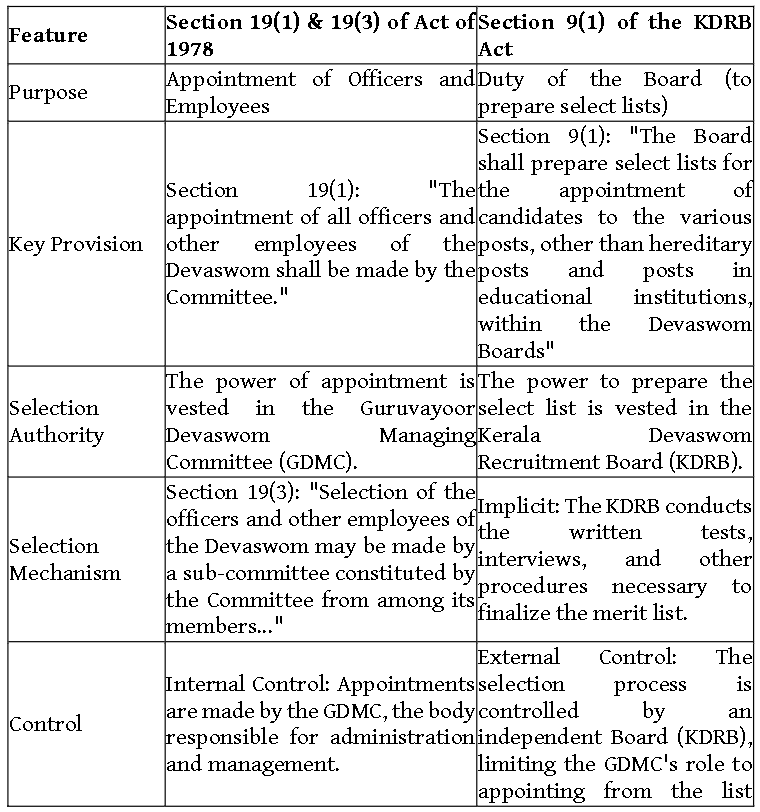
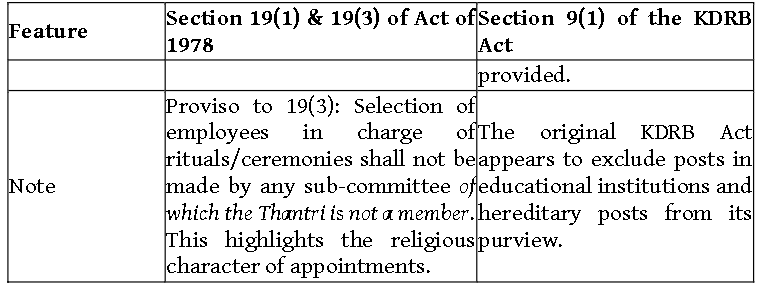
3.1 In Krishnan (supra), the Full Bench of this Court held that insofar as Section 20 of the Act of 1971 confers the power of appointment of officers and employees of the temple not on the Managing Committee but on a separate and independent body, namely the Board, it is violative of Articles 26(a), (b), and (d) of the Constitution of India. The KDRB Act was promulgated after a considerable lapse of time, with the intention to address the infirmities and intricacies pointed out by this Court in Krishnan (supra) by establishing an autonomous Board for selecting candidates to be appointed to various posts in the Devaswom Boards of the State of Kerala. However, the KDRB Act was enacted in contravention of the directions issued by this Court in Krishnan (supra). The learned Single Judge ought to have decided the case on its merits. Section 20 of the Act of 1971 provides for the appointment of the Officers and employees.
4. The validity of Section 20 was considered and decided in Krishnan (supra). Paragraph 54 of the judgment reads as under:
“54. Very strong objection was taken by the petitioner to the provisions of S.20 which deal with subject of appointment of officers and employees of the Temple. Sub-section (1) of the Section lays down that appointments of all officers and employees of the Temple are to be made by a Board consisting of (a) the Commissioner, Hindu Religious
The Kerala Devaswom Recruitment Board Act's provisions undermining the authority of the Guruvayoor Devaswom Managing Committee for appointments were declared unconstitutional, preserving the fundamen....
Recruitment to temple posts must follow statutory regulations, overriding customary claims by Thantris, in alignment with the KDRB Act.

The court established that disputes regarding hereditary claims and functions related to temple duties should be resolved in civil court rather than through writ jurisdiction, emphasizing the secular....
The appointment of the Devaswom Commissioner must comply with statutory provisions, including eligibility and probation requirements; failure to do so renders the appointment invalid.

The Sikh Gurdawaras and Religious Endowment Act, 1973 does not violate constitutional rights as the legislature possesses the authority to regulate religious property management.

The Travancore Devaswom Board must verify credentials of officers before postings to ensure integrity and proper management of religious institutions.
As per Rule 6, Committee shall not alter or cause to alter performance of customary rites and ceremonies in temple.
Administrative Tribunals are competent to adjudicate upon the constitutional validity of statutory rules and regulations, excluding their own parent statute. Consequently, such Tribunals must functio....



An indispensable Tool for Legal Professionals, Endorsed by Various High Court and Judicial Officers
Please visit our Training & Support
Center or Contact Us for assistance

Scan Me!
India’s Legal research and Law Firm App, Download now!


For Daily Legal Updates, Join us on :



 Back to top


