
 Back
Back





IN THE HIGH COURT OF KERALA AT ERNAKULAM
Mohammed Nias C.P., J.
Sajeesh Kumar – Petitioner
Versus
The Regional Transport Authority - Respondent
W.P(C) Nos. 36460, 20638, 21253, 24048, 24059, 33089, 35967, 35983, 36019, 36491, 37193, 39009, 39598, 43308, 43370, 43600, 44593, 44753, 45194, 45491, 45495, 46004, 46037, 46057, 48223 of 2025 and 298 of 2026
Decided On : 05-02-2026
Certainly. Based on the provided legal document, the following key points are evident:
The primary issue concerns whether Regional Transport Authorities (RTAs) are legally competent to impose conditions requiring compliance with AIS-052 bus body standards and BS-VI emission norms at the stage of granting stage carriage permits. The court clarified that these conditions are not indirect age restrictions but are necessary for public safety and environmental protection (!) (!) .
The standards prescribed under AIS-052 and BS-VI norms are statutory requirements that relate to the construction, safety, and emission standards of vehicles. These standards are linked to the intended use of the vehicle and are incorporated into the statutory framework through specific rules, such as Rule 125-C of the Central Motor Vehicles Rules (!) (!) .
The authority of RTAs to impose such conditions is supported by their statutory powers under Section 72(2) of the Motor Vehicles Act, which allows for conditions related to the description, safety, and standards of vehicles used under permits. The phrase "specified description" is broad and encompasses compliance with these standards (!) (!) (!) (!) (!) .
The standards and norms are not merely procedural but serve the broader legislative objectives of ensuring safety, environmental sustainability, and higher technological adoption in road transport. The standards are aligned with the legislative intent to promote public safety and environmental health (!) (!) (!) .
The contention that imposing these standards effectively functions as an indirect age restriction is rejected. The standards do not fix vehicle age but ensure vehicles meet current safety and environmental criteria. Compliance with these standards can incidentally exclude older vehicles that do not meet the prescribed norms (!) (!) (!) .
The court emphasized that a valid fitness certificate does not grant an indefeasible right to a permit. The RTA retains the authority to assess whether a vehicle is suitable for the specific service under the permit, including compliance with current statutory standards (!) (!) .
The hierarchical powers of the STA and RTAs are recognized as independent within their respective spheres, with RTAs having the authority to impose conditions related to vehicle standards, separate from the policy directions of the STA (!) (!) .
The court upheld the validity of the conditions mandating compliance with AIS-052 and BS-VI norms, stating they are within the legal powers conferred by the relevant statutes and rules, and are aimed at safeguarding passenger safety and environmental interests (!) (!) .
An interim order clarified that permits granted before a certain date would not be subject to these new standards, and the orders impugned in the case were quashed insofar as they mandated compliance with AIS-052 and BS-VI norms for permits granted prior to that date. The court directed the authorities to ensure uniform standards across RTAs (!) (!) .
The court also directed the State Transport Authority to issue uniform instructions to all RTAs to maintain consistency in applying these standards and to reconsider applications that were rejected solely on the basis of non-compliance with these norms, in accordance with the existing legal framework (!) (!) .
Overall, the decision reinforces that the imposition of safety and environmental standards at the permit stage is within the statutory powers of transport authorities and aligns with the legislative objectives of improving road safety and reducing pollution, and not as an indirect age restriction.
| Table of Content |
|---|
| 1. overview of writ petitions (Para 1 , 3) |
| 2. conditions imposed by rtas. (Para 2) |
| 3. responses and justification by the state transport authority. (Para 4 , 5) |
| 4. rta's powers and regulatory framework. (Para 6) |
| 5. assessment of rtas' authority to set conditions. (Para 7 , 8 , 9 , 10 , 11) |
| 6. legal position on compliance and fitness requirements. (Para 12 , 13 , 14 , 15 , 16) |
| 7. public interest and regulatory compliance. (Para 17 , 18 , 19 , 20 , 21) |
| 8. conditions upheld and jurisdiction confirmed. (Para 22) |
| 9. final judgment and directive. (Para 23) |
JUDGMENT :
Mohammed Nias C.P., J.
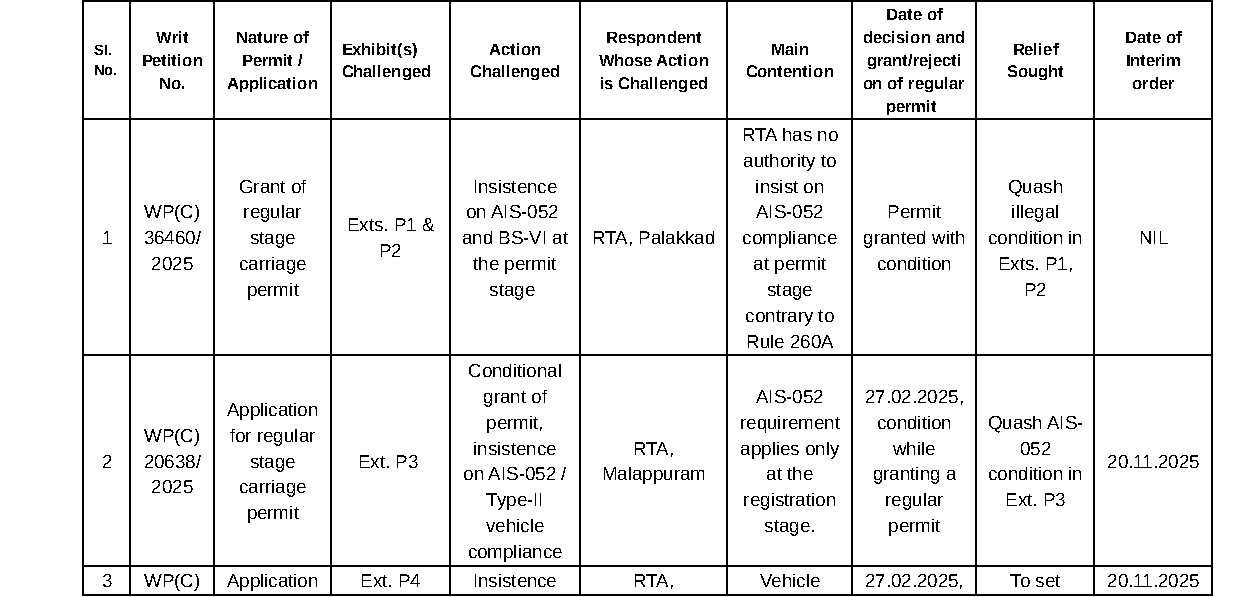
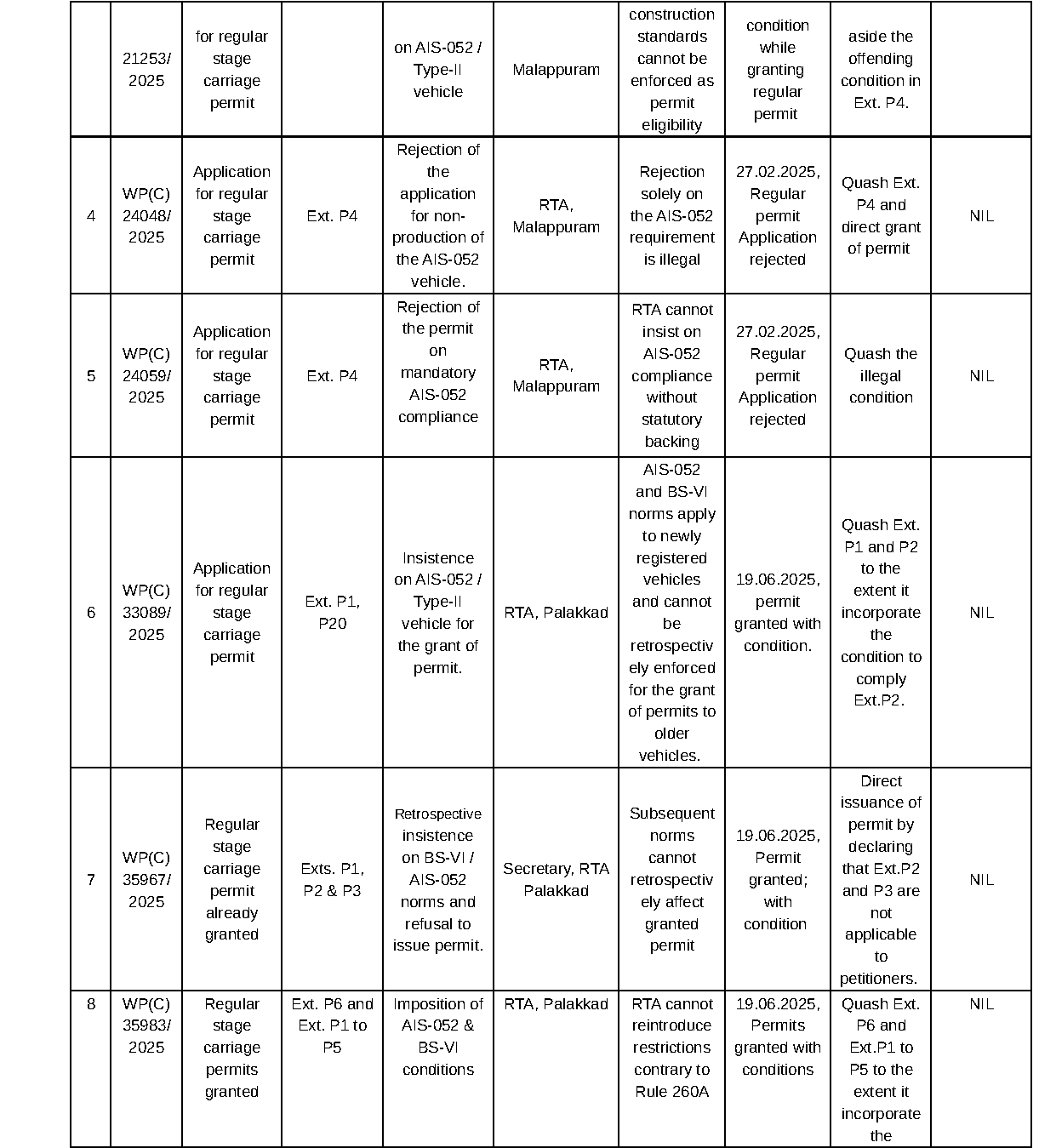
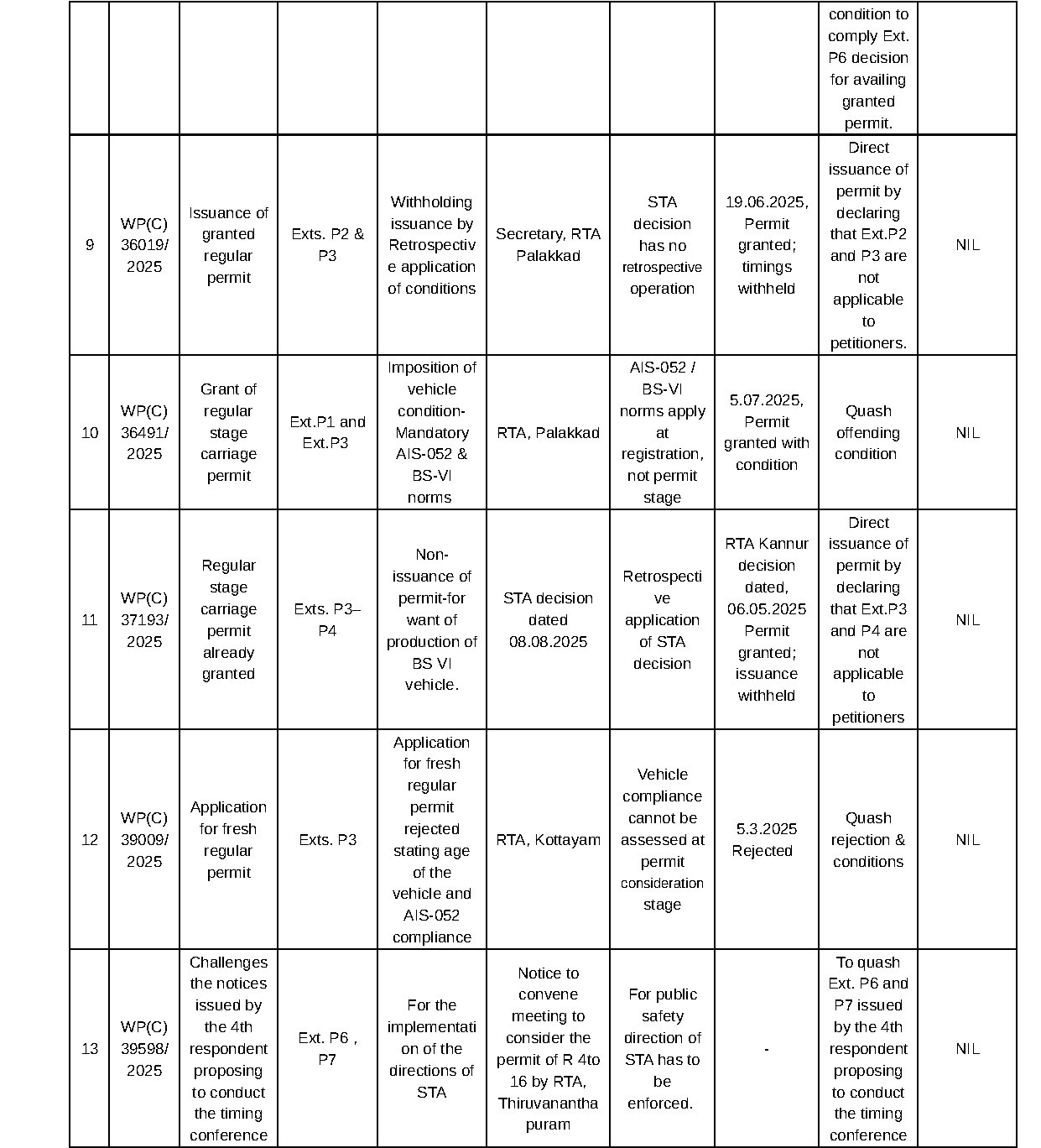
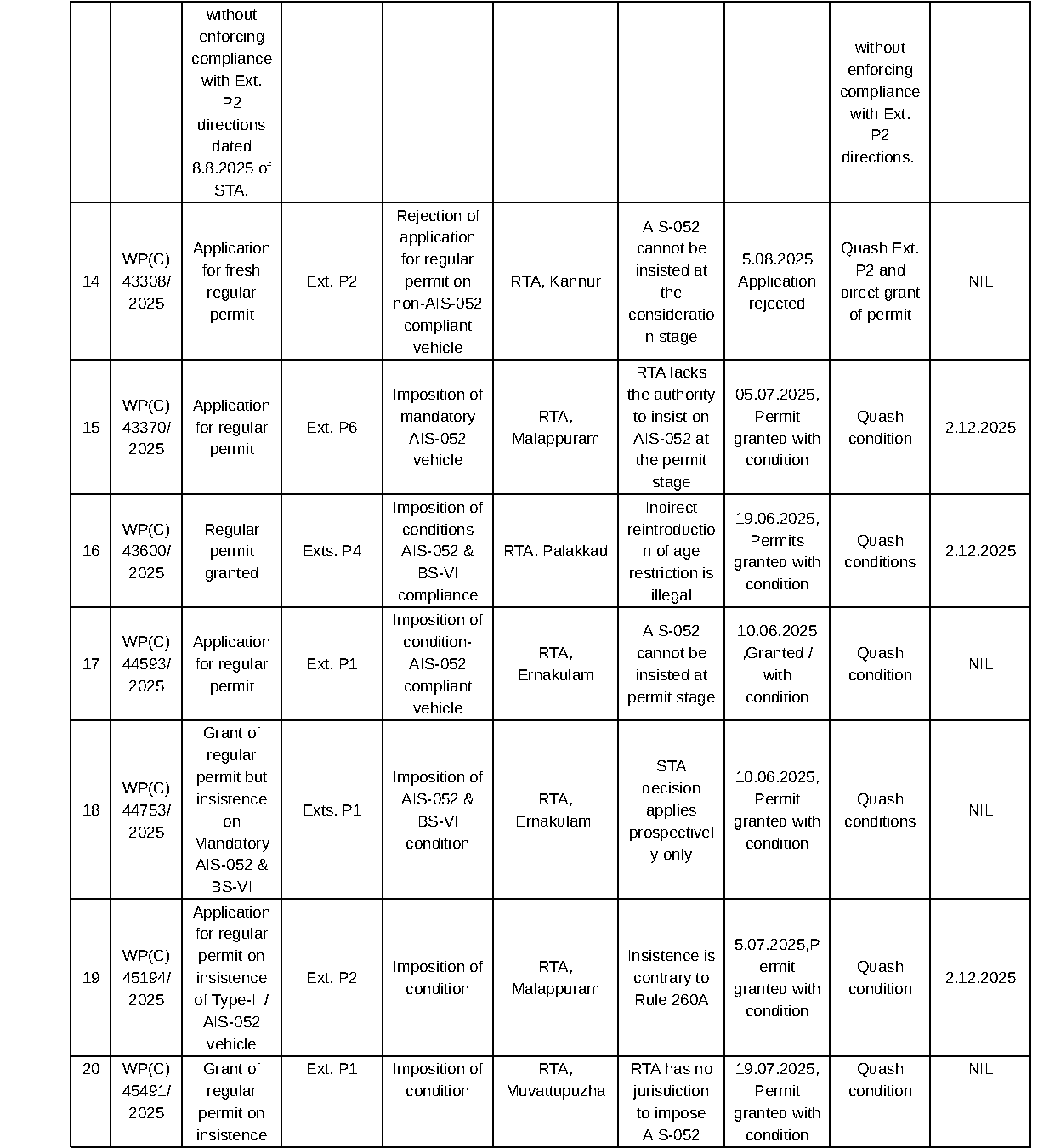
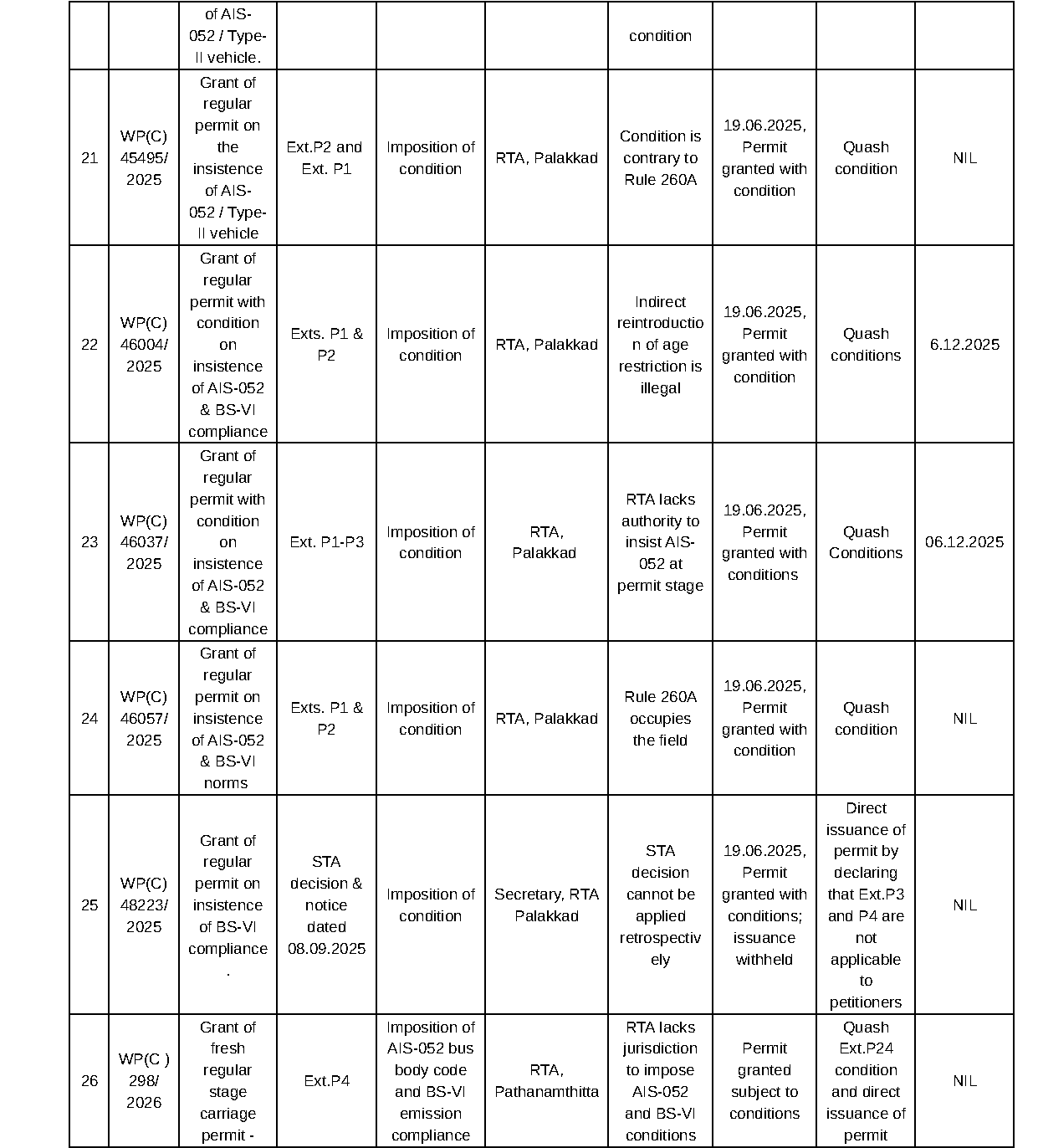
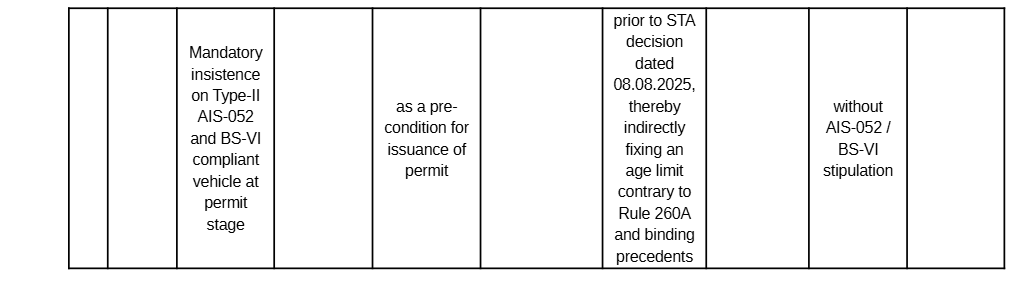
The petitioners in this batch of writ petitions challenges the decisions made by the State Transport Authority (henceforth referred to as "the STA") or the corresponding Regional Transport Authority (henceforth referred to as "the RTA") regarding the granting or rejection of regular stage carriage permits, subject to the requirement that the vehicle to be produced adhere to BS-VI emission norms under Rule 115 and AIS-052 bus body design standards under Rule 125-C of the Central Motor Vehicles Rules, 1989 (hereinafter "the CMV Rules").
2. The common issue arising for consideration in these writ petitions are whether the RTAs are legally competent to impose, at the stage of grant of a regular stage carriage permit, conditions mandating compliance with AIS-052 specifications and BS-VI emission norms, when such conditions virtually operate as an indirect fixation of the age of the vehicle, contrary to the statutory scheme under the Motor Vehicles Act, 1988 (hereinafter ‘the MV Act’) and the Kerala Motor Vehicles Rules (hereinafter ‘the KMV Rules’).
2.1. The petitioners submit that in all these cases, applications for regular stage carriage permits were considered and permits were granted subject to the condition that the suitable vehicle offered shall be a Type-II category bus registered for inter-urban/inter-city transport, complying with AIS-052 standards in terms of Rule 125-C of the CMV Rules and also satisfying BS-VI emission norms under Rule 115. According to the petitioners, the imposition of such a condition is wholly illegal and unsustainable, as it runs directly contrary to the law laid down by this Court in Shahabudheen and Others v. State Transport Authority and Others [ 2020 (2) KLT 211 ], which held that once the field relating to the maximum permissible age of stage carriages is occupied by Rule 260A of the Kerala Motor Vehicles Rules, the transport authorities have no jurisdiction to impose additional or indirect conditions at the permit stage which, in effect, fix the age of the vehicle or restrict the choice of an otherwise eligible vehicle beyond the statutory prescription.
2.2. It is contended that Rule 125-C and the AIS-052 specifications merely prescribe standards relating to bus body design and approval, and the phased implementation of AIS-052 commenced from 01.10.2014, with different parameters becoming applicable from 01.01.2017 and 01.01.2018. In Kerala, the body code came into effect only from 01.10.2017, from which date registration of a new stage carriage became possible only on compliance with the body code. Consequent to the introduction of the body code, seating capacity norms were altered, and the taxation structure was modified by adopting floor area instead of seating capacity. Subsequently, bus bodies were classified as Type-I for city services and Type-II for mofussil services. The registering authorities are presently registering new vehicles in accordance with these specifications.
2.3. With regard to BS-VI emission norms, it is pointed out that Rule 115 of the CMV Rules governs emission standards, and BS-VI norms became applicable only from 16.09.2016. Prior to that, vehicles complying with earlier emission standards were statutorily permitted to operate. The petitioners contend that by insisting upon AIS-052 and BS-VI compliance as a condition for the grant of a fresh permit, the RTAs have effectively introd
The court affirmed that Regional Transport Authorities can mandate compliance with emission and design standards for stage carriage permits, such conditions are not indirect age restrictions but nece....

State Government lacks authority to impose vehicle age limit for permit issuance under the Motor Vehicles Act, 1988; such power is vested solely with the Central Government.

The State Government lacks authority to issue circulars imposing vehicle age limits for permit renewals, a power reserved for the Central Government under the Motor Vehicles Act, 1988.
![Kerala Taxi Drivers Organization [KTDO], Represented By Its Secretary, Bahulayan A.P, S/o. Parameswaran vs State Of Kerala, Represented By Chief Secretary, Government Secretariat, Thiruvananthapuram - 2025 Supreme(Ker) 2602](https://supremetoday-s3.b-cdn.net/Kerala_3.png)
The State Transport Authority possesses statutory authority to impose safety regulations on transport vehicles, prioritizing public safety over procedural rights of individual permit holders.


(1) Replacement of vehicle covered under transport permit – Right to replace vehicle under a permit is subject to permission of Authority – Right, as well as power to grant permission, are subject to....
Court directions for timely permit consideration bind authority to pre-existing law despite later standards.

Point of law: prescription of standards relating to testing and approval for body building of buses/sleeper coaches, as provided under Rule 125C of the Rules, 1989 are applicable to all buses/sleeper....


Suo motu applications for stage carriage route permits impermissible without prior route notification and publication; authorities must strictly adhere to procedural rules and binding precedents to p....



An indispensable Tool for Legal Professionals, Endorsed by Various High Court and Judicial Officers
Please visit our Training & Support
Center or Contact Us for assistance

Scan Me!
India’s Legal research and Law Firm App, Download now!


For Daily Legal Updates, Join us on :



 Back to top


