
 Back
Back





IN THE HIGH COURT OF KERALA AT ERNAKULAM
Easwaran S., J.
Kuttikrishnan – Petitioner
Versus
Suchetha, D/O. Prabhakaran – Respondent
RSA NO. 979 OF 2015
Decided On : 06-02-2026
| Table of Content |
|---|
| 1. factual basis for the appeal and history of possession. (Para 1 , 2) |
| 2. arguments regarding adverse possession and evidence. (Para 3 , 4 , 5 , 6) |
| 3. court's observations on legal principles of adverse possession and interpretation of ext.b1. (Para 7 , 8 , 9 , 10 , 11 , 12 , 13 , 14 , 15 , 16 , 17 , 18 , 19 , 20 , 21 , 22 , 23 , 24 , 25 , 26 , 27) |
| 4. conclusion declaring the defendant's possession as permissive. (Para 28) |
JUDGMENT :
Easwaran S., J.
The plaintiff in OS No.27/2010 on the files of the Munsiff's Court, Alathur, a suit for recovery of possession, has come up in the present second appeal challenging the concurrent findings rendered against him.
2. The brief facts necessary for the disposal of the appeal are as follows:
The plaint schedule property was allotted to the share of the plaintiff as item No.1 of D schedule to the partition deed No.754/1968 of SRO, Nenmara. Since one of the sharers had not signed the document, yet another document was executed in the year 1970 with the same stipulation. Thereafter, the plaintiff was in exclusive possession and enjoyment of the plaint schedule property. In the meanwhile, the defendant preferred OS No.90/2009 before the Munsiff’s Court, Alathur and obtained a decree restraining the plaintiff from entering into the plaint schedule property. Since the suit was decreed, the plaintiff was deprived of enjoying the property, and hence, the suit was filed for recovery of possession of the plaint schedule property from the defendant on the strength of title. The defendant entered appearance and resisted the suit contending that the property was not allotted to the sharers as per the partition deed and that there was an agreement to execute an actual partition deed within 30th Makaram 1158 and that the properties were not in possession of the sharers in accordance with the partition effected in the year 1968, but on the basis of their prior possession of the properties. The plaint schedule property was handed over to the defendant by the plaintiff and his three brothers by executing an assignment deed on 24.5.1982 and thereafter, the property is in her exclusive hands. Since the plaintiff was divested of the possession of the property from 1982 onwards, the claim of the plaintiff is lost by adverse possession. On behalf of the plaintiff, Ext.A1 was marked and PW1 was examined. On behalf of the defendant, Exts.B1 to B4 were marked and DW1 and DW2 were examined. The trial court, on appreciation of oral and documentary evidence, came to the conclusion that though the plaintiff has title over the property, the same was divested by adverse possession, because the defendant was holding the property from 1982 onwards, and, accordingly, dismissed the suit. Aggrieved, the plaintiff preferred AS No.139/2011 before the Additional District Court-III, Palakkad. The first appellate court, on re-appreciation of evidence, came to the conclusion that the findings of the trial court do not require interference and accordingly, dismissed the appeal and hence, the present second appeal.
3. On 4.9.2015, this Court admitted the appeal and issued notice on the following substantial questions of law :
(A) Has not the lower appellate court failed to see that, as the Defendant’s case that her possession originated through permission and based on Ext.B1 unregistered partition deed, can never be adverse possession?
(B) If possession is found to be permissive at the inception, can the possessor prescribe or sustain title by adverse possession without specifying the date on which such permissive possession became adverse?”
4. Heard Sri.S.V.Balakrishna Iyer, the learned Senior Counsel assisted by Sri.P.B.Subramanyan, appearing for the appellant/plaintiff and Sri.K.S.Hariharaputhran, the learned counsel appearing for the respondent/defendant.
5. Sri.S.V.Balakrishna Iyer, the learned Senior Counsel appearing for the appellant/plaintiff, contended that the findings of the courts below are vitiated by perversity a
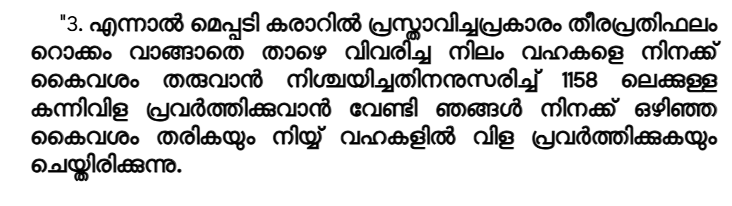
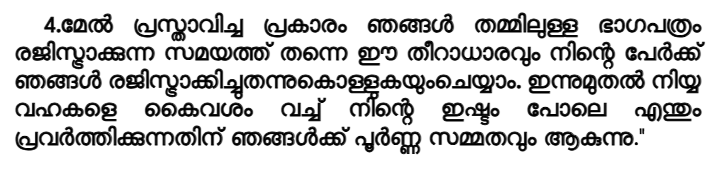
The court ruled that possession granted under a deed cannot constitute adverse possession as it lacks the requisite elements of hostility necessary to challenge the title of the original owner.

Mere possession for a long time does not convert permissive possession into adverse possession. The burden of proof rests on the party claiming adverse possession, and unregistered documents may not ....


to approach the Civil Court for adjudicating the title in issue and when the defendant's patta had been cancelled during 1995 merely on the production of certain electricity bills and house tax recei....

A fresh suit for recovery of possession based on title after a partition decree is barred by Section 47 CPC; delivery is part of execution; adverse possession cannot defeat a decree holder where co-o....


The claim of title and plea of adverse possession cannot coexist. An unregistered sale deed cannot be looked into for collateral purposes.
Ownership rights cannot exceed what is originally conveyed in property transactions, substantiating claims requires clear and convincing evidence.

Mere possession of land does not ripen into a possessory title. The possessor must have animus possidendi and hold the land adverse to the title of the true owner. The requirement to prove hostility ....



An indispensable Tool for Legal Professionals, Endorsed by Various High Court and Judicial Officers
Please visit our Training & Support
Center or Contact Us for assistance

Scan Me!
India’s Legal research and Law Firm App, Download now!


For Daily Legal Updates, Join us on :



 Back to top


