
 Back
Back





IN THE HIGH COURT OF KERALA AT ERNAKULAM
RAJA VIJAYARAGHAVAN V., K.V. JAYAKUMAR, JJ.
Edamana Vasudevan Namboothiri S/o E. Narayanan Namboothiri – Appellant
Versus
Malabar Devaswom Board Represented by its Secretary – Respondent
W.P. (C) No. 44515 of 2025
Decided On : 23-03-2026
| Table of Content |
|---|
| 1. overview of petitioner's role and temple administration (Para 1 , 2 , 3 , 4 , 5 , 6) |
| 2. counterarguments regarding petitioner's standing and authority (Para 10 , 11 , 12 , 13 , 14 , 15) |
| 3. discussion on the legality of ext.p6 and powers of board/commissioner (Para 26 , 27 , 29 , 30) |
| 4. interpretation of powers under hr & ce act regarding temple administration (Para 38 , 45 , 63 , 67) |
| 5. final judgment quashing described orders while emphasizing administration compliance (Para 70 , 71) |
JUDGMENT :
K.V. JAYAKUMAR, J.
1. This Writ Petition is filed under Article 226 of the Constitution of India.
2. The petitioner, Sri. Edamana Vasudevan Namboothiri is the Manager of Naduvilmadom group of temples, which consists of 18 temples spread over the Malabar area. Naduvilmadom is a mutt coming under the Madras Hindu Religious and Charitable Endowments Act (for the sake of brevity, ‘the HR & CE Act’).
3. Ext.P1 scheme was framed on 03.09.1936 for the administration of these 18 temples. The petitioner contends that, as per Clause (3) of the said Scheme, the Mooppil Swamiyar is the hereditary trustee and the Manager appointed by him is empowered to administer those temples. One of the temples out of the 18 temples is the Sree Annapoorneswari temple, Puthucode.
4. The petitioner herein is the Manager of the aforesaid temple appointed by the hereditary trustee pursuant to Ext.P1 scheme. The petitioner states that the 3rd respondent, Assistant Commissioner, Malabar Devaswom Board, has issued a notice dated 16.12.2021, pointing out that an inspection was conducted by the Divisional Inspector, Palakkad, on 17.11.2021 and noted certain defects in the administration of the Temple, and those defects are to be rectified. The petitioner contends that the inspection was conducted without any notice to the petitioner. Certain remedial measures were also suggested in the said notice, regarding the maintenance of accounts, counting of money etc. It is also suggested that committees for different purposes are to be formed with full participation of the devotees and the accounts have to be submitted for audit.
5. Thereafter, the Devaswom has filed a report stating that all the records and the registers are being kept intact, and it can be verified at any time. The delay for the conduct of the audit was also explained stating that, the entire files were kept in Thiruvalathur temple coming under the group, which was taken over by the Board. Moreover, the festival committee was constituted as permitted by the Board and the Kumbabhisheka committee was approved by the Assistant Commissioner on 11.10.2021.
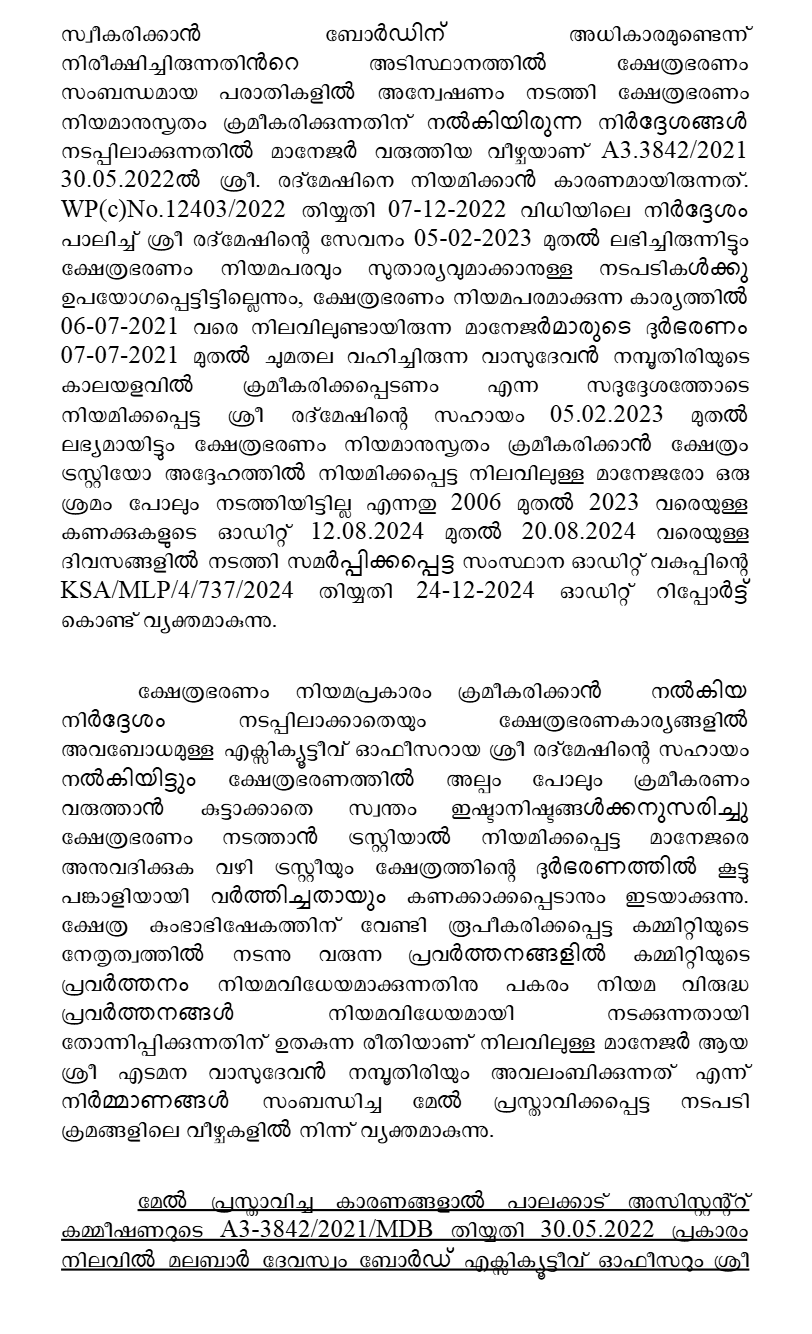
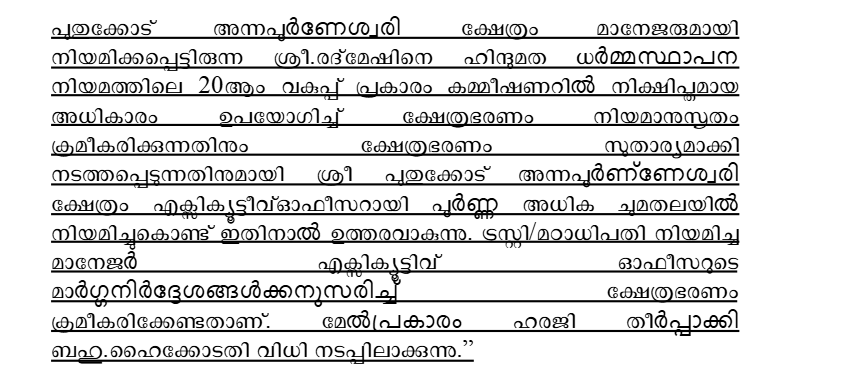
6. The petitioner further contends that the Assistant Commissioner has appointed the fourth respondent, Sri.R. Radmesh, as the Executive Officer without hearing the Hereditary Trustee and the petitioner. Ext.P2 is the copy of the said order dated 30.05.2022. The said appointment was subject to ratification by the Commissioner.
7. Thereafter, the petitioner received another communication, which was produced and marked as Ext.P3, issued by the Commissioner dated 13.06.2022, approving the appointment of Sri. Radmesh as the Executive Officer. In the meanwhile, the Hereditary Trustee (Mooppil Swamiyar) has challenged the correctness of Ext.P2 by filing Writ Petition (C) No. 19403 of 2022 before this Court. By Ext.P4 judgment rendered by this Court dated 07.12.2022, Exts. P2 and P3 Orders were upheld and this Court observed that the administration of Sree Annapoorneswari temple shall strictly be done in accordance with the scheme and the role of Manager appointed as per Ext.P4 (Ext.P2 in this petition) is only to assist the Manager of the temple appointed by the trustee and not to replace him.
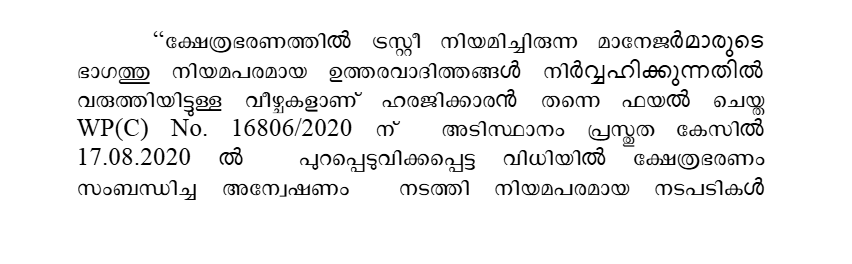
8. It is further contended that the 4th respondent, Sri. Radmesh continued as Manager appointed by the Malabar Devaswom Board, and he was co-operating with the administration by the petitioner. While so, the 5th respondent, Sri. Pramod moved another writ petition as WP(C) No
The Commissioner lacked authority to appoint an Executive Officer for temple administration, violating established law and trustee rights under the HR & CE Act.

The appointment of non-hereditary trustees is valid under the Hindu Religious and Charitable Endowments Act when there is evidence of mismanagement by hereditary trustees, and full legal procedures a....

The governing body's power to appoint an executive officer is limited to exceptional cases for a fixed duration. Hereditary trustees retain authority over internal administration, including staff app....
Point of Law : Temple or its precincts cannot be made a place where political parties should look forward to give political asylum to their workers.


The court established that the Commissioner of Endowments lacked jurisdiction to revoke exemptions and appoint trustees without following due process as mandated by the Endowments Act.
Point of Law : Exercise of jurisdiction under Article 226 of the Constitution of India is not barred merely because there is an alternative remedy of appeal.
The court ruled that the Madras Hindu Religious and Charitable Endowments Act does not permit the formation of a committee to oversee the actions of a hereditary trustee.
The central legal point established in the judgment is that the appointment of an Executive Officer to a religious institution must be supported by objective reasons and proper application of mind by....



An indispensable Tool for Legal Professionals, Endorsed by Various High Court and Judicial Officers
Please visit our Training & Support
Center or Contact Us for assistance

Scan Me!
India’s Legal research and Law Firm App, Download now!


For Daily Legal Updates, Join us on :



 Back to top


