Back
Back





2026 Supreme(Ker) 443
IN THE HIGH COURT OF KERALA AT ERNAKULAM
RAJA VIJAYARAGHAVAN V., K.V. JAYAKUMAR, JJ.
Vibin, S/o. Surya Narayanan – Petitioner
Versus
Malabar Devaswom Board, Represented By Secretary – Respondent
WP(C) No. 8867 of 2026
Decided On : 12-03-2026
For the Petitioner: Sri. K. Mohanakannan, Smt. Maya S. Kumar
For the Respondent: Smt. R. Ranjanie, SC, MDB
Active politicians and office bearers are disqualified from being appointed as non-hereditary trustees under the relevant statutes.
Headnote:This writ petition filed under Article 226 seeks directions not to appoint certain respondents as non-hereditary trustees of a temple, citing disqualifications under the Madras HR & CE Act. The court emphasized adherence to relevant statutory provisions, highlighting that active politicians and office bearers cannot be appointed. The petition was disposed of with directions to consider objections and ensure compliance with the law on appointments, including fair assessment and verification of qualifications.
| Table of Content |
|---|
| 1. relief sought in writ petition concerning temple trusteeship. (Para 2 , 3 , 4) |
| 2. arguments presented regarding legal compliance for appointments. (Para 5 , 6 , 7) |
| 3. applicable statutory disqualifications for non-hereditary trustees discussed. (Para 8 , 9 , 10 , 11) |
| 4. court directives for fair and statutory appointments outlined. (Para 12 , 13) |
JUDGMENT :
K.V. Jayakumar, J.
This Writ Petition is filed under Article 226 of the Constitution of India, claiming the following relief:
“1) To issue a writ of Mandamus or any other writ order or direction directing the Respondents 1 to 4 not to appoint Respondents 6 to 9 as Non Hereditary Trustees of Sree Pookkottukalikavu Bhagavathi Temple, in Ottappalam;
ii) To issue a writ of Mandamus or any other writ order or direction directing the Respondents 3 and 4 to finalise Exhibit P1 and P6 taking note of the objections in Exhibits P7 to P9 and to pass appropriate orders within a time frame to be fixed by this Hon'ble Court;
iii) To issue a writ of Mandamus or any other writ order or direction directing the Respondents 3 and 4 to appoint the Petitioners as Non Hereditary Trustees of the 5th Respondent temple (Sree Pookkottukalikavu Bhagavathi Temple).”
2. The petitioners are applicants for the position of non-hereditary trustees of Sree Pookkottukalikavu Bhagavathi Temple (for the sake of brevity, “the temple”) situated in Ottappalam Taluk, Palakkad District . It is an ancient temple. The aforesaid temple is under the supervisory jurisdiction of the Malabar Devaswom Board. The 3rd respondent, the Assistant Commissioner of the Malabar Devaswom Board, invited applications for the post of non-hereditary trustees to the temple. Altogether 12 applications were received and accordingly, the 3rd respondent, issued Ext. P1 public notice dated 18.10.2025, calling for objections with respect to the candidature of the applicants and to submit the same within the prescribed timeframe. As the petitioners are themselves applicants, they are precluded from filing objections in the manner directed. Notwithstanding the foregoing, the petitioners have raised objections to the candidature of respondents 6 to 9 by submitting Exts. P7 to P9 representations to the Inspector, Malabar Devaswom Board.
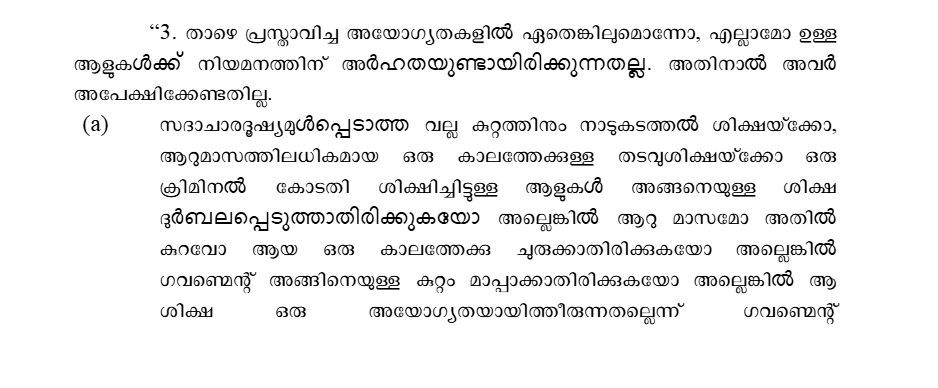
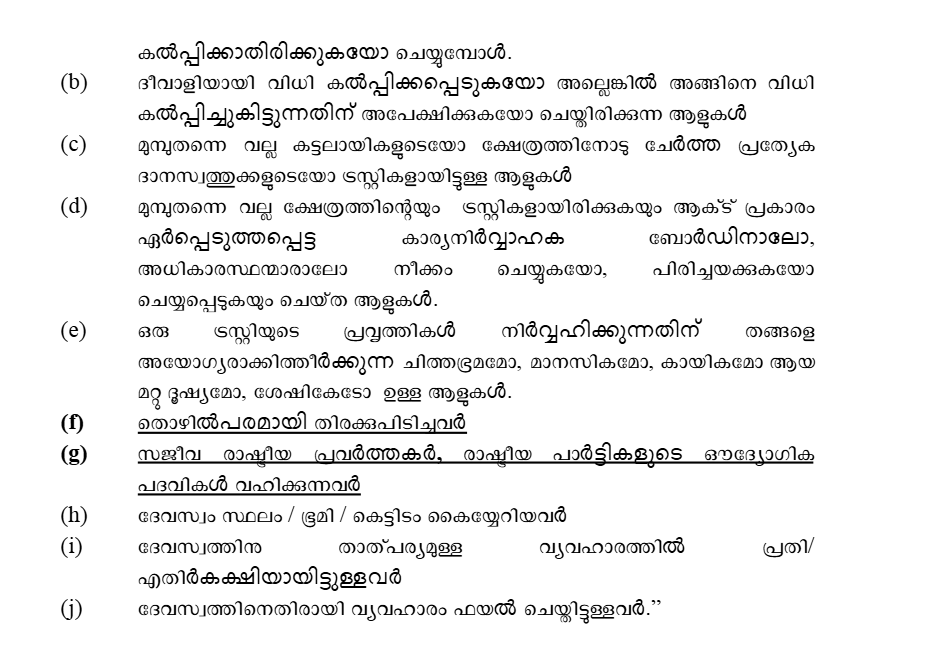
3. The learned counsel for the petitioners would submit that respondents 6 to 9 are disqualified as per Clause 3(f) and (g) of Ext.P1. Respondents 7 to 9 are active politicians and office bearers of the political party and the 6th respondent is a Government servant working as a Headmaster in VR UP School, Muthukurussi.
4. The learned counsel for the petitioners submits that the area committee of Malabar Devaswom Board has not considered the objections and the Board is going to appoint respondents 6 to 9 as non-hereditary trustees, violating the provisions of the Madras Hindu Religious and Charitable Endowments Act (for the sake of brevity, ‘the Madras HR & CE Act’) and the directives issued by this Court in Muraleedharan M. v. Malabar Devaswom Board, 2024 KHC 953.
5. In response, Smt. R. Ranjanie, learned Standing Counsel for the Malabar Devaswom Board, would submit that the appointment of the non-hereditary trustees in the temple would be conducted strictly in accordance with the Madras HR & CE Act, Ext.P1 notification and the directives issued by this Court from time to time.
6. We have heard the submissions of Sri. K. Mohanakannan, learned counsel for petitioners and Smt. R. Ranjanie, learned Standing Counsel for Malabar Devaswom Board and perused the records.
7. The principal grievance highlighted by the petitioners is that the respondent/Board is trying to appoint non-hereditary trustees, violating the relevant statutory provisions and disregarding directions issued by this Court. According to the petitioner, respondents 6 to 9 are disqualified for appointment under Clauses 3(f) and 3(g) of Ext.P1 notification.
8. Clause 3 of Ext.P1 notification clearly stipulates the disqualifications for the appointment a